Innisbrook Resort

Preferred Hotels Member
Innisbrook Resort in Palm Harbor occupies 900 acres of rolling terrain on Florida's Gulf Coast, hosting 280 rooms across a spread of low-rise lodges that reads more like a private residential enclave than a conventional resort. The property is best known as the long-standing home of the PGA Tour's Valspar Championship, placing it in a specific tier of golf resort that competes on course reputation as much as accommodation quality.

Pearl is the En Primeur Club membership app — saves, bookings, and concierge access live there. Same editors, same standards.
- Address
- 36750 US Highway 19 North, Palm Harbor, FL 34684
- Phone
- (727) 942-2000
- Website
- innisbrookgolfresort.com
- Directions
- Get directions
A Resort Built Around Landscape, Not Lobby
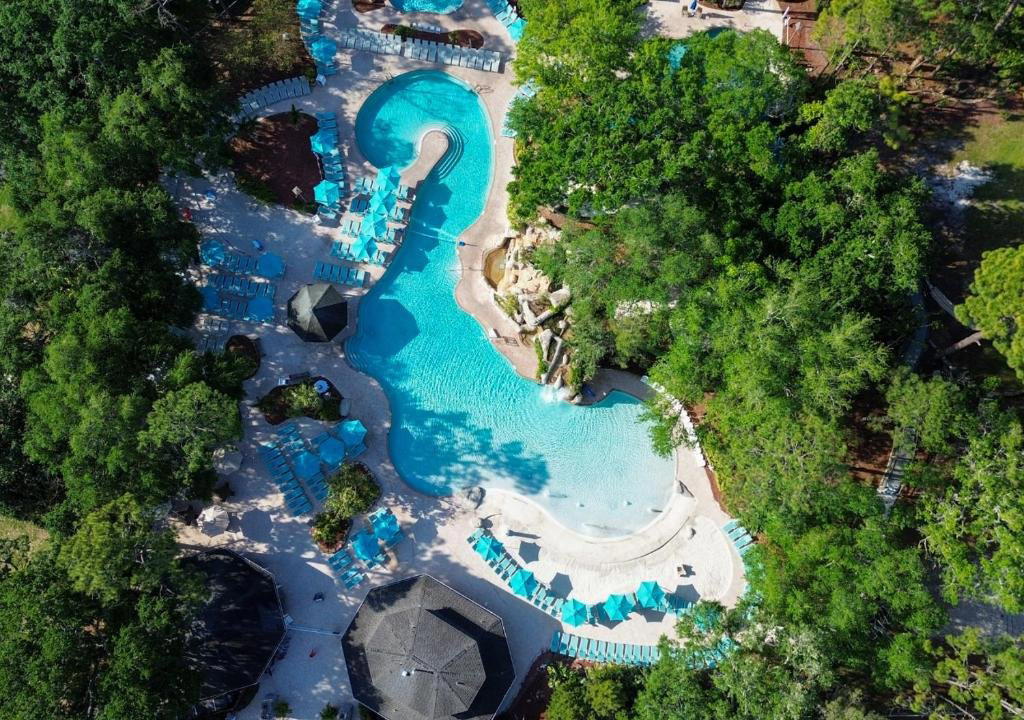
Florida's resort geography tends to sort itself into two camps: the high-rise beachfront towers that line the coasts, and the inland golf resorts that trade ocean views for acreage. Innisbrook Resort, at 36750 US Highway 19 North in Palm Harbor, belongs firmly to the second category. The property sits on approximately 900 acres of terrain unusually varied for the Tampa Bay region, with natural ravines, dense tree cover, and elevation changes that give the grounds a character closer to Carolina hill-country than Gulf Coast flatland. For a state not known for topographic drama, that physical texture matters enormously to how the place feels.
The arrival experience sets this up clearly. Rather than funneling guests through a grand porte-cochere into a single monumental lobby, the resort disperses its 280 rooms across a collection of low-rise lodge buildings arranged through the landscape. The architecture is deliberately understated, favoring integration with the wooded site over any single showpiece structure. That restraint is a design choice with real consequences: it means the resort reads as a private residential enclave rather than a convention-oriented destination, and it means the grounds themselves do the heavy lifting that a dramatic lobby would do elsewhere.
Among Florida's larger resort properties, this low-density, lodge-dispersal model is less common than the concentrated tower format. Properties like Amangiri in Canyon Point and Sage Lodge in Pray operate on similar logic in different geographies: the landscape is the primary architectural statement, and the buildings exist in deliberate deference to it.
Golf as Infrastructure
The four golf courses on the property are not amenities appended to a hotel. They are the structural reason Innisbrook exists in its current form, and they shape the spatial organization of the entire resort. The Copperhead Course, the longest-tenured PGA Tour venue on the property, has hosted the Valspar Championship for decades, giving Innisbrook a measurable credential that sits in a category most Florida resorts cannot claim. Tour-level hosting requires course conditioning standards, maintenance infrastructure, and spectator logistics that persist year-round, not just during tournament week.
That PGA Tour relationship puts the property in a specific comparative position. Golf resorts in the American Southeast compete along a spectrum from daily-fee resort operations to members-and-guests-only private clubs. Innisbrook operates closer to the resort-public end of that spectrum while maintaining Tour-caliber course standards, a combination that makes it more accessible than peer courses of equivalent competitive standing. For guests whose primary reason to travel is golf, that positioning is the key practical fact about the property.
The Valspar Championship itself, typically scheduled in March, represents the one period when the property operates at maximum visibility. Booking around that window requires early planning, and guests who prefer the grounds without the tournament footprint typically target the shoulder seasons of late autumn and early spring, when Tampa Bay's climate sits in its most favorable range.
The Lodge Architecture in Context
The decision to build at low density across a large site, rather than consolidating room count into a vertical tower, is an architectural philosophy with both aesthetic and operational implications. Low-rise lodge formats require more land, more infrastructure distributed across that land, and more investment in landscape maintenance to sustain the character the design depends on. They also impose a slower pace on the guest experience: getting from one part of the property to another takes longer, the grounds function as connective tissue between uses rather than as decoration around a central building.
This model has precedents in American resort design going back to mid-century planned resort communities, where the separation of accommodation from recreational facilities was a deliberate spatial strategy. At Innisbrook, the result is a property that rewards guests who engage with the full breadth of the site over multiple days rather than those looking for a concentrated, single-building experience. It is a different value proposition from, say, Four Seasons at The Surf Club in Surfside or Hotel Bel-Air in Los Angeles, both of which concentrate their identity in a more contained physical footprint.
Properties that use acreage as their primary offering tend to attract guests with longer average stays and a higher proportion of repeat visitors, because the grounds themselves have enough variation to sustain multiple days of discovery. That dynamic is visible across comparable American resort formats: Blackberry Farm in Walland and Canyon Ranch Tucson in Tucson both build their case on the depth of engagement available within the property boundary rather than on proximity to external attractions.
Palm Harbor and the Tampa Bay Context
Palm Harbor sits on the Pinellas Peninsula between Clearwater and Tarpon Springs, roughly 25 miles from Tampa International Airport and positioned between the Gulf beach communities to the west and the inland suburban sprawl of greater Tampa to the east. It is not a resort town in the way that areas like Naples or the Florida Keys have become destination zones in their own right. The surrounding area is predominantly residential and commercial, which means Innisbrook functions as a self-contained destination rather than a property embedded in a walkable hospitality district.
That insularity is by design for a golf resort of this type. The logic is that guests arrive for the courses, the pool facilities, and the on-property dining, and the surrounding area functions primarily as airport logistics. For guests who want to extend beyond the property, Tarpon Springs to the north offers a Greek-American community with a legitimate restaurant and cultural character distinct from generic Gulf Coast tourism. Our full Palm Harbor restaurants guide covers the broader dining options in the area for those looking to combine the resort with local exploration.
Planning a Stay
With 280 rooms distributed across the lodge buildings, Innisbrook operates at a scale that is large by boutique standards but modest relative to Florida's major convention resorts. That room count, spread across 900 acres, means the property rarely feels crowded in the way that high-density coastal resorts can during peak season. Tampa Bay's peak travel window runs from January through April, when snowbirds and spring-break travelers overlap. The Valspar Championship in March compresses availability and prices further during its specific week.
For travelers whose itinerary centers on golf rather than the specific tournament, the late-autumn months offer the most favorable combination of course conditions, climate, and availability. Florida's summer heat and humidity are significant factors at an outdoor-intensive property: afternoon rounds in July and August are a different experience from the same courses in November. Guests arriving by air should account for Tampa International Airport as the primary gateway, with ground transfers running approximately 30 to 40 minutes depending on traffic on US-19.
Travelers building broader Florida itineraries around Innisbrook might consider pairing the property with Gulf Coast stops further south. Little Palm Island Resort and Spa in Little Torch Key represents the opposite end of the Florida resort spectrum in both geography and format. For those extending to the Atlantic side, Four Seasons at The Surf Club in Surfside anchors the Miami luxury tier. And for guests drawn to the Innisbrook model of landscape-first resort design but seeking it in other American geographies, Bernardus Lodge and Spa in Carmel Valley, Amangani in Jackson Hole, and Post Ranch Inn in Big Sur each demonstrate how the site-integrated lodge format translates across different American landscapes.
Fast Comparison
Comparable venues nearby, for context on price, style, and recognition.
| Venue | Cuisine | Price | Awards | Notes |
|---|---|---|---|---|
| Innisbrook ResortThis venue — the venue you are viewing | Wooded golf resort with spacious accommodations and extensive recreational facilities. | Not listed | Preferred Hotels Member | Not listed |
| Southernmost Beach Resort & Guesthouses | Contemporary tropical resort blending historic charm with modern luxury, featuring restored 19th-century Victorian guesthouses alongside contemporary main buildings. | $500–750 | Michelin Selected | Old Town |
| Art Ovation Hotel, Autograph Collection | art-inspired boutique in cultural district | Not listed | Michelin Selected | Downtown Arts District |
| Walt Disney World Dolphin Resort | Postmodern entertainment architecture with bold geometric volumes and whimsical animal-shaped pediments designed by Michael Graves. | $300–500 | Not listed | Epcot Resort Area |
| The Goodtime Hotel | Art Deco urban oasis with stylish retro rooms and experience-driven spaces | Not listed | World Travel Awards | South Beach |
| The Vinoy Resort & Golf Club, Autograph Collection | Historic Mediterranean Revival resort blending old-Florida hospitality with modern sophistication. | $300–500 | Not listed | downtown St. Petersburg |
Recognition history
Dated appearances from independent guides and award organizations, with the underlying list record or original source where available.
Preferred Hotels Member
Preferred Hotels
Continue exploring
More in Palm Harbor
Hotels in Palm Harbor
Browse all →
Bars in Palm Harbor
Browse all →
Details
- Scenic
- Relaxed
- Family Vacation
- Group Retreat
- Weekend Escape
- Golf Course
- Infinity Pool
- Wi Fi
- Pool
- Spa
- Fitness Center
- Golf Course
- Tennis
- Restaurant
- Room Service
- Hot Tub
- Garden
Relaxed and scenic with rolling hills, peaceful lakes, and family-friendly pool areas featuring waterslides and natural surroundings.