

A 16th-century palazzo on Via dei Lamberti, Hotel Calimala occupies one of Florence's most central addresses with a design approach that layers art deco detailing and contemporary artwork across historic bones. Independent and Michelin Key-recognised since 2024, it holds a 4.9-star rating across more than 1,800 Google reviews, placing it in a tier defined by intimacy and architectural character rather than branded scale.
Staying Inside Florence's Historic Core
Florence's luxury hotel stock divides along a clear fault line: large international properties with branded wellness infrastructure on one side, and independent palazzo conversions on the other. Hotel Calimala sits firmly in the second category. The address, Via dei Lamberti 5, places guests within walking distance of the Uffizi, the Duomo, and the Mercato Nuovo, in a part of the city where the street grid has changed little since the Renaissance. That kind of positioning is not incidental. Staying inside the historic core rather than on the periphery changes the texture of a Florence visit entirely, particularly for guests whose days are built around walking between sites rather than arranging transfers.
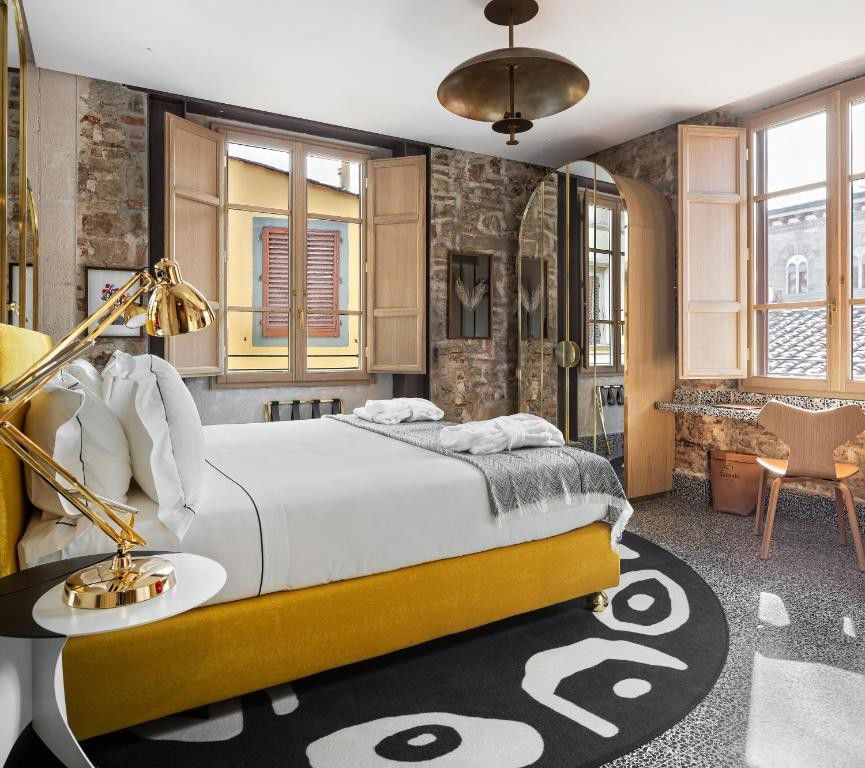
The building is a 16th-century palazzo, a structure type that defines much of Florence's higher-end accommodation. What distinguishes Hotel Calimala within that category is how it handles the interior. Rather than defaulting to a single period-restoration aesthetic, the property layers art deco elements alongside contemporary artwork, creating public spaces that read as assembled over time rather than designed in a single brief. One reader, quoted in the property's recognition as a newcomer to the Condé Nast Traveller reader-voted list, described it as having "a really classic atmosphere" while also noting the eclectic quality of the design. That combination is harder to achieve than it sounds in a city where historic bones can easily overwhelm everything placed against them.
Recognition and Where It Places in Florence's Competitive Field
The 2024 Michelin Key award is the clearest external signal of where Hotel Calimala sits relative to its peers. Michelin's hotel programme, expanded significantly in recent years, applies criteria around welcome, architecture, interior design, and overall experience rather than food alone. A single Key places Hotel Calimala in the same broad recognition tier as several other Florence independents while sitting below the two-Key properties in the city, which include Four Seasons Hotel Firenze, Palazzo Portinari Salviati Residenza D'Epoca, and Villa Cora. The distinction matters: two-Key properties in Florence tend to be larger, more programmatically comprehensive, and carry a broader amenity set. Hotel Calimala's Michelin recognition signals quality and considered design within a more intimate format.
Guest review data reinforces this reading. A 4.9-star aggregate across 1,814 Google reviews, collected since the hotel opened in 2019, indicates a high degree of consistency over a sustained period. Properties that maintain scores at that level typically do so through service reliability and a guest experience that delivers against expectations set at booking, rather than through volume alone.
For a broader view of Florence's accommodation options across price tiers and formats, the EP Club Florence hotels guide covers the full field.
The Atmosphere of a Palazzo Stay
In Florence, the palazzo hotel format carries specific atmospheric qualities that are worth understanding before booking. These buildings were designed for a different kind of life, with proportioned rooms, stone staircases, internal courtyards, and facades that open directly onto narrow streets. Hotel Calimala's address on Via dei Lamberti places it in one of the denser parts of the centro storico, where the streetscape is active during the day and quieter after dark. The experience of returning to a palazzo from an afternoon at the Uffizi, a ten-minute walk away, is materially different from returning to a hotel in a quieter residential zone or outside the city walls.
The design decision to introduce art deco flourishes and contemporary artwork into a 16th-century shell is a particular editorial choice. Florence has no shortage of palazzo hotels that lean entirely into Renaissance decoration, and that approach has its own logic. Hotel Calimala's eclectic interior signals a different kind of guest experience, one where the building's history is present but not the only register the hotel operates in. For guests who find heavily period-restored interiors somewhat static, that distinction is meaningful.
Placing Hotel Calimala in the Wider Retreat Context
The concept of urban retreat in a city like Florence functions differently from destination spa resorts. Properties such as Villa La Massa, set along the Arno south of the city, or Ad Astra, offer a different rhythm entirely, one built around physical separation from the urban core. Hotel Calimala's version of retreat is embedded in the city itself. The recovery and decompression it offers comes from the architecture and the neighbourhood rather than from programmatic wellness amenities.
This is a pattern common to central Florence's independent hotels. The Brunelleschi Hotel and Hotel Lungarno occupy similar territory: historically significant buildings where the sense of removal comes from crossing a threshold into a different acoustic and visual register rather than from physical distance from the city. That kind of retreat is not inferior to the spa-led model, but it requires a different framing of what rest and recovery means in travel.
Guests who want the balance of urban access and more rural quietude might also consider Riva Lofts Florence, which sits further from the centre along the Arno and offers a different pace. The decision between central palazzo and peripheral retreat is less about quality than about what kind of trip the guest is constructing.
Florence in the Wider Italian Context
Hotel Calimala's independent status places it in an increasingly interesting position within Italian hospitality more broadly. The country's premium accommodation has expanded significantly toward internationally branded luxury, with properties like Aman Venice and Rosewood Castiglion Del Bosco in Montalcino representing that segment. At the same time, independent properties occupying historic buildings in tight urban centres retain a guest set that specifically does not want the infrastructure of a global hospitality group. Hotel Calimala, with no group affiliation, sits in that independent tier and competes on character and location rather than amenity breadth.
For comparison across Italy's independent luxury segment, properties like Castello di Reschio in Lisciano Niccone and Casa Maria Luigia in Modena represent how the country's strongest independents use architectural heritage as their primary differentiator. Hotel Calimala's addition of a contemporary design layer to its 16th-century fabric reflects a similar impulse applied to an urban context rather than a rural estate.
Planning a Stay
Hotel Calimala opened in 2019, which means its review base and operational consistency have been tested across several full seasons, including the disrupted years of the early 2020s. The property's 4.9-star rating across more than 1,800 reviews suggests it has maintained standards through that period. Florence's peak seasons run from April through June and September through October, when the city's museums and galleries draw the largest volume of visitors and accommodation demand across all tiers rises accordingly. Guests targeting spring or autumn visits, particularly around the Easter period or Florentine cultural events, should plan well ahead.
For guests building a broader Italy itinerary around a Florence stay, the EP Club guides cover the full spectrum of relevant categories: Florence restaurants, Florence bars, Florence wineries, and Florence experiences provide the surrounding context for a stay in the centro storico. For those extending south, Borgo Santandrea on the Amalfi Coast and Il San Pietro di Positano represent the coastal Italian independent luxury format at a different scale and setting.
Frequently Asked Questions
What should I expect atmosphere-wise at Hotel Calimala?
The atmosphere is defined by the 16th-century palazzo structure combined with an eclectic interior design approach that brings art deco detailing and contemporary artwork into the historic shell. One Condé Nast Traveller reader described it as having a "really classic atmosphere" while specifically noting the eclectic design as a distinguishing quality. The Via dei Lamberti address puts the hotel in one of Florence's most active central neighbourhoods, so the building functions as a point of contrast to the street rather than an escape from it. The Michelin Key awarded in 2024 reflects the quality of the welcome and the interior design as external validators of that atmosphere.
Which room category should I book at Hotel Calimala?
Room-specific data is not available in our current records for Hotel Calimala. Given the palazzo format and the Michelin Key recognition, which evaluates design quality across the property, guests should prioritise booking directly with the hotel to understand the specific room configurations within a 16th-century building, where room dimensions and character can vary significantly by floor and aspect. Properties of this type typically offer meaningful differences between standard and superior categories that are worth clarifying before confirming.
What is Hotel Calimala leading at?
Based on its Michelin Key recognition, its sustained 4.9-star Google rating across more than 1,800 reviews, and its Condé Nast Traveller reader recognition, Hotel Calimala's clearest strength is delivering a well-executed independent palazzo experience in central Florence. It sits in the single-Key Michelin tier, below the two-Key properties in the city, which positions it as a high-quality independent rather than the most comprehensive luxury option in Florence. Its location on Via dei Lamberti, within ten minutes on foot of the Uffizi and the Duomo, is a genuine operational advantage for guests prioritising proximity to the historic centre.
How far ahead should I plan for Hotel Calimala?
Florence's accommodation demand at the independent luxury tier peaks in April through June and September through October. If your travel dates fall within those windows, particularly around Easter or major cultural periods, booking three to four months ahead is a reasonable baseline for a property of this size and recognition level. If you are travelling in the lower-demand winter months, shorter lead times are more workable, though the hotel's sustained high review volume suggests it rarely has surplus capacity. Booking details are leading confirmed directly with the property, as specific lead-time guidance is not available in our current records.
Recognition, Side-by-Side
A quick look at comparable venues, using the data we have on file.
| Venue | Awards | Cuisine | Notes |
|---|---|---|---|
| Hotel Calimala | “It had a really classic atmosphere,” said one reader of this newcomer to the list that opened in 2019. Voters favored the eclectic design of the property, which occupies a 16th-century palazzo, with art deco flourishes and contemporary artwork within the public spaces.; (2024) Michelin 1 Key | This venue | |
| Four Seasons Hotel Firenze | Michelin 2 Key, World's 50 Best | Michelin 2 Keys | |
| Hotel Savoy, a Rocco Forte Hotel | |||
| The St. Regis Florence | |||
| Palazzo Portinari Salviati Residenza D'Epoca | Michelin 2 Key | Michelin 2 Keys | |
| Villa Cora | Michelin 2 Key | Michelin 2 Keys |
Preferential Rates?
Our members enjoy concierge-led booking support and priority upgrades at the world's finest hotels.
Access the Concierge