


A Luxury Collection member occupying Warsaw's Royal Route since 1901, Hotel Bristol pairs its neo-Renaissance façade with Art Nouveau interiors restored after a 12 million Euro renovation in 2013. The 206-room hotel sits beside the Presidential Palace, steps from Old Town, and houses Café Bristol and the Column Bar among Warsaw's most storied dining and drinking addresses.
 Discover on Pearl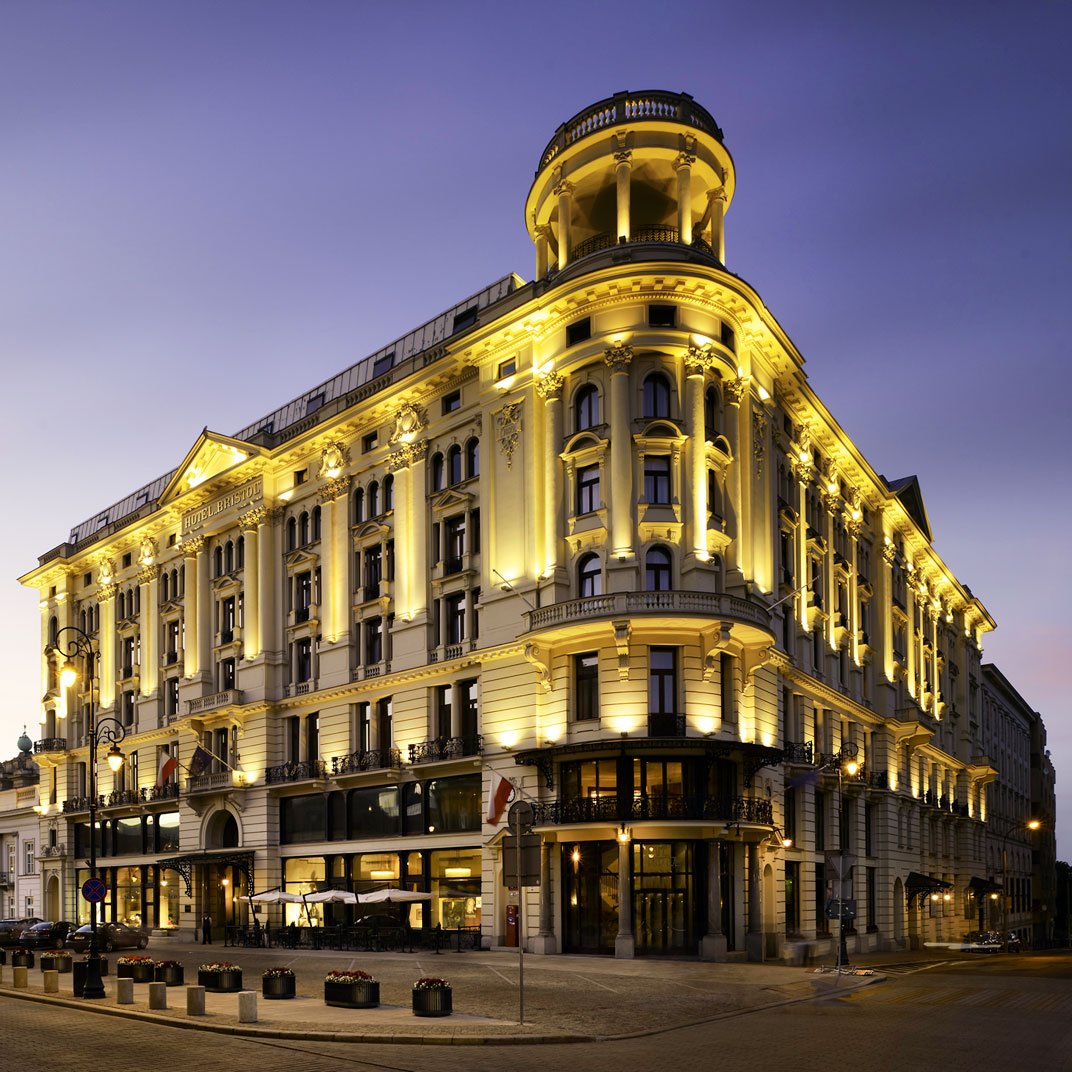
Warsaw's Grand Hotel Tradition and Where the Bristol Fits
Grand hotels that survive more than a century without losing their architectural identity belong to a small category. Warsaw's Hotel Bristol, a Luxury Collection Hotel, is one of them — a neo-Renaissance building on Krakowskie Przedmieście 42/44 that has absorbed wars, regime changes, and a complete ownership restructuring and come out, following a meticulous 12 million Euro renovation completed in January 2013, as the closest thing Warsaw has to a living archive of the city's pre-war social life. Positioned on the Royal Route directly adjacent to the Presidential Palace, the hotel occupies a stretch of the city where institutional memory runs deep and the competition for prestige address is not with other hotels but with embassies and government ministries.
Warsaw's upper hotel tier has become increasingly crowded in recent years. Raffles Europejski Warsaw occupies a comparable historic footprint a short distance away, while Nobu Hotel Warsaw and Hotel Warszawa, Likus Hotels represent the newer generation of luxury entrants targeting the same market. The Bristol operates in a different register from all of them: its competitive claim rests not on contemporary programming or brand-led dining concepts, but on the continuous weight of its own history. That is a deliberate positioning, and it comes with trade-offs. Guests who want modular, flexible spaces or a deliberately contemporary identity will look elsewhere — at properties like H15 Boutique Hotel or PURO Warszawa Centrum. Guests who want a hotel that doubles as a building of cultural record will find the Bristol operates without serious competition in Warsaw.
The shortlist, unlocked.
Hard-to-book tables, cellar releases, and concierge-planned trips.
Get Exclusive Access →The Dining Programme: Marconi, Café Bristol, and the Column Bar
For hotels of this age and footprint, the food and beverage operation tends to either coast on institutional reputation or make a genuine argument for itself within the city's broader dining scene. The Bristol manages both. Its restaurant and bar portfolio has been consistently cited among Warsaw's better in-hotel offerings , not as a consolation for guests who can't get a table elsewhere, but as destinations that attract non-resident Warsaw diners in their own right.
Marconi, the hotel's main restaurant, works from a Mediterranean framework , a sensible positioning for a grand hotel with an international guest base, and one that sits comfortably within the polished, slightly formal tone the building itself sets. The kitchen's Mediterranean orientation gives it a defined culinary identity rather than the all-things-to-all-guests breadth that weakens many hotel restaurants at this price tier. Warsaw's fine dining scene is rich enough , see our full Warsaw restaurants guide , that in-hotel restaurants without a clear point of view tend to lose non-resident diners quickly. Marconi's focus holds its position.
Café Bristol occupies a different register entirely. The Vienna-style café format , coffee, pastries, a pre-war Central European atmosphere , is one of the most culturally specific offerings any Warsaw hotel makes. The Viennese café tradition, which once ran through Warsaw's intellectual and artistic life as naturally as it did through Prague or Budapest, was effectively erased during the Second World War and the decades that followed. A hotel café that can credibly invoke that tradition, in a building with documented connections to that pre-war milieu, is making an argument about cultural continuity that no amount of contemporary programming can replicate.
Then there is the Column Bar. The room functions as the hotel's social anchor in a way that Marconi and Café Bristol, for all their merit, do not quite match. Leather banquettes, original Otto Wagner lighting installations (Wagner the Younger designed the hotel's first interiors), and live piano create an environment where the room itself carries the conversation. Column Bar is the kind of space that rewards slow drinking and unhurried evening hours , a format that has largely disappeared from the kind of high-turnover bar programming that now defines most international luxury hotels. In Warsaw's current bar scene, that pace is an editorial statement as much as a hospitality choice.
The Interior: Restoration as Editorial Act
The 2013 renovation, designed by London-based hotel designer Anita Rosato, was developed in close consultation with Warsaw's Architectural Conservator , a requirement given the building's 110-year age at the time and its position within a protected historic streetscape. The result navigates the tension between contemporary comfort and period authenticity through specificity rather than pastiche.
The detail work is what separates this from generic heritage-hotel restoration. Over 600 handmade brass leaves, drawn from the organic forms of a Secessionist brooch, are installed in the reception. A handcrafted rug was developed from a remnant of Art Nouveau fabric. Nickel-glass wall fittings, embossed white leather panels, and embellished wool drapes carry the Jugendstil influence through the rooms and corridors without allowing any single element to dominate. The lobby, returned to its original location beside the main entrance, re-interprets Wagner the Younger's original winter garden concept , deep-buttoned armchairs, marbled walls, antiqued brass mirrors, a restored chandelier above a floral display of palm trees and cut flowers.
Guest rooms take the period references into practical spaces without sacrificing modern infrastructure. Ornate wall treatments, marble bathrooms, and sizable pelmeted windows that frame views along the Royal Route toward Old Town landmarks are matched by high-speed internet access, a business centre, an indoor pool, a fitness centre, sauna, and Turkish steam bath. The 206-room count keeps the property scaled appropriately for the building's character without tipping into the anonymity that affects larger luxury hotel footprints.
History, Founding, and the Weight of Address
The Bristol opened in 1901, founded by Ignacy Paderewski , pianist, composer, and later the second Prime Minister of the Polish Republic. That origin sets the hotel's cultural register immediately. It was not built as a commercial lodging operation, but as a statement of Varsovian social ambition at a moment when Poland was pressing toward independence. The guest list that followed , artists, musicians, heads of state, cultural figures of European reputation , was a function of that ambition, and the hotel's address on the Royal Route, beside the Presidential Palace, reinforced it across successive generations.
The mid-century decades were difficult: Warsaw's destruction in 1944 and the following decades under the Polish People's Republic took a toll on the building and its position. The recovery, which tracks Poland's post-1989 reintegration into European political and cultural life, culminated in the 2013 rebranding as a Luxury Collection member , Marriott International's portfolio tier for hotels with documented historical and cultural significance. The rebranding was accompanied by the renovation that restored the building to something close to its early 20th-century character, while updating the infrastructure for contemporary travel standards.
Planning a Stay
Bristol sits at the upper end of Warsaw's hotel pricing bracket, appropriate for a Luxury Collection property on the Royal Route. The hotel's 206 rooms give it enough scale that availability is generally accessible, though the property can compress during major Warsaw events, government-adjacent international gatherings, and summer peak season on the Royal Route. Guests arriving by air land at Warsaw Chopin Airport, the city's main international hub, approximately 10 kilometres southwest of the hotel , a taxi or rideshare journey of 20 to 35 minutes depending on traffic, or accessible via train to Warsaw Central Station, itself a short taxi ride from Krakowskie Przedmieście.
Hotel's address requires almost no transport for Old Town access: the historic centre is on foot from the main entrance, which also means the Royal Route's pedestrian character puts considerable Warsaw sightseeing within walking distance. For guests who want to compare Warsaw's luxury hotel options before committing, Mamaison Hotel Le Regina Warsaw offers a smaller, more boutique alternative in a comparable neighbourhood tier.
For those extending a Polish itinerary beyond Warsaw, the country's other historic hotel addresses are worth mapping in advance: Hotel Stary in Krakow, Copernicus Toruń Hotel in Torun, Hilton Gdansk in Gdansk, and H15 Palace, a Luxury Collection Hotel in Kraków each represent distinct points on Poland's premium accommodation spread. Beyond Poland, the broader Luxury Collection standard applies comparably at properties like Aman Venice in Venice, while different models of urban grand-hotel programming can be found at The Fifth Avenue Hotel in New York City and Aman New York in New York City. For broader Polish regional coverage, the EP Club database also holds records for Hotel Altus Palace in Wrocław, Bachleda Residence Zakopane in Zakopane, PURO Łódź Centrum in Łódź, PURO Poznań in Poznań, Hotel Monopol Katowice, Likus Hotels in Katowice, Quadrille in Gdynia, Jaskolka Dom i SPA in Szklarska Poręba, Pałac Ciekocinko Hotel Resort & Wellness in Ciekocinko, HOTEL GLAR CONFERENCE & SPA in Świnoujście, Zamek Łeba in Łeba, and Hotel Galery69 in Stawiguda Masuria.
The shortlist, unlocked.
Hard-to-book tables, cellar releases, and concierge-planned trips.
Get Exclusive Access →Frequently Asked Questions
Cost and Credentials
A quick peer reference to anchor this venue in its category.
Preferential Rates?
Our members enjoy concierge-led booking support and priority upgrades at the world's finest hotels.
Get Exclusive AccessThe shortlist, unlocked.
Hard-to-book tables, cellar releases, and concierge-planned trips.
Get Exclusive Access →