
Grand Hyatt Macau transforms the Cotai Strip with twin towers inspired by classical elements, where 791 sophisticated rooms and suites feature innovative design including egg-shaped bathtubs and Pearl River views. This Forbes Four-Star property within City of Dreams offers Macau's largest outdoor pool venue, acclaimed dining at Beijing Kitchen and mezza9, plus the nearly 3,000-square-foot Chairman's Suite.
 Discover on Pearl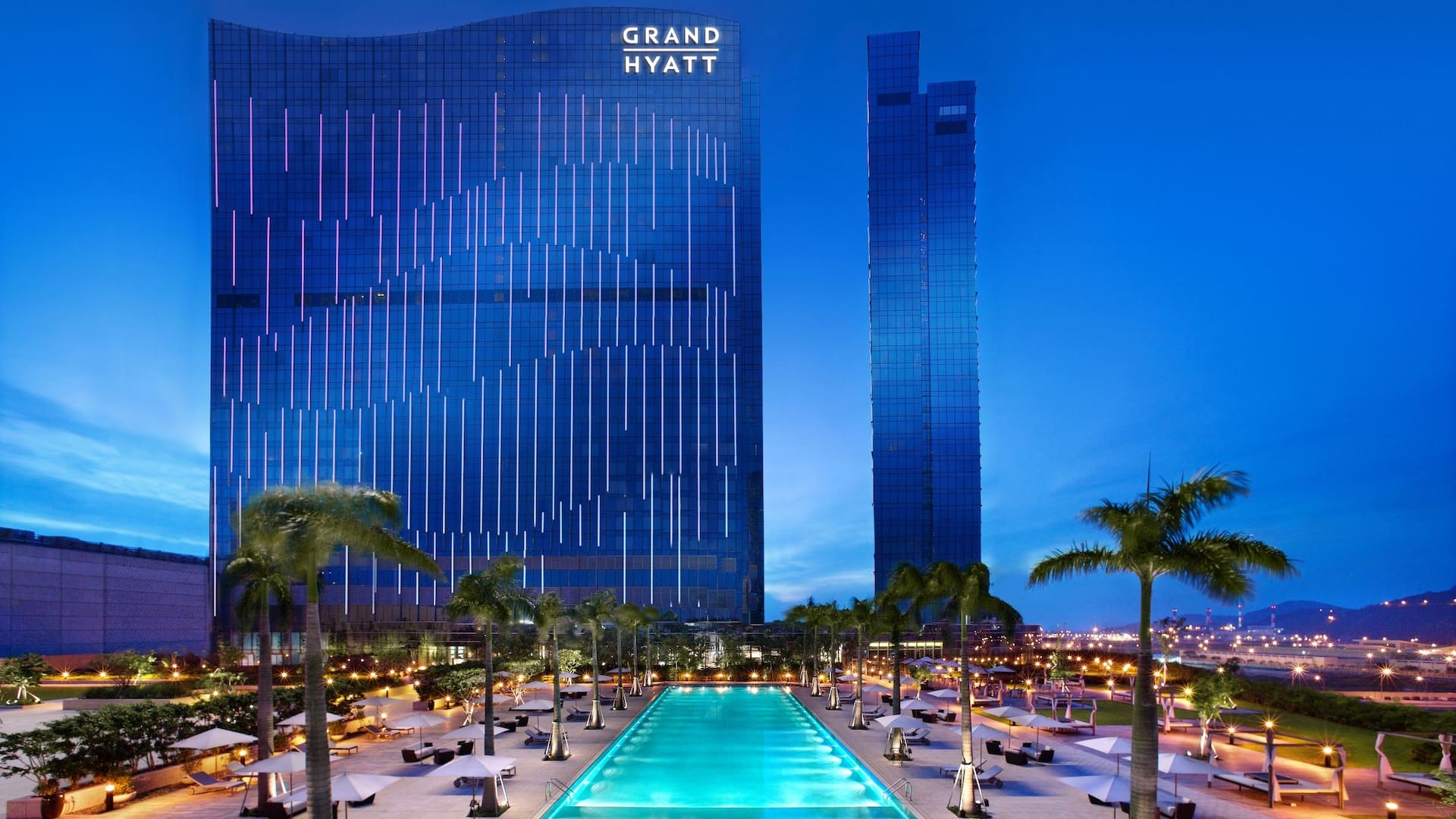
Cotai's Retreat Logic: Stillness Inside the Casino Strip
Macau's Cotai corridor operates at a frequency most travelers either seek out or actively avoid. The integrated resorts here, City of Dreams among them, are built around stimulation: casino floors that never dim, entertainment venues cycling through residencies, and F&B; operations running around the clock. What makes Grand Hyatt Macau worth examining as a retreat proposition is precisely how it positions itself within that context, not apart from it. The two wave-inspired towers rise above the City of Dreams complex, and the hotel holds a Forbes Travel Guide Four-Star rating, placing it in a peer set that includes Four Seasons Hotel, Macau, Banyan Tree Macau, and Encore Macau on the same strip. The question for any guest calibrating between those options is what form of retreat each property actually delivers. At Grand Hyatt, the answer is grounded in programming depth and physical environment rather than boutique-scale isolation.
The Pool as the Hotel's Clearest Argument
Temperature-controlled infinity pools exist across Cotai, but the specific engineering behind Grand Hyatt Macau's 40-metre pool addresses a genuine problem: outdoor pools in Macau contend with both subtropical heat in summer and wind chill in cooler months. The shallow lounge section, where submerged chairs allow guests to recline in the water, converts the pool from a lap-swimming facility into something closer to a recovery environment. That distinction matters for guests treating a Macau stay as decompression rather than activity. Compared with the enclosed spa-pool formats at properties like Banyan Tree Macau or the more architectural pool presence at Four Seasons Hotel, Macau, Grand Hyatt's approach leans toward usability across the calendar rather than aesthetic impact in a single season.
The gym extends the same logic. Shorts, sneakers, and headphones are provided at no additional charge, removing the friction that often makes hotel fitness centres feel like afterthoughts. For guests arriving light or on short Cotai layovers from Hong Kong or Guangzhou, this detail shifts the gym from optional to default.
Evening Rhythm and the Role of Live Music
In many integrated resort hotels, evenings are surrendered to the casino floor by default. Grand Hyatt Macau counters that with a live four-piece band in the evenings, notably one that incorporates traditional Chinese instruments, specifically the erhu and pipa, alongside a contemporary ensemble. This is not background music as wallpaper. The erhu produces a sustained, reedy tone that carries differently through a room than Western string instruments, and the pipa's percussive plucked register marks time in a way that orients the evening without overwhelming conversation. For guests who have come to Macau with some interest in the territory's cultural position between Chinese tradition and international commerce, this programming functions as a cue rather than a performance.
The Grand Club Lounge adds another dimension to the evening architecture. Access, where included in the room rate, provides a self-serve bar with spirits, liqueurs, wine, champagne, and beer, alongside a limited buffet during cocktail hours. Properties at this price tier in Macau increasingly use club lounge access as a differentiator; at Grand Hyatt, the evening session is specific enough in format to anchor a pre-dinner routine without requiring guests to commit to the casino floor.
Breakfast as a Sustained Ritual
Macau's hotel breakfast culture skews substantial, reflecting the city's position as a destination for travellers from mainland China, Hong Kong, and Southeast Asia, each with distinct morning food expectations. The mezza9 breakfast buffet at Grand Hyatt Macau addresses this directly. Dim sum, congee, noodles, and fried rice sit alongside made-to-order eggs, flaky pastries, tropical fruits, smoothies, muesli, and a range of cereals. The format is not a compressed continental offering with Asian additions bolted on; it functions as a genuine parallel operation running Chinese and Western tracks simultaneously. For guests spending several days in Cotai, this matters more than it might at a shorter-stay property, because it removes the need to source breakfast externally and turns the morning into a deliberate start rather than a logistical problem.
Tea, Tradition, and Beijing Kitchen
The tea program at Beijing Kitchen operates within a tradition that Macau's casino hotels have been inconsistent about preserving. The selection runs from a Yunnan pu-erh that has been fermented and aged 25 years, carrying the earthy, compressed character associated with older-vintage pu-erh, through Huo Shan yellow-bud tea, a relatively rare category from Anhui province, to artisan blossoming teas that unfurl in the glass. This range signals a procurement approach rather than a decorative tea menu. China's luxury hotel circuit has increasingly used serious tea programs as a cultural positioning tool; properties like Aman Summer Palace in Beijing and Amanfayun in Hangzhou have built entire guest experiences around tea as ritual. Grand Hyatt Macau's approach is less immersive but no less deliberate, and it offers a quiet counterpoint to the evening casino energy for guests who prefer a more grounded afternoon anchor. For broader context on Macau's dining circuit, see our full Macau restaurants guide.
Rooms: Architecture of Stillness
Cotai hotel room design tends toward one of two modes: maximalist spectacle or composed restraint. Grand Hyatt Macau's guest rooms sit firmly in the second category. The emphasis on defined lines, geometric shapes, and a palette of bright whites contrasting with tan and dark brown creates a visual register that reads calm against the sensory load of the casino complex below. Floor-to-ceiling windows and 42-inch flat-screen televisions are standard across the tier, but the bathroom configuration is more considered: the shower and bath area is fully glass-enclosed, separated from the bedroom by sliding dark-wood panels, with a one-panel shade for privacy adjustment. The bathtub is freestanding, with access to both a ceiling-mounted rainfall shower and a detachable wall-mounted head.
For guests requiring more space, the Grand Executive Suite at 775 square feet offers a separate living room and bedroom with views over the west bank of the Pearl River Delta. At the Cotai price tier, this configuration competes with suite formats at Emerald Tower at MGM COTAI and Epic Tower at Studio City Macau, though the Pearl River Delta outlook at Grand Hyatt provides a specific geographic orientation that some travellers will weigh against a city-facing alternative.
Logistics and Timing
Grand Hyatt Macau sits within the City of Dreams complex on the Cotai strip, close to the Macau airport and a short taxi ride from the Taipa ferry terminal, which handles high-speed ferry connections from Hong Kong. This access profile makes it practical for short stays arriving by sea from Hong Kong or direct flights into Macau. Room amenities include universal adapters, a full range of personal care kits, and gym consumables, reducing the preparation burden for guests arriving from multiple-country itineraries. Timing a visit matters: weekdays away from Chinese public holidays deliver the quiet that makes the retreat framing credible. Chinese New Year, Golden Week in early October, and Grand Prix weekend shift the property into a different register entirely, with the City of Dreams casino at its highest volume. Both modes are available; they are simply different experiences. For guests planning around the quieter window, consulting our full Macau hotels guide for timing context across the Cotai properties provides useful comparative framing.
Travelers also exploring other areas of China's luxury hotel circuit may find useful parallels at Amanyangyun in Shanghai, Amandayan in Lijiang, or Banyan Tree Ringha in Shangrila for contrasting takes on the retreat format within the Chinese context. For Cotai alternatives, Altira Macau and Conrad Macao occupy adjacent positions in the market. Those looking further into the region's dining and entertainment programming can consult our full Macau bars guide and our full Macau experiences guide.
Frequently Asked Questions
- What room should I choose at Grand Hyatt Macau?
- For standard stays, the base guest rooms deliver the property's core design language: geometric restraint, floor-to-ceiling windows, and a glass-enclosed bathroom with a freestanding bathtub and rainfall shower. Guests wanting more space and a Pearl River Delta outlook should consider the Grand Executive Suite, a 775-square-foot corner unit with a separate living room and bedroom. If the rate includes Grand Club Lounge access, that inclusion changes the evening value proposition considerably, adding a self-serve cocktail and buffet session that reduces the need to engage the casino floor for pre-dinner drinks.
- What's the main draw of Grand Hyatt Macau?
- The Forbes Travel Guide Four-Star rating places it within Macau's upper-tier integrated resort bracket, but the specific draw depends on the guest. For retreat-oriented travelers, the temperature-controlled 40-metre infinity pool with its submerged lounge chairs and the structured evening programming, including live music with traditional Chinese instruments, provide a framework that is harder to replicate at comparable Cotai properties. The mezza9 breakfast buffet, which runs Chinese and Western tracks in parallel, is consistently cited by inspectors as one of the property's most substantive daily offerings.
- How hard is it to get in to Grand Hyatt Macau?
- Availability at Grand Hyatt Macau fluctuates sharply with the Macau calendar. During Chinese New Year, Golden Week (October 1st), and Grand Prix weekend, the City of Dreams complex operates at peak capacity and rates rise accordingly. Booking several weeks ahead for those windows is advisable. Outside major holidays and festival periods, availability is generally more accessible and the property operates at a quieter register that aligns better with a retreat stay. The hotel's proximity to both the Macau airport and the Taipa ferry terminal makes last-minute arrivals from Hong Kong logistically feasible in quieter periods.
- What makes the tea program at Beijing Kitchen worth seeking out?
- Beijing Kitchen's tea selection draws from across China's producing regions with genuine range: the 25-year aged Yunnan pu-erh alone places it in a category most hotel tea menus don't reach, given the storage commitment and sourcing required for properly aged pu-erh. The inclusion of Huo Shan yellow-bud tea, a relatively low-production category from Anhui, and artisan blossoming teas adds breadth across fermented, oxidised, and specialty formats. For guests interested in Chinese tea tradition, it functions as a more grounded afternoon alternative to the casino and entertainment circuit, and it connects Grand Hyatt Macau to a wider Chinese luxury hotel culture that treats tea service as a cultural marker rather than an amenity add-on.
Where the Accolades Land
Comparable options at a glance, pulled from our tracked venues.
| Venue | Awards | Cuisine | Notes |
|---|---|---|---|
| Grand Hyatt Macau | Two majestic wave-inspired towers form Grand Hyatt Macau within the City of Drea… | This venue | |
| Banyan Tree Macau | |||
| Conrad Macao | |||
| Four Seasons Hotel, Macau | |||
| Grand Suites at Four Seasons Hotel, Macao | |||
| JW Marriott Hotel Macau |
Preferential Rates?
Our members enjoy concierge-led booking support and priority upgrades at the world's finest hotels.
Get Exclusive Access