

Set on eleven private hectares along Ungurys Lake inside Aukštadvaris Regional Park, Esperanza Lake Resort occupies a cedar-built main lodge where stillness is the primary amenity. Thirty rooms look onto either the lake or the surrounding forest, and the property sits roughly 40 kilometres from Vilnius, far enough that the city feels genuinely remote. Starting from around $206 per night, it prices itself as a considered retreat rather than a destination hotel.
Pearl is the En Primeur Club membership app — saves, bookings, and concierge access live there. Same editors, same standards.
- Address
- Paungurių k 1, Paunguriai, 21282 Trakų r. sav.
- Phone
- +370 660 03366
- Website
- esperanzaresort.lt
 Saves & bookings on Pearl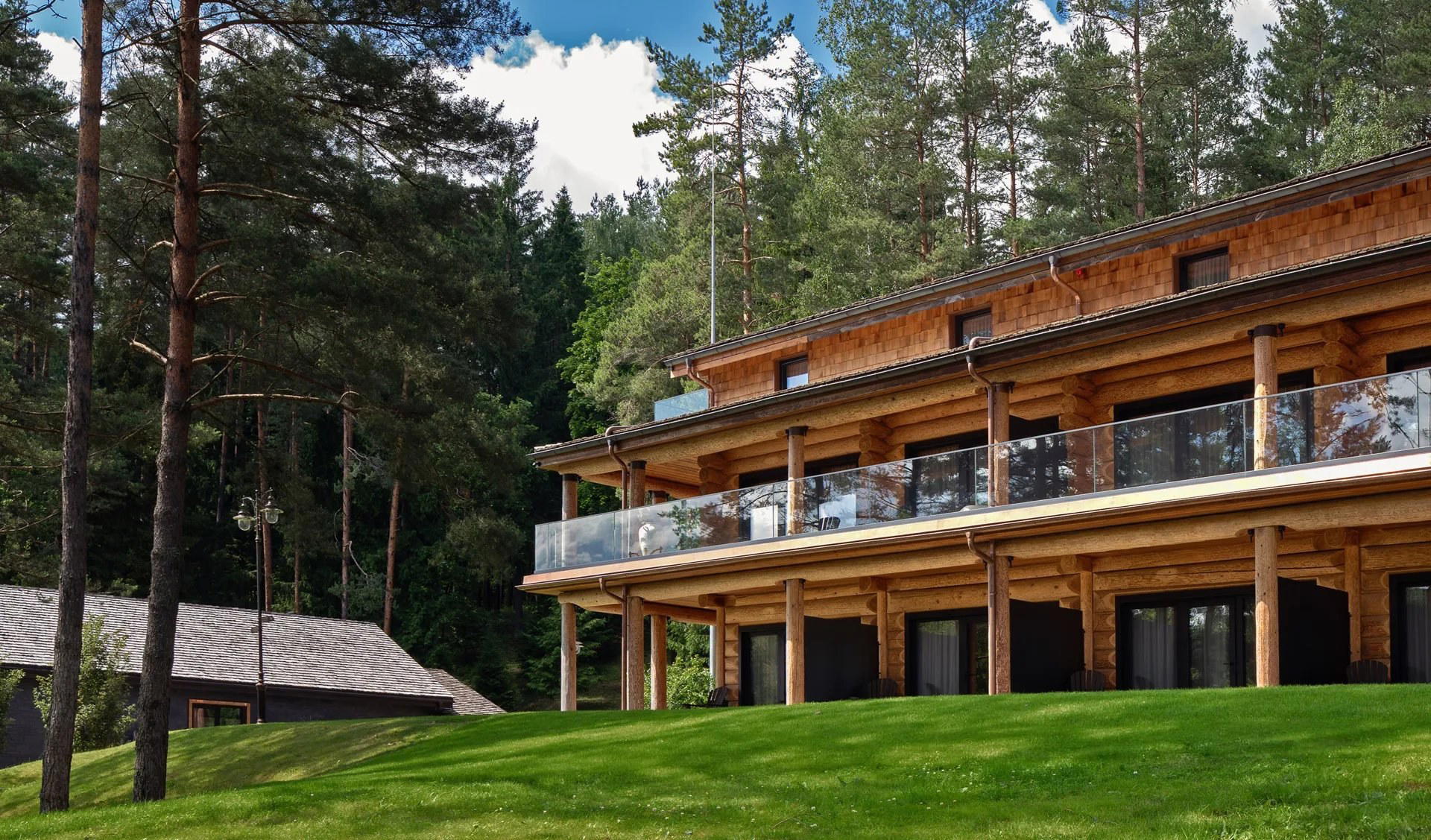
Where the Forest Meets the Water: Lithuania's Quiet Architecture of Retreat
Esperanza Lake Resort is a 5-star hotel in Paunguriai, Lithuania, and holds one Michelin Key. Forest roads replace motorway before the lodge appears, and the shift from urban speed to woodland quiet happens faster than the 40-kilometre distance from Vilnius would suggest. That compression of geography, city to deep nature in under an hour, has become one of the more compelling arguments for Aukštadvaris Regional Park as a destination in its own right, and Esperanza sits at the sharper end of the properties that have taken that argument seriously.
A Building Shaped by Its Site
The main lodge at Esperanza is built from centuries-old cedar, and that material choice is not incidental. Cedar construction in a lakeside forest setting does something that contemporary glass-and-concrete resort architecture rarely achieves: it creates thermal and visual continuity between interior and exterior. The building does not announce itself against the landscape; it reads as an extension of it.
Interiors are warm, open, and restrained in their detailing. Natural materials carry through from structure to finish, and the spatial logic favours openness over compartmentalisation. Rooms orient toward either the lake or the tree line, which means every guest has a framed view of the park and no view of another wing of the building. At thirty rooms across eleven private hectares, the density is deliberately low, a ratio that keeps the property feeling more like a private compound than a hotel.
This design discipline, limited keys, materials-led construction, site-responsive orientation, has become a defining characteristic of the premium nature-retreat category globally. Properties in this tier, whether in Scandinavia, the American Southwest, or rural Italy, share a commitment to restraint as a design value. Esperanza makes a coherent version of that argument in a Central European context that remains less saturated than its Alpine or Adriatic equivalents.
The Eleven-Hectare Proposition
Eleven private hectares along the wooded edge of Ungurys Lake constitutes a meaningful spatial offer. For context, that footprint allows for genuine separation between accommodation, communal spaces, and the lakefront without any one element crowding the others. The park itself, Aukštadvaris Regional Park, provides the wider buffer, regulated land that prevents development from encroaching on the resort's immediate environment. The combination of private grounds and protected regional parkland is what gives Esperanza's nature immersion its credibility. This is not a resort that has placed a deck near some trees; it is a property with water on one boundary and forest on the others.
Guests who have spent time at more urban Lithuanian properties, Hotel Pacai in Vilnius, for instance, which operates at the sophisticated end of the city's hospitality offer, will register Esperanza as a structural shift rather than a variation on the same theme. The programming logic here is not about access to the city's cultural assets; it is about the deliberate removal of those pressures. Slow mornings, long walks, no need for a schedule: these are the amenities the property is selling, and the architecture exists to deliver them.
Pricing and comparable set
Properties like Aman Venice or Cheval Blanc Paris operate in an entirely different price category, and comparison with them is most useful as a way of establishing that Esperanza's design seriousness does not yet carry international trophy pricing. For travellers who want a materially credible nature retreat, the value proposition here is real.
Within Lithuania, the nearest design-led comparison is probably Reja in Klaipėda, which occupies a different geographic register but shares a commitment to considered materials and restrained hospitality. Esperanza's thirty-room count and private-hectare footprint give it a structural advantage in the isolation argument that urban or coastal properties cannot replicate.
Getting There and Planning the Stay
The property sits in Paunguriai, roughly 40 kilometres southwest of central Vilnius. Guests arriving by car from Vilnius should expect a drive of approximately 45 to 60 minutes depending on route and conditions, with the final stretch running through the park. The transition from main road to forest track is part of the arrival sequence rather than an inconvenience, it is how the property establishes its remove. Vilnius International Airport provides the most practical international entry point, with onward ground transfer to the resort direct to arrange. Booking is recommended.
The Broader Argument for Aukštadvaris
Lithuania's regional park system has been slower than Scandinavia's or Slovenia's to develop a strong hospitality infrastructure, which means that properties operating at Esperanza's level occupy a relatively thin competitive tier. The lake district around Trakai is the most visited part of the national park network, Trakai Castle draws substantial day-trip volume from Vilnius, but the accommodation offer within the park boundaries has historically lagged behind the scenery. Esperanza represents the kind of investment in materials and spatial thinking that begins to close that gap, placing the area in a conversation with nature-led hospitality destinations that have built stronger international profiles over the past decade. Properties like Mandarin Oriental Bangkok or Hotel The Mitsui Kyoto have demonstrated that design credibility and setting specificity, more than brand scale, determine which properties accumulate lasting reputation. Esperanza is making the same bet at a fraction of the scale and price.
Comparable Spots, Quickly
Comparable venues nearby, for context on price, style, and recognition.
| Venue | Cuisine | Price | Awards | Notes |
|---|---|---|---|---|
| Esperanza Lake ResortThis venue — the venue you are viewing | Eco-friendly luxury resort in harmony with nature | $$$$ | Michelin 1 Key | |
| Hotel Pacai | Renovated 17th-century Baroque palace with modern luxury. | $$$$ | Michelin 1 Key | Vilnius Old Town |
| Stikliai Hotel | Historic luxury boutique with French elegance | $$$$ | 5-Star | Vilnius Old Town |
| NARUTIS Hotel | Historic boutique hotel in a 16th-century building blending Gothic and Baroque architecture. | $$$$ | 5-Star | Vilnius Old Town |
| Radisson Collection Astorija Hotel, Vilnius | Historic luxury lifestyle hotel blending 20th-century architecture with contemporary interiors. | $$$$ | 5-Star | Vilnius Old Town |
| Hotel Vilnia | 19th-century heritage building mixing classical and modern solutions | $$$ | 4-Star | Old Town |
At a Glance
- Scenic
- Quiet
- Elegant
- Cozy
- Sophisticated
- Romantic Getaway
- Wellness Retreat
- Family Vacation
- Weekend Escape
- Beachfront
- Infinity Pool
- Destination Spa
- Panoramic View
- Wifi
- Pool
- Spa
- Fitness Center
- Sauna
- Room Service
- Concierge
- Tennis Court
- Playground
- Waterfront
- Garden
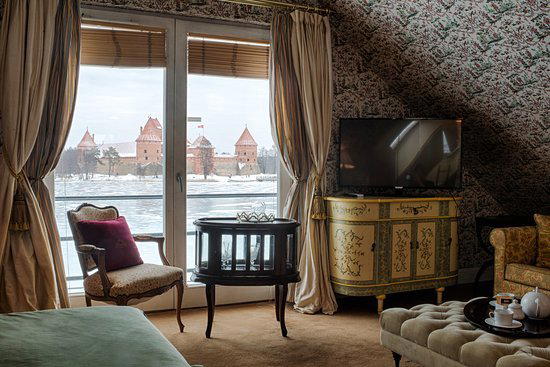
Calm and relaxing with natural light, warm textures, earthy tones, and wabi-sabi minimalist organic interiors surrounded by forest and lake.