DALAT PALACE HERITAGE HOTEL

World Luxury Hotel Awards WLHA Regional Winner
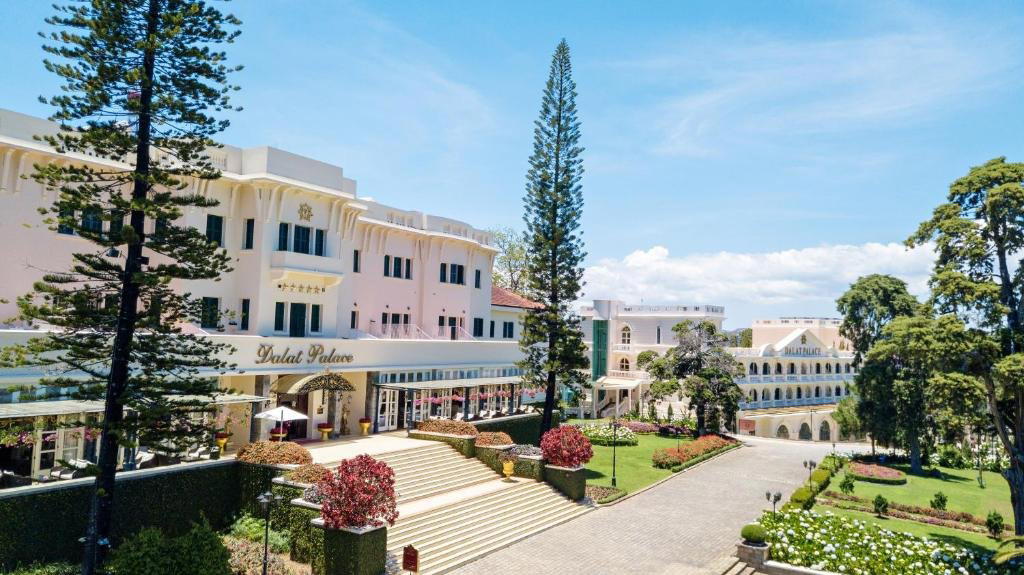
Dalat Palace Heritage Hotel holds both the Regional Winner for Luxury Hotel and Conference Centre and the Country Winner for Luxury Heritage Hotel, placing it at the top of Vietnam's colonial-era property category. Set on Tran Phu Street overlooking Xuan Huong Lake, the 1922 building reads as a physical record of French Indochina's highland retreat architecture, and remains the clearest reference point for heritage hospitality in Dalat City.

Pearl is the En Primeur Club membership app, where members save venues, book tables and use the concierge.
Where the French Left the Highlands Standing
Dalat was designed to be escaped to. When French colonial administrators began developing the Central Highlands plateau in the early twentieth century, they were building a cooler counterpart to the coastal lowlands, a place where the architecture would signal permanence and refinement against a range of pine forests and mist. The building that became the Dalat Palace Heritage Hotel, completed in 1922 at 2 Tran Phu Street, is the physical residue of that ambition. It sits on a rise overlooking Xuan Huong Lake, its colonnaded facade and pale rendered walls reading less like a hotel and more like a civic monument that happens to accommodate guests. That distinction matters: properties of this vintage, built with institutional seriousness rather than commercial calculation, carry a spatial weight that purpose-built luxury hotels cannot replicate regardless of budget.
Vietnam's heritage hotel category has matured significantly over the past decade. Properties in Hue, Hoi An, and Hanoi have restored colonial-era structures into functioning luxury hotels, but Dalat's altitude and relative isolation from Vietnam's main tourist corridors gave the Palace a different preservation context. The building never needed to be reimagined for beach tourism or rebranded for convention trade; it simply continued.
The Architecture as the Argument
The Dalat Palace's design language belongs to French colonial eclecticism at its most considered. The exterior presents a long, symmetrical facade with a central projecting pavilion, arched windows at the piano nobile level, and shuttered openings that manage the highland light without compromising the formal composition. This is not the tropical-vernacular adaptation seen in lowland colonial buildings, where thick walls and deep overhangs were necessary responses to heat and monsoon. Dalat's cooler climate allowed the architects to deploy a closer approximation of metropolitan French institutional style, and the result sits somewhere between a Loire Valley chateau and a provincial prefecture building, scaled to its lakeside setting.
Inside, the spatial logic is that of a grand hotel from the interwar period: corridors of meaningful width, ceiling heights that resist the intimacy of boutique design, and public rooms that assume collective use rather than private retreat. This approach to scale is increasingly rare in contemporary luxury hospitality, where the dominant model compresses common areas in favour of suite square footage. At the Dalat Palace, the proportion of public to private space reflects an older social contract between hotel and guest, one in which arrival, circulation, and gathering were considered as seriously as the rooms themselves. For guests arriving from properties like Azerai La Residence in Hue or Hotel de la Coupole in Sapa, both of which occupy French colonial structures in upland Vietnamese cities, the comparison is instructive: the Palace holds the longest unbroken history of the group, and its architecture retains the least mediated relationship to its original construction.
The Country Winner designation for Luxury Heritage Hotel places the Dalat Palace in direct competition with properties across Vietnam that combine verified age with contemporary service standards. Within that category, the building's 1922 date of completion and its lakefront position in the original French administrative quarter of Dalat City are the strongest differentiating credentials. Heritage certification of this kind depends on both physical authenticity and operational continuity, and the dual award signals that the property satisfies both criteria at a national level.
Dalat City's Position in Vietnamese Luxury Travel
Dalat occupies a specific and somewhat separate position in Vietnam's premium travel circuit. The coastal corridor from Danang to Nha Trang to Phu Quoc concentrates the majority of international resort development, and properties like Amanoi in Vinh Hy, Anantara Quy Nhon Villas, and Amiana Resort in Nha Trang compete on beach access and contemporary amenity packages. Dalat offers none of that. What it offers instead is altitude, roughly 1,500 metres above sea level, a temperate climate that makes it Vietnam's primary domestic retreat destination, and an urban fabric that preserves French-era planning more intact than almost any other Vietnamese city.
For visitors already moving through Vietnam's heritage corridor, the Palace sits logically between Hue and Ho Chi Minh City as a highland detour of architectural substance. The city's flower markets, coffee culture, and French-era villas attract a domestic tourist base that is growing rapidly, which means peak periods, particularly Vietnamese public holidays and the December-to-March dry season, carry genuine pressure on room availability at the better-positioned properties. Anyone considering the Palace during those windows should treat advance booking as a planning requirement rather than a courtesy. For broader context on what the city offers beyond the property itself, our full Dalat City guide maps the dining and experiences landscape in detail.
Where It Sits in Vietnam's Heritage Hotel Conversation
The Vietnamese luxury hotel market now runs from international brand outposts in major cities, InterContinental Hanoi Westlake, Indochine Palace in Hue City, through to design-led boutique openings and resort developments aimed at international leisure travellers. The heritage subcategory is smaller and more tightly defined: it requires original built fabric, not reconstruction, and a provenance that can be independently verified. The Dalat Palace's 1922 construction date and its position in the French administrative quarter give it a founding claim within this subcategory that newer restorations, however accomplished, cannot match on grounds of age alone.
Compared against the broader regional pool of heritage luxury hotels, the Palace competes with properties in Cambodia, Myanmar, and Laos that occupy similar French Indochina-era buildings. The Country Winner award for Luxury Heritage Hotel formalises that positioning.
For guests comparing highland properties in Southeast Asia, the Palace also invites comparison with Emeralda Resort Ninh Binh and, at a higher price point, with Aman's heritage-adjacent properties such as Aman Venice, which occupies a similarly weighted historic structure in a European context. The comparison is imperfect but useful: both properties derive their authority from the built fabric rather than from designed amenity, and both ask guests to accept that the building itself is the primary experience.
Planning a Stay
The Dalat Palace Heritage Hotel is located at 2 Tran Phu Street, directly on the northern shore of Xuan Huong Lake in central Dalat City. The property is reachable from Lien Khuong Airport, approximately 30 kilometres south of the city, by road transfer. Dalat's climate runs cooler than the Vietnamese coast year-round, with the driest and clearest conditions typically from November through April. That window aligns with peak domestic and regional travel demand, so rooms at heritage-tier properties fill earlier than coastal equivalents. Guests planning conference or group travel should factor in the Regional Winner designation for Luxury Hotel and Conference Centre, which signals that the property maintains meeting infrastructure alongside its heritage residential offering. For comparable heritage experiences elsewhere in Vietnam, Azerai La Residence in Hue and Hotel de la Coupole in Sapa offer the closest architectural parallels among currently operating properties.
Comparable Venues
Comparable venues nearby, for context on price, style, and recognition.
| Venue | Cuisine | Price | Awards | Notes |
|---|---|---|---|---|
| DALAT PALACE HERITAGE HOTELThis venue (the venue you are viewing) | French colonial heritage property with Art Deco architecture | $100–200 | World Luxury Hotel Awards WLHA Regional Winner | Not listed |
| InterContinental Nha Trang | Contemporary luxury beachfront resort combining international hospitality standards with Vietnamese coastal charm and local cultural elements. | $200–300 | World Travel Awards | Nha Trang beachfront |
| Villa Le Corail, a Gran Meliá Hotel | Luxury beach resort with private villas | $300–500 | Michelin Selected | Hon Tre Island |
| Hilton Quang Hanh Onsen Resort | Japanese ryokan-style resort with modern Hilton comforts | Not listed | Not listed | Quang Hanh Ward |
| Asteria Mui Ne Resort | Modern beachfront luxury resort | $1–100 | World Luxury Hotel Awards WLHA Regional Winner | Mui Ne |
| Six Senses Ninh Van Bay | Traditional Vietnamese architecture with modern luxury villas integrated into jungle and bay landscape | $750–1,000 | 1 Michelin Key · Virtuoso Luxury Hotel Partner | Ninh Van Bay |
Recognition history
Dated appearances from independent guides and award organizations, with the underlying list record or original source where available.
World Luxury Hotel Awards WLHA Regional Winner
World Luxury Hotel Awards
Full recognition history (2 entries)
World Luxury Hotel Awards WLHA Country Winner
World Luxury Hotel Awards
Continue exploring
More in Dalat City
Details
- Elegant
- Classic
- Romantic
- Sophisticated
- Romantic Getaway
- Honeymoon
- Anniversary
- Historic Building
- Garden
- Wi Fi
- Spa
- Pool
- Fitness Center
- Room Service
- Concierge
- Business Center
- Valet Parking
- Garden
- Wheelchair Accessible
- Elevator
Elegant colonial atmosphere with chandeliers, fireplaces, and serene garden settings praised for its tranquil retreat feel.