
La Liste Top Hotels
In the Bregenzerwald village of Bizau, Biohotel Schwanen operates in a category that Austria's Alpine hospitality scene rarely produces: a property where organic commitment and architectural restraint function as the primary design language. Recognised by La Liste Top Hotels 2026 with 93 points, it occupies a niche between wellness retreat and considered country hotel, drawing guests who arrive specifically for what the valley offers rather than what a larger resort might manufacture.

Pearl is the En Primeur Club membership app — saves, bookings, and concierge access live there. Same editors, same standards.
- Address
- Kirchdorf 77, 6874 Bizau
- Phone
- +43 5514 2133
- Website
- biohotel-schwanen.com
- Directions
- Get directions
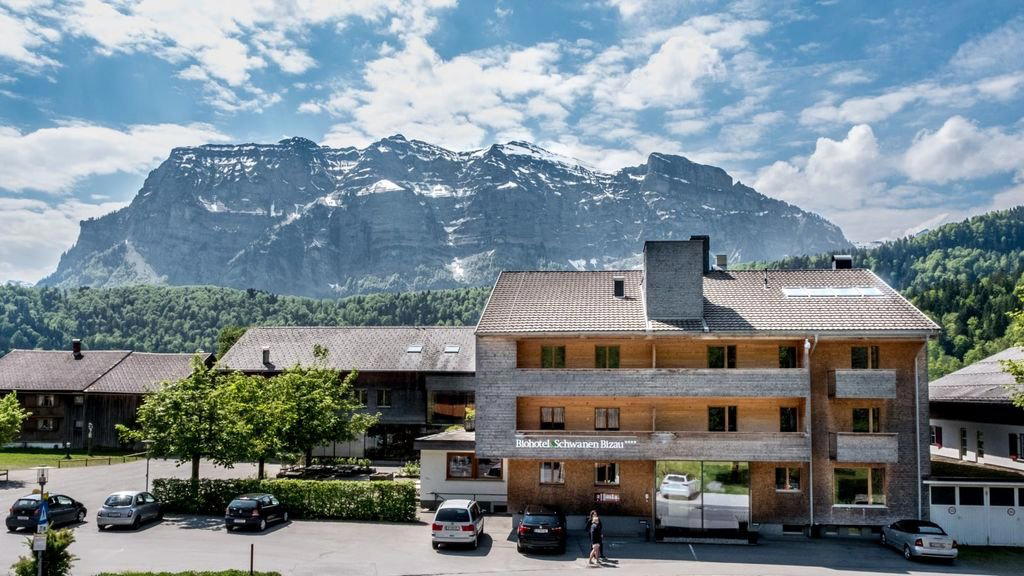
Timber, Quiet, and the Bregenzerwald Way of Building
The Bregenzerwald in Vorarlberg has developed one of the most coherent regional building cultures in the Alpine world. Local craftsmen and architects here have, over several decades, refined a practice that applies traditional timber construction to contemporary spatial thinking, producing buildings that read as deeply local without being historicist. Biohotel Schwanen in Bizau sits within that tradition. The approach is not decorative Tyrolean vernacular dressed up for tourism; it is a material logic rooted in the specific forests, workshops, and generational craft knowledge of this corner of western Austria. Arriving at Kirchdorf 77, the absence of grand signage or resort-scale infrastructure is itself a design statement — one that aligns with how the Bregenzerwald's most considered properties tend to present themselves.
This matters because the design choices in this part of Austria are inseparable from the ecological commitments behind them. The biohotel designation is not marketing shorthand. In Austria, certified organic hotels operate under frameworks that govern supply chains, building materials, cleaning products, and food sourcing — a coherent system rather than a collection of sustainability talking points. The physical environment, in other words, reflects a set of decisions that run through every layer of the operation.
Where Biohotel Schwanen Sits in the Austrian Premium Tier
La Liste's Leading Hotels ranking for 2026 placed Biohotel Schwanen at 93 points, a score that positions it within a cohort of Austrian properties recognised for quality without necessarily competing on the grand-hotel terms of, say, Hotel Sacher Wien in Vienna or Rosewood Schloss Fuschl in Hof bei Salzburg. Those properties operate within a different logic: historical grandeur, international brand frameworks, and a guest profile that arrives expecting a certain theatrical scale. Schwanen operates on entirely different terms, and the La Liste score signals that those terms are taken seriously by the people who evaluate them.
Among Alpine wellness properties, the comparison set is instructive. Properties like Alpen-Wellness Resort Hochfirst in Obergurgl, Aktiv & Wellnesshotel Bergfried in Tux, and Naturhotel Waldklause in Längenfeld each represent different inflections of the Alpine wellness model. The Bregenzerwald version, exemplified by Schwanen, leans harder into material authenticity and organic certification than the spa-and-ski format that dominates further east in Tirol. The valley's relative obscurity on the international circuit compared to Lech or Kitzbühel is, for many guests, a feature rather than a drawback.
The Bregenzerwald as Context
Understanding what Biohotel Schwanen offers requires understanding the valley it occupies. The Bregenzerwald is an area of Vorarlberg where tourism has historically been quieter and more locally inflected than in the better-known Austrian ski regions. The valley communities have maintained agricultural and craft traditions that in other parts of Austria exist mainly as heritage performance. Cheese production here, for instance, remains genuinely active, with the Bregenzerwald's dairy culture producing a range of Alpine cheeses that are consumed regionally rather than manufactured primarily for export.
For a biohotel operating in this environment, the sourcing logic writes itself: the regional supply chain is intact in a way that it often is not elsewhere. This is the backdrop against which Schwanen's organic positioning makes structural sense rather than appearing as a retrofit of sustainability credentials onto a conventional hotel operation.
Guests arriving from Zurich or Munich are roughly two hours by road. The nearest significant town is Egg, with Dornbirn accessible further west. The valley's road infrastructure is functional but not motorway-fast, which further reinforces the sense that arriving here requires intention. That friction is, again, part of the design logic for guests choosing this over more accessible alternatives.
The Property in Practice
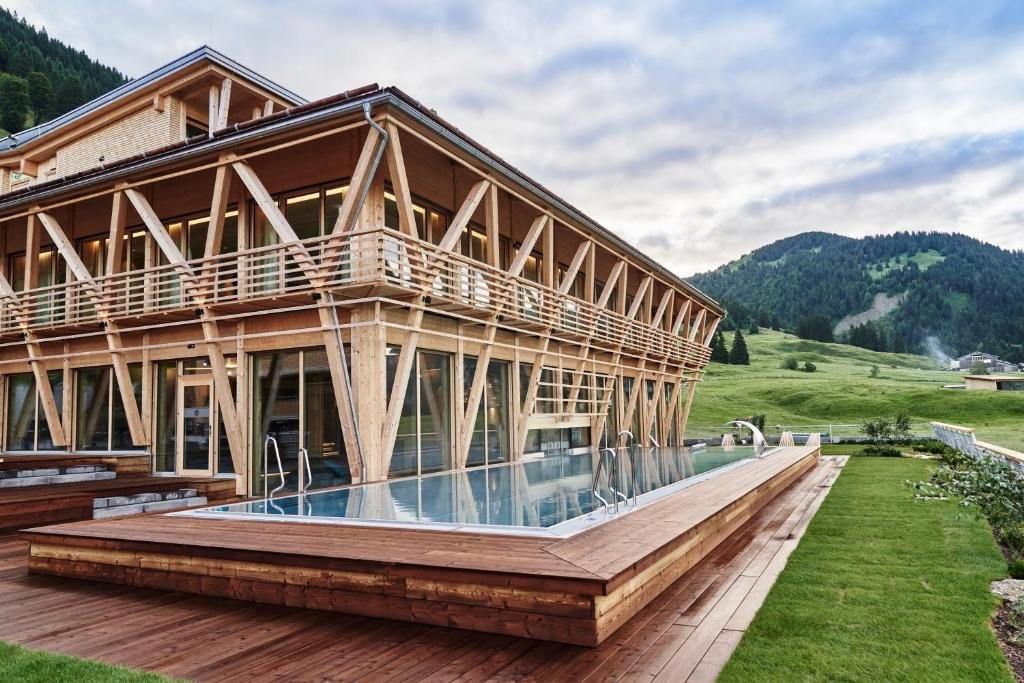
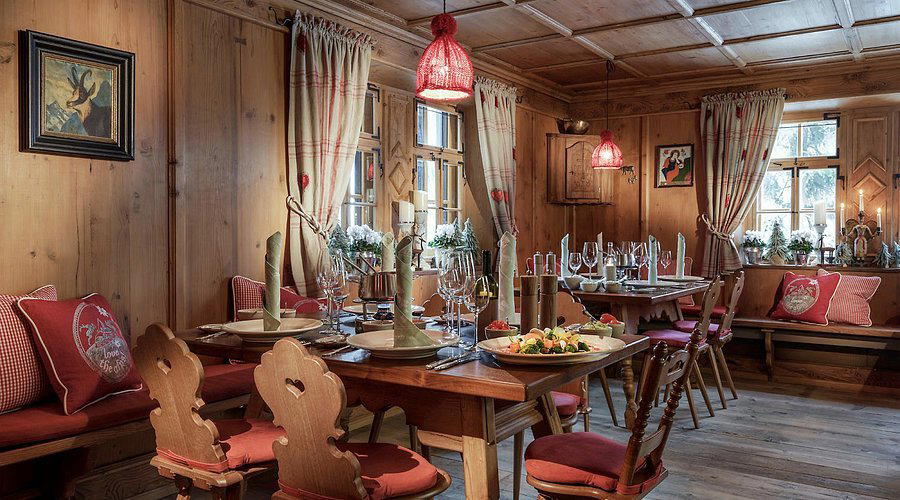
The spatial experience of a Vorarlberg timber building differs from the stone-and-plaster interiors common across Tirol and Salzburg. Wood here is structural and surface simultaneously: ceilings, walls, and floors read as continuous rather than assembled. Light behaves differently in these interiors, particularly in winter, when the reflection off snow outside interacts with warm-toned timber inside. The sensory register is quieter and more textural than what large-format resort properties produce.
Guests planning stays should approach logistics with the awareness that Bizau is a small village with limited surrounding amenities. The property itself functions as a self-contained environment to a significant degree, which is consistent with how premium rural biohotels operate throughout the German-speaking Alpine world. For readers who prefer the combination of rural positioning with nearby urban infrastructure, alternatives like Schloss Mönchstein in Salzburg or Hotel Schwarzer Adler Innsbruck offer a different balance. For those specifically drawn to the Vorarlberg model, the valley's character rewards the trade-off. See our full Bizau guide for broader orientation in the area.
Other design-led Austrian properties worth considering for comparison include DAS EDELWEISS in Grossarl, Alpinresort Schillerkopf in Bürserberg, and Bergland Sölden in Solden. Each operates in a different sub-register of the Alpine design-led hotel category, and the contrast between them clarifies what makes the Bregenzerwald's approach distinctive. Further afield, properties like Grand Tirolia Kitzbühel, Falkensteiner Schlosshotel Velden, Hotel Schloss Seefels, Hotel Almhof Schneider in Lech, Alpenresort Schwarz, Alpine Resort Sacher Seefeld, LEADING Hotel Hochgurgl, Augarten Art Hotel in Graz, Garner Hotel Klagenfurt Moser Verdino, LOISIUM Wine & Spa Resort Langenlois, and Chalet Untersberg in Grodig represent the full breadth of Austria's premium accommodation options across different regional identities. For international reference points in the same premium tier, Aman Venice, Aman New York, and The Fifth Avenue Hotel in New York City each demonstrate how the low-key, design-considered premium format translates across contexts.
Comparable Spots, Quickly
Comparable venues nearby, for context on price, style, and recognition.
| Venue | Cuisine | Price | Awards | Notes |
|---|---|---|---|---|
| Biohotel SchwanenThis venue — the venue you are viewing | Modern wooden architecture blending tradition and simplicity in Bregenzerwald. | $100–200 | La Liste Top Hotels | Not listed |
| Ritzenhof Hotel & Spa am See | Modern alpine lakeside retreat | $300–500 | Michelin Selected | Saalfelden am Steinernen Meer |
| Walch's Rote Wand Gourmet Hotel | Contemporary Alpine luxury blending centuries-old Walser tradition with modern minimalist design; six interconnected historic buildings unified by underground passages. | Not listed | 1 Michelin Key | Zug am Arlberg |
| Ullrhaus - St. Anton | Modern alpine design hotel with Nordic influences. | $300–500 | 1 Michelin Key | St. Anton am Arlberg |
| Genießer - & Romantikhotel DAS SCHIFF | Modern romantic boutique hotel with nautical heritage | $100–200 | 1 Michelin Key | Hittisau |
| Hotel Gotthard - Zeit | family-run chalet-style with modern renovations | Not listed | Michelin Selected | Obergurgl |
Recognition history
Dated appearances from independent guides and award organizations, with the underlying list record or original source where available.
La Liste Top Hotels
La Liste
Continue exploring
More in Bizau
Hotels in Bizau
Browse all →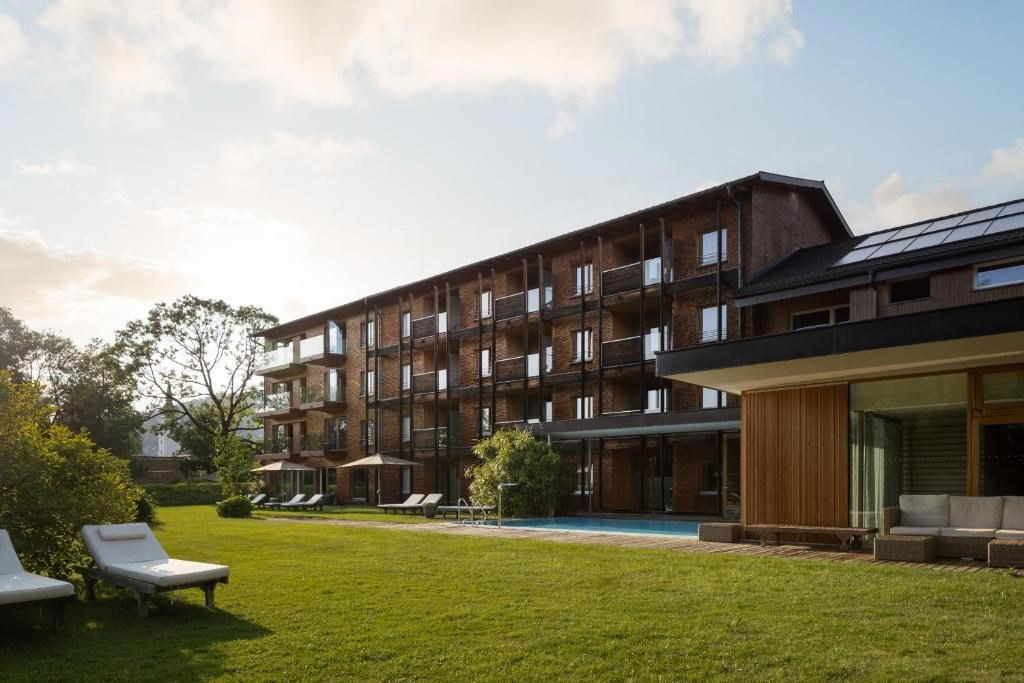
Bars in Bizau
Browse all →

Restaurants in Bizau
Browse all →

Details
- Quiet
- Cozy
- Rustic
- Scenic
- Elegant
- Wellness Retreat
- Romantic Getaway
- Weekend Escape
- Panoramic View
- Garden
- Terrace
- Wi Fi
- Spa
- Sauna
- Restaurant
- Fitness Center
- Garden
- Mountain
- Garden
- Wheelchair Accessible
- Step Free Entrance
- Elevator
Cozy and relaxing with natural materials, fragrant pine beds, and a serene mountain setting.