Bawe Island

Bawe Island, winner of the 2025 World Travel Awards for Zanzibar's Leading Luxury Resort, occupies its own private island off the Tanzanian coast. The property sits in a comparable set defined by exclusivity of access and design-led seclusion rather than scale. For travellers routing through Tanzania's Indian Ocean coast, it represents the upper tier of the Zanzibar luxury accommodation category.
Pearl is the En Primeur Club membership app — saves, bookings, and concierge access live there. Same editors, same standards.
- Address
- Bawe Island, Tanzania
- Website
- baweisland.com
 Saves & bookings on Pearl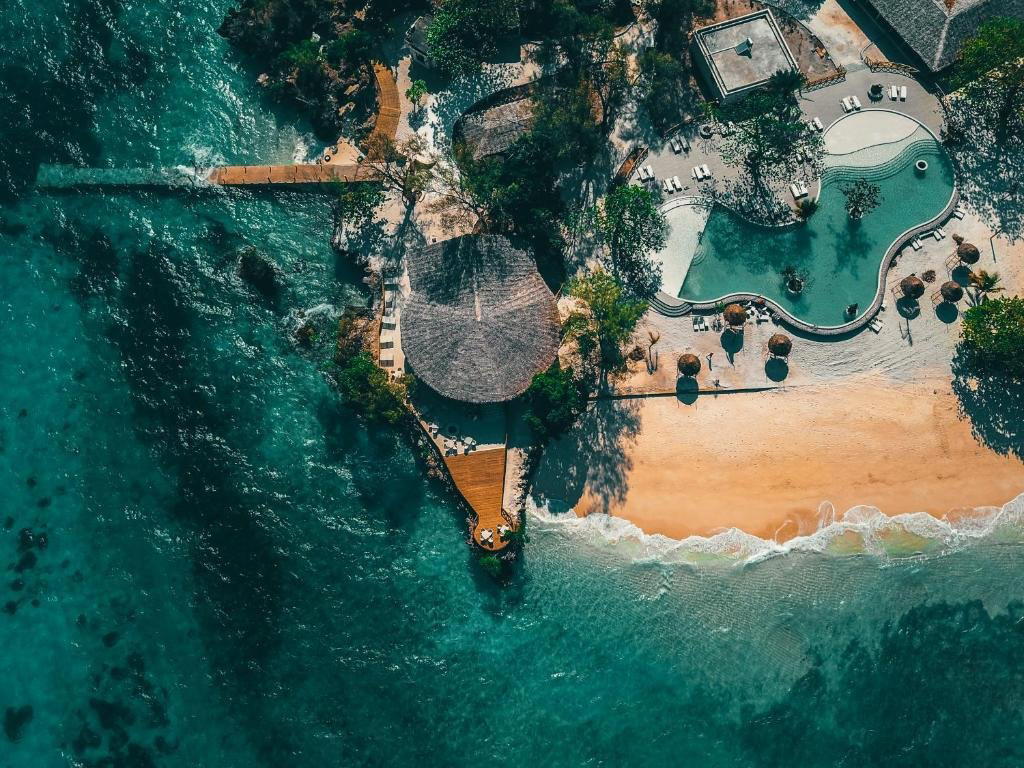
A Private Island at the Upper End of Zanzibar's Luxury Tier
Zanzibar's premium accommodation market has split decisively over the past decade. On one side sit the larger resort complexes along the east coast, competing on amenity breadth and beach frontage. On the other sits a smaller cohort of genuinely private-island or low-key, design-disciplined properties where the central selling point is separateness from the mainland and from other guests. Bawe Island belongs to that second category. Positioned off the west coast of Zanzibar island, accessible only by boat, it operates as a self-contained property in a way that the more accessible east-coast resorts cannot replicate. The 2025 World Travel Awards recognised it as Zanzibar's Leading Luxury Resort, and it won one award in 2025.
That award matters as a positioning signal rather than merely a marketing credential. The World Travel Awards, voted on by travel industry professionals worldwide, tend to reward properties that set a clear standard within their region. For Bawe Island, the recognition confirms what its format already implies: this is a private-island resort competing less against mainland beach resorts and more against a narrow category of exclusive retreats. In East Africa, that category includes properties where location inaccessibility is part of the appeal.
The Architecture of Seclusion
Private-island design in the Indian Ocean tends toward one of two modes: the over-engineered resort that attempts to replicate all urban conveniences in a remote setting, or the more disciplined approach that uses the natural environment as the primary design element and lets architecture serve rather than dominate. The latter approach is harder to execute and rarer to find at true luxury price points, where guest expectations for finish and comfort are high. When properties in this category succeed, it is typically because the physical relationship between structures and landscape has been considered at the site-planning stage rather than retrofitted.
Bawe Island's position as a private island off Zanzibar's western shore gives it a specific design advantage: the orientation toward the open ocean, without the reef-flat exposure of the east coast, creates different light conditions and a calmer sea surface for much of the year. The west coast of Zanzibar faces the Zanzibar Channel toward the Tanzanian mainland, and sunsets from this aspect are among the more dramatic available from any Zanzibari property. That geographic circumstance shapes the guest experience in ways that are architectural in the broad sense: where you place a guest room, a terrace, or a dining pavilion relative to that western light determines what the property feels like at its most memorable moments.
For travellers who have moved through Tanzania's wider luxury circuit, from the Four Seasons Safari Lodge Serengeti or Singita Grumeti on the mainland to a coastal conclusion, the shift from savanna-facing architecture to ocean-facing design is one of the more pronounced transitions in East African travel. The grammar of the spaces changes: thatch gives way to canvas or coral stone, expansive land views compress into horizon lines, and the sound design of a property shifts entirely. The hotel sits at the end of that particular journey.
Where Bawe Island Fits in the Zanzibar Context
Zanzibar's luxury property market covers a wider price and quality spectrum than most visitors anticipate. At the accessible end, Stone Town's hotels, including the Park Hyatt Zanzibar, offer urban luxury rooted in the archipelago's Swahili and Omani architectural heritage. Further along the coast, properties like Xanadu Luxury Villas in Dongwe and Amani Boutique Hotel occupy the design-led boutique tier. At the summit of this structure, private-island properties separate themselves from mainland-accessible competition through the fact of requiring a boat transfer: that threshold removes a category of guest and narrows the pool to those for whom the crossing is either appealing or at least acceptable.
The regional comparison also extends to other Indian Ocean private-island formats. Properties like andBeyond Mnemba Island have set a benchmark for what this format can mean in East African waters, with small room counts and conservation-linked programming. The hotel's World Travel Awards recognition for 2025 positions it alongside, or above, those established references within Zanzibar's specific competitive context.
For travellers building an East Africa itinerary that includes both safari and coast, the sequencing often determines the quality of the coastal experience. Arriving at a private island after a week of game drives in Serengeti Under Canvas or Kuro Tarangire makes the contrast sharper, and properties like Bawe Island are structured around delivering that decompression.
Planning a Stay
Access to the hotel requires a boat transfer from Zanzibar's main island, which operationally means coordinating arrival times with the property's transfer schedule. Zanzibar itself is reached by short flight from Dar es Salaam, where Hotel Sea Cliff serves as a functional stopover option, or by direct international connections on select carriers. Travellers arriving via the northern safari circuit through Arusha, with a night at Arusha Coffee Lodge, will route through Kilimanjaro International Airport before connecting south to Zanzibar. The weather window matters: the long rains in April and May affect the west coast of Zanzibar differently than the east, but most premium properties advise booking within the June to October dry season or the December to February short-dry window for particularly consistent conditions.
Comparable Spots, Quickly
Comparable venues nearby, for context on price, style, and recognition.
| Venue | Cuisine | Price | Awards | Notes |
|---|---|---|---|---|
| Bawe IslandThis venue — the venue you are viewing | Exclusive private island villas blending luxury and Zanzibari charm | $$$$ | 5-Star | Not listed |
| Kilindi Zanzibar | Exclusive ultra-luxury boutique resort owned by Elewana Collection, originally designed for ABBA's Benny Andersson, positioned as a romantic barefoot getaway with personalized service. | $$$$ | 5-Star | Kendwa |
| Elewana the Manor at Ngorongoro | Old-world Cape Dutch manor house blending East African hospitality with Afro-European architecture, positioned as an elegant upscale safari lodge. | $$$$ | 5-Star | Karatu |
| Siringit Migration Camp | Mobile luxury tented camp following the Great Migration | $$$$ | 5-Star | Kogatende |
| Gibb's Farm | Historic colonial farmhouse on a working coffee plantation | $$$$ | 5-Star | Karatu |
| Lemala Osonjoi | High-end safari lodge in the Ngorongoro highlands, focused on immersive wildlife access and comfort within a conservation area. | $$$$ | 5-Star | Ngorongoro Conservation Area |
Recognition history
Dated appearances from independent guides and award organizations, with the underlying list record or original source where available.
World Travel Awards
World Travel Awards
At a Glance
- Romantic
- Quiet
- Elegant
- Scenic
- Intimate
- Sophisticated
- Ornate
- Honeymoon
- Romantic Getaway
- Anniversary
- Weekend Escape
- Beachfront
- Private Villa
- Panoramic View
- Pool
- Spa
- Fitness Center
- Room Service
- Concierge
- Private Beach
- Wi Fi
- Beach Access
- Waterfront
- Pool
- Spa
- Fitness Center
- Room Service
- Concierge
- Private Beach
- Wi Fi
- Beach Access
Serene and inviting with natural lighting, harmoniously blending luxury with tropical nature, praised for peaceful atmosphere and dramatic sea views.