

On a clifftop above a secluded Bahian cove, Barracuda Hotel & Villas positions itself as one of the few genuinely sophisticated options in Itacaré's surf-and-jungle belt. Seventeen suites combine local carpenter-built furnishings with Scandinavian clean lines, while freestanding villas add private infinity pools. Rates from $637 per night reflect its placement at the top of a thin regional market.
 Discover on Pearl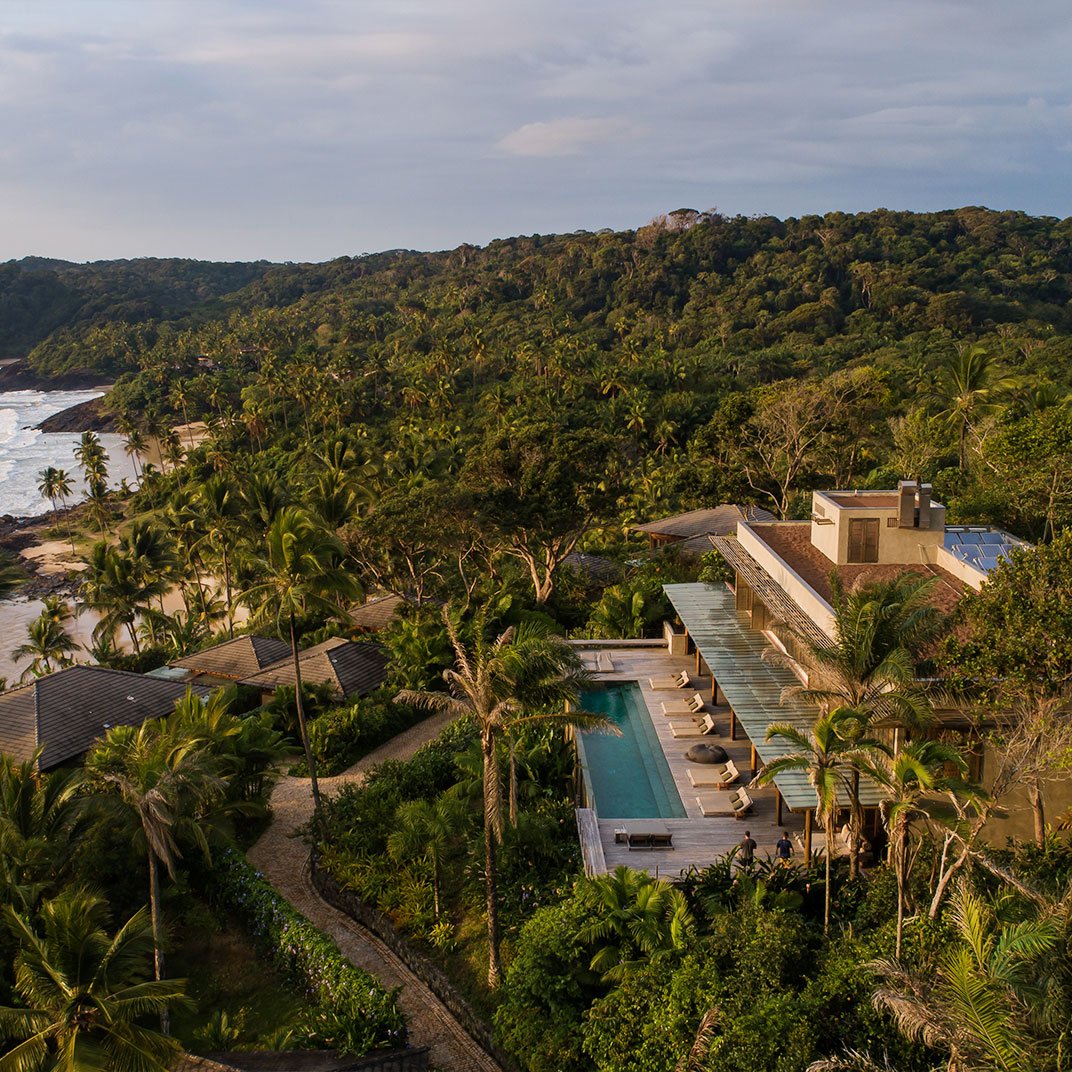
A Clifftop in the Atlantic Forest
The approach to Itacaré sets expectations immediately. The town sits on a narrow peninsula at the mouth of the Rio de Contas, hemmed in by one of the last remaining stretches of Atlantic Forest on Brazil's northeast coast. Roads into the area are slow and the infrastructure is deliberately limited — which is precisely why the surfers, ecotourists, and a small number of design-conscious travelers who find their way here tend to stay longer than planned. Against that context, our full Itacaré restaurants guide maps the wider scene, but the accommodation question is simpler: the market thins quickly above the mid-range pousada tier, and Barracuda Hotel & Villas occupies most of the space at the leading.
The property sits on a palm-framed clifftop above a small cove, with the Atlantic Forest pressing in on three sides and the ocean opening in front. The physical position is the primary design gesture — everything else, from the orientation of the suites to the placement of the terraces, is organized around that view. A wide infinity pool runs along the cliff edge, and the wooden decks surrounding it feel more like an extension of the landscape than a conventional hotel amenity. At night, with the jungle sounds carrying across from the tree line, the architecture recedes and the setting takes over entirely.
The shortlist, unlocked.
Hard-to-book tables, cellar releases, and concierge-planned trips.
Get Exclusive Access →Design Philosophy: Two Traditions, One Material Palette
Aesthetic vocabulary at Barracuda reflects a genuine duality. The property's original owners brought Brazilian and Swedish backgrounds to the project, and the result is not a hybrid that compromises both traditions but a design that finds where they genuinely overlap: clean architectural lines, minimal ornament, and a prioritization of natural materials over applied decoration. This approach has parallels elsewhere in Brazilian boutique hospitality , Botanique Hotel Experience in Campos do Jordão and NÓR Hotel & Spa in São Roque both draw on a similar logic of local materials filtered through restrained European design sensibility , but Barracuda applies it in an environment where the surrounding forest does most of the visual work.
Inside the main building, the 17 suites use polished concrete floors, wood-paneled ceilings, and furnishings built by local carpenters. Floor-to-ceiling white drapery moves in the sea breeze , a detail that, in photographs, reads as styling, but in practice functions as passive climate control in a coastal tropical environment. Most suites open onto private verandas facing the water. The freestanding villas extend the format further, adding full kitchens and private infinity pools for guests who want the property's aesthetic without the shared facilities.
Sustainability is embedded in the material choices and the operational model rather than announced through certification language. The use of local craftspeople for furniture, the forest-adjacency that shapes the landscaping approach, and the emphasis on low-footprint activities all point toward a coherent position rather than a marketing posture. Comparable thinking appears at Cristalino Lodge in Alta Floresta and Atlantica Jungle Lodge in Vila do Abraão, where the ecological context is the primary offering and the built environment is calibrated not to compete with it.
Food, Drink, and the Rooftop Question
The restaurant and bar occupy the pool deck, serving freshly caught seafood alongside cachaça-based cocktails. The format is relaxed and appropriate to the setting , this is not a destination dining operation, and the property does not position it as one. The food program exists to keep guests on-site and comfortable rather than to draw outside visitors. For reference points in Brazilian coastal hotel dining that do operate at a more ambitious register, Kenoa Exclusive Beach & Spa Resort in Barra de São Miguel and Carmel Charme Resort in Ceará provide a different calibration.
The property's smaller rooftop bar carries the more compelling case for staying in-house. At sunset, with a caipirinha and the forest-to-ocean panorama, the argument for leaving the property to find dinner becomes hard to construct. The view from that position, with the Atlantic Forest canopy at eye level and the ocean below, concentrates everything the property is trying to do into a single moment.
Activities and the Wider Itacaré Context
Itacaré's draw for travelers with some tolerance for remoteness lies in the density of natural experience available within a small radius. Surfing is the entry point , the town has a serious surf culture built around breaks at Tiririca, Resende, and Ribeira beaches , but hiking trails into the Atlantic Forest reserve, river canoeing on the Rio de Contas, and snorkeling at quieter coves give the area staying power beyond a surf trip. Barracuda's staff arranges access to all of these, which matters in a destination where independent logistics can be friction-heavy without local contacts.
The wellness offer is calibrated to the setting rather than to a spa-hotel format: an indoor-outdoor space with a yoga deck that uses the forest edge as its backdrop. This is consistent with how the property approaches everything else , using the environment as infrastructure rather than adding built amenities that compete with it. Properties like Txai Resort Itacaré take a more elaborate spa-and-beach-club approach to the same geography, which is a useful calibration point for travelers deciding which model fits their preference.
Placing Barracuda in the Brazilian Luxury Market
Brazil's premium hotel market has developed along two distinct tracks. On one side sit large, urban anchor properties , Copacabana Palace in Rio de Janeiro, Rosewood São Paulo , where scale, brand recognition, and city-center position define the offer. On the other sit smaller, location-driven retreats where the surrounding environment carries more weight than the built product. Barracuda belongs firmly to the second category, alongside properties like Hotel Fasano Trancoso and Casas Brancas Boutique Hotel & Spa in Armação de Búzios, where the logic of travel is landscape-first rather than brand-first.
At 17 suites plus villas, the property operates at a scale where the guest-to-staff ratio allows for attentive service without the formality of larger resort operations. Rates from $637 per night place it at the ceiling of what the Itacaré market supports, which means it is pricing against the concept of the trip rather than against local competition. For travelers already committed to Bahia's southern coast as a destination, the comparison set shifts to Trancoso alternatives , Hotel Fasano Salvador covers the urban Bahia base , or to comparable forest-and-coast retreats elsewhere in Brazil, such as Awasi Santa Catarina.
Planning Your Stay
Itacaré is reached most efficiently via Ilhéus Airport (IOS), approximately 70 kilometers south, with connections through Salvador or São Paulo. The drive from Ilhéus takes around an hour on the BA-001 coastal highway. Barracuda's 17 suites and villa inventory is small enough that availability during the December-to-March high season , when Brazilian domestic travel peaks , requires advance planning. The shoulder months of April-May and October-November offer the same forest and ocean conditions with considerably less demand pressure. For travelers building a longer Brazil itinerary, pairing Itacaré with Hotel das Cataratas at Iguassu Falls or a Pantanal lodge like Caiman in Miranda creates a coherent natural-Brazil circuit without repeating the same landscape logic twice.
The shortlist, unlocked.
Hard-to-book tables, cellar releases, and concierge-planned trips.
Get Exclusive Access →Frequently Asked Questions
Comparison Snapshot
These are the closest comparables we have in our database for quick context.
| Venue | Cuisine | Price | Awards | Notes |
|---|---|---|---|---|
| Barracuda Hotel & Villas | This venue | |||
| Copacabana Palace, A Belmond Hotel, Rio de Janeiro | World's 50 Best | |||
| Hotel das Cataratas, A Belmond Hotel, Iguassu Falls | World's 50 Best | |||
| Rosewood São Paulo | World's 50 Best | |||
| Fairmont Rio de Janeiro Copacabana | ||||
| JW Marriott Hotel São Paulo |
Preferential Rates?
Our members enjoy concierge-led booking support and priority upgrades at the world's finest hotels.
Get Exclusive AccessThe shortlist, unlocked.
Hard-to-book tables, cellar releases, and concierge-planned trips.
Get Exclusive Access →