60 Hyde Park Gate Hotel

Michelin Selected
A Michelin Selected townhouse hotel at 60 Hyde Park Gate, steps from Kensington Gardens and the Royal Albert Hall. The address places guests at the quieter, residential end of the premium London hotel spectrum, where Georgian proportions and proximity to the park define the stay rather than lobby spectacle. Michelin recognition in 2025 confirms its standing in the city's smaller, character-led property tier.
- Address
- 60 Hyde Park Gate, London, UK
- Phone
- +44 207 3685700
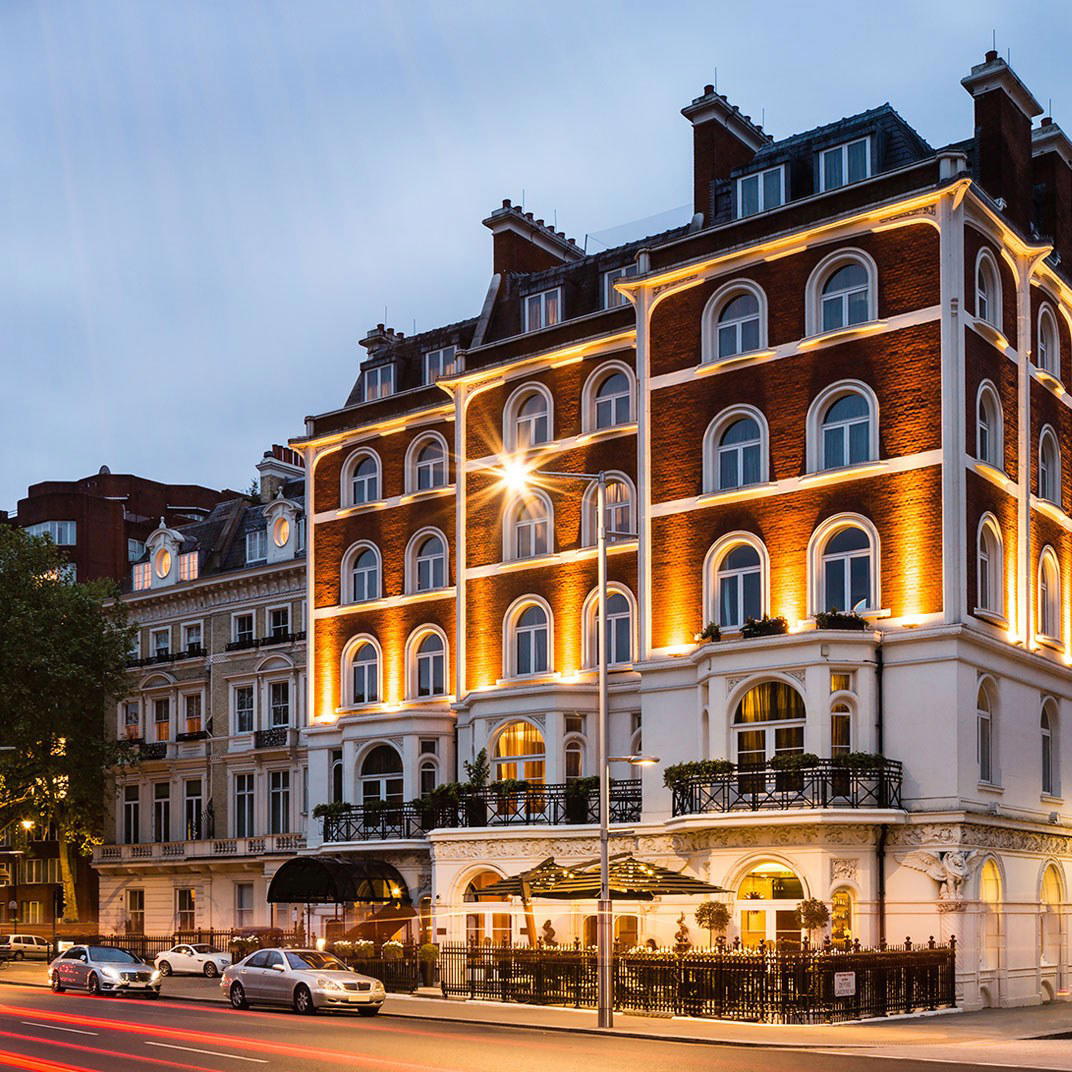
A Kensington Address That Does the Work Quietly
The stretch of Hyde Park Gate that runs south from Kensington Road is one of those London addresses that signals status without announcing it. The street is residential in character, broad enough for a sense of ease, and flanked by the kind of late-Victorian and Edwardian stucco that has housed diplomats, artists, and senior civil servants for well over a century. Winston Churchill lived and died a few doors along. The natural history of the gate sits immediately to the west, and Kensington Palace Gardens is a short walk north. For travellers who measure a London stay by proximity to parks and museums rather than proximity to a nightlife corridor, this is an argument made in bricks and mortar.
London's premium hotel sector has developed along two clear lines over the past decade. One trajectory runs through the grand-institutional model — the Claridge's, the The Savoy — where scale, dining, and event infrastructure are part of the proposition. The other runs through smaller, address-led properties where the hotel itself recedes and the neighbourhood carries much of the experiential weight. 60 Hyde Park Gate belongs firmly to the second category. It competes not on facilities count but on the quality of a specific location, on the character of its rooms, and on a service model suited to guests who know exactly where they are and why they chose it.
The 2025 Michelin Selected Hotels list, a companion to the restaurant guides, operates as a quality filter rather than a ranking. Selection indicates that Michelin's inspectors found the property to meet a standard of comfort, maintenance, and hospitality worth recording. For a smaller townhouse property without the name recognition of The Connaught or the design profile of NoMad London, that inclusion matters as a third-party signal.
In practical terms, Michelin Selected status tends to correlate with a particular style of attention. Properties that earn it typically maintain a tighter focus on the physical condition of rooms, on personalised service, and on anticipating guest needs that a purely transactional hotel operation would leave to the guest to raise. The selection is current for 2025, making it the most recent available verification of the hotel's standing.
Service at This Scale: What Small Actually Means
The editorial argument for townhouse hotels in London consistently comes back to the same point: at a certain size, the relationship between staff and guest changes materially. The anonymity that is an unavoidable by-product of a 300-room hotel, where front-desk staff cycle through hundreds of check-ins and the concierge desk operates more like a booking agency than a conversation, does not apply in the same way at a property of this character. Guests at smaller addresses in Kensington tend to be remembered, preferences noted, and requests answered without the internal routing that larger operations require.
This is not to romanticise boutique scale. A small hotel that is under-resourced delivers worse service than a well-run large one. But a well-resourced small hotel, with staff-to-guest ratios that allow for actual engagement, can personalise a stay in ways that are structurally impossible at volume. The neighbourhood context reinforces this: Hyde Park Gate is not a hotel-dense street, which means the guest profile skews toward return visitors and those who have made a deliberate choice rather than a convenience booking.
For guests arriving by air, Heathrow is the natural gateway, with the Piccadilly line's Gloucester Road or High Street Kensington stops both within manageable distance of Hyde Park Gate. The area also sits well for guests using the Elizabeth line into Paddington and transferring south. Those arriving by Eurostar at St Pancras have a direct route on the Circle or District line to High Street Kensington. The lack of a hotel-operated garage is typical of this part of Kensington, and self-drive guests should expect to use NCP facilities or the local resident permit zone arrangements.
Kensington's Hotel Ecology and Where This Property Sits
South Kensington and the streets immediately around Hyde Park Gate occupy a specific niche in London's accommodation geography. The area is dense with cultural infrastructure, the Victoria and Albert Museum, the Natural History Museum, the Science Museum, and the Royal Albert Hall, and historically attracts an international visitor profile oriented toward arts, culture, and extended stays. This is not the corporate hotel corridor of Mayfair or the restaurant-driven pull of Soho.
Within that ecology, the choice set for premium travellers in this postcode runs from large, branded addresses with full amenity stacks through to private, serviced apartments and character hotels like 60 Hyde Park Gate. Those who want the experiential density of Raffles London at The OWO or the design-forward credentials of The Emory will find those properties operating on a different scale and in different parts of the city. The trade-off here is deliberate: less lobby spectacle, more address, more quiet, and a service model that depends on knowing who is in the building.
Travellers extending into the wider UK after a London stay have strong options accessible from this base. The Lime Wood in Lyndhurst in the New Forest, Estelle Manor in North Leigh in Oxfordshire, and The Newt in Somerset in Castle Cary each represent a different register of English countryside hospitality for those adding rural legs to a city trip. Further afield, Gleneagles in Auchterarder and Crossbasket Castle in High Blantyre anchor the Scottish circuit for those continuing north. For the full London dining and hotels picture, the Our full London restaurants guide covers the relevant context across neighbourhoods.
Internationally, guests arriving via London who then need a European city base will find comparable townhouse-scale quality in different registers: Hôtel de Paris Monte-Carlo in Monte Carlo operates at a very different price and spectacle tier, while Badrutt's Palace Hotel in St. Moritz occupies its own alpine-institutional category. The comparison is useful not because these are direct peers but because they clarify the spectrum: 60 Hyde Park Gate sits at the quieter, more residential end of premium, where the city does the lifting.
Planning a Stay: What to Know Before Booking
Kensington properties at this tier tend to book at variable lead times depending on the season and the reason for travel. The weeks around Chelsea Flower Show in May, major exhibitions at the V&A, and the Proms season at the Royal Albert Hall from July through September all compress availability in this postcode specifically. Guests with fixed dates in those windows should plan accordingly. The 11 Cadogan Gardens in Chelsea and 1 Hotel Mayfair are alternatives in adjacent premium areas for travellers who find Hyde Park Gate fully committed during peak periods.
Category Peers
| Venue | Price | Awards |
|---|---|---|
| 60 Hyde Park Gate HotelThis venue — the venue you are viewing | Not listed | Michelin Selected |
| The Connaught | $1,000–1,500 | 3 Michelin Keys · World's 50 Best #49 |
| Raffles London at The OWO | $1,000–1,500 | 3 Michelin Keys · World's 50 Best #28 |
| Bvlgari Hotel London | Not listed | 2 Michelin Keys · La Liste Top Hotels |
| JW Marriott Grosvenor House London | Not listed | Forbes Recommended |
| The Cadogan, A Belmond Hotel, London | $1,000–1,500 | 2 Michelin Keys · La Liste Top Hotels |
Recognition history
Dated appearances from independent guides and award organizations, with the underlying list record or original source where available.
Michelin Selected
Michelin
Continue exploring
More in London
Hotels in London
Browse all →
Bars in London
Browse all →
Restaurants in London
Browse all →



Details
- Ornate
- Elegant
- Sophisticated
- Romantic
- Romantic Getaway
- Anniversary
- Business Trip
- Celebration
- Historic Building
- Design Destination
- Garden
- Terrace
- Panoramic View
- Wi Fi
- Spa
- Fitness Center
- Room Service
- Concierge
- Restaurant
- Bar
- Valet Parking
- EV Charging
- Garden
- Street Scene
- Elevator
- Accessible Restroom
Luxurious and decadent with rich textures of ebony, velvet, gold leaf, and black lacquer; dark, masculine, and romantic aesthetic with plush furnishings and warm hospitality.