← Guides
Russia absorbs 66% of Georgian wine exports—then raised excise taxes. Here's which producers are genuinely pivoting West, and which remain tethered to Moscow.
Russia absorbs 66% of Georgian wine exports—then raised excise taxes. Here's which producers are genuinely pivoting West, and which remain tethered to Moscow.
Patrick Honnef poured a 2019 Château Mukhrani Tavkveri, pale, spiced, made from one of Kartli's rarest indigenous red grapes, and said the quiet part out loud: if Russia closes the market for Georgian wines, 90 percent of sales disappears. That is not a hypothetical.
In the first eight months of 2025, Georgian wine exports fell 15.8 percent after Russia raised excise taxes on imported alcohol, with shipments to Russia down 24 percent year-over-year, according to Georgia's National Statistics Office.
Russia now absorbs 66 percent of all Georgian wine shipped abroad, the highest share since before the 2006 ban that once wiped out half the country's export volume overnight.
Understanding which producers are genuinely executing a Georgian wine western pivot, and which are hoping Moscow doesn't pull the lever again, is the question every collector and trade buyer should be asking right now.
The 2006 Russian wine ban is the reference point every Georgian producer carries. Russia's official justification was pesticide contamination; Georgia's then-president Mikheil Saakashvili called it a political decision tied to his NATO ambitions. The embargo caused an immediate 50 percent loss in exports, and Georgian wine did not recover its pre-ban volume until 2013, the same year Russia lifted the restrictions. Seven years of rebuilding, compressed into a single political act.
What followed was not diversification. It was drift. Producers who had scrambled for European and American footholds during the embargo found the Russian market reopening and, with it, the familiar pull of volume, proximity, and a consumer base that already knew Georgian wine. By 2024, Russia's share of Georgian wine exports had climbed to 66 percent, the highest since before the ban. Then Moscow raised excise taxes on imported alcohol, and the 15.8 percent export collapse of 2025 arrived like a bill that had been accumulating for a decade.
Tamta Shvangiradze, an economics professor at Kutaisi International University, has said publicly that Russia can close the market anytime, and she was not speaking hypothetically. At Georgia's National Wine Day conference in Tbilisi, the debate between export-diversification advocates and Russia-market pragmatists played out in real time.
The pragmatists have a point: the U.S. market is not a ready substitute for Russian volume. The diversification advocates have a harder point: neither is continued dependency. The 66 percent figure is not just a market-share statistic, it is the number that determines whether a Georgian producer survives a political decision made in Moscow.
Every conversation about the Georgian wine western pivot begins and ends with it.
The stakes are existential in a way that export charts alone don't convey. Georgia has already lived through the scenario once. It took seven years to recover. The producers who rebuilt fastest after 2006 were the ones with Western market relationships already in place, not the ones who started building them after the ban landed. That history is one important context for reading every producer decision described below.
Patrick Honnef has spent 12 years as winemaker at Château Mukhrani, a historic estate in Georgia's Kartli region, and he carries the geopolitical bind of Georgian wine in a single sentence. "If we lean too much to the west, we're in trouble. And if we lean too much to the north, we're in trouble," he said.1 The estate is part of Marusia Beverages, a Swedish-owned distribution group more focused on spirits than wine, a structural mismatch that has cost Château Mukhrani American momentum. A decade in channels not designed for fine wine placement is difficult to reverse quickly.

The anxiety runs deeper than distribution. A rumor is circulating among European-linked Georgian producers that any European-owned company could be moved to a Russian "bad list", effectively frozen out of the market. Château Mukhrani, with its Swedish ownership through Marusia Beverages, sits squarely in that exposure zone. Honnef is direct about what a Russian market closure would mean: if Russia closes the market for Georgian wines, 90 percent of sales disappears, because Western consumers still do not buy enough Georgian wine to fill that gap. That is precisely why he was in the room making the case for American attention.
What Château Mukhrani has going for it is terroir credibility and a brand identity built around European-style winemaking in Kartli, a region less associated with the amber qvevri wines that dominate Western coverage of Georgian wine, and more aligned with the kind of estate-driven prestige positioning that translates to on-premise placement in London, New York, or Stockholm.
The 2019 Château Mukhrani Tavkveri, pale, spiced, from one of Kartli's rarest indigenous varieties, is the kind of wine that earns a sommelier's attention precisely because it is genuinely unlike anything else on a list.
The challenge is that "genuinely unlike anything else" is a harder sell at scale than it sounds, and Marusia's distribution infrastructure was never engineered for that conversation.
For collectors tracking the Georgian wine western pivot at the producer level, Château Mukhrani is one structurally interesting case: the brand identity and terroir are there, the ownership and distribution are misaligned, and the window for correcting that misalignment is narrowing. Kartli labels from this estate, particularly the indigenous varietal bottlings, are worth adding to your watchlist before U.S. distribution catches up, or before the ownership question forces a change. The scarcity is real: Tavkveri is one of the rarest red varieties in Kartli, and allocations reaching Western markets remain thin.
The Joseph-Kublashvili collaboration is also a signal of how Kakheti producers are seeking Western wine-trade credibility. Bringing in a British consultant with international market relationships is a different kind of western pivot than adding five U.S. importers, it is a bet on winemaking language and positioning that Western buyers already understand.
Khareba's Russian dependency problem is, at least, already solved. The question now is whether its scale and Soviet-era infrastructure can be repositioned convincingly for premium Western placement, and whether the tunnel cave tourism operation can generate enough direct consumer loyalty to support that repositioning from the ground up.
Khareba Winery in Kakheti is a different kind of Georgian producer, vast in scale, Soviet in origin, and already through the worst of its Russian market exposure. British wine consultant Robert Joseph, who has a joint wine project with Khareba's chief winemaker Vladimer Kublashvili, notes that Russian exports for the company dropped from roughly 25 percent before the Ukraine war to approximately one percent today. The mechanism was financial rather than strategic: Russian sanctions made dollar-denominated bank transfers for wine sales effectively unworkable, forcing a de facto exit from the market.
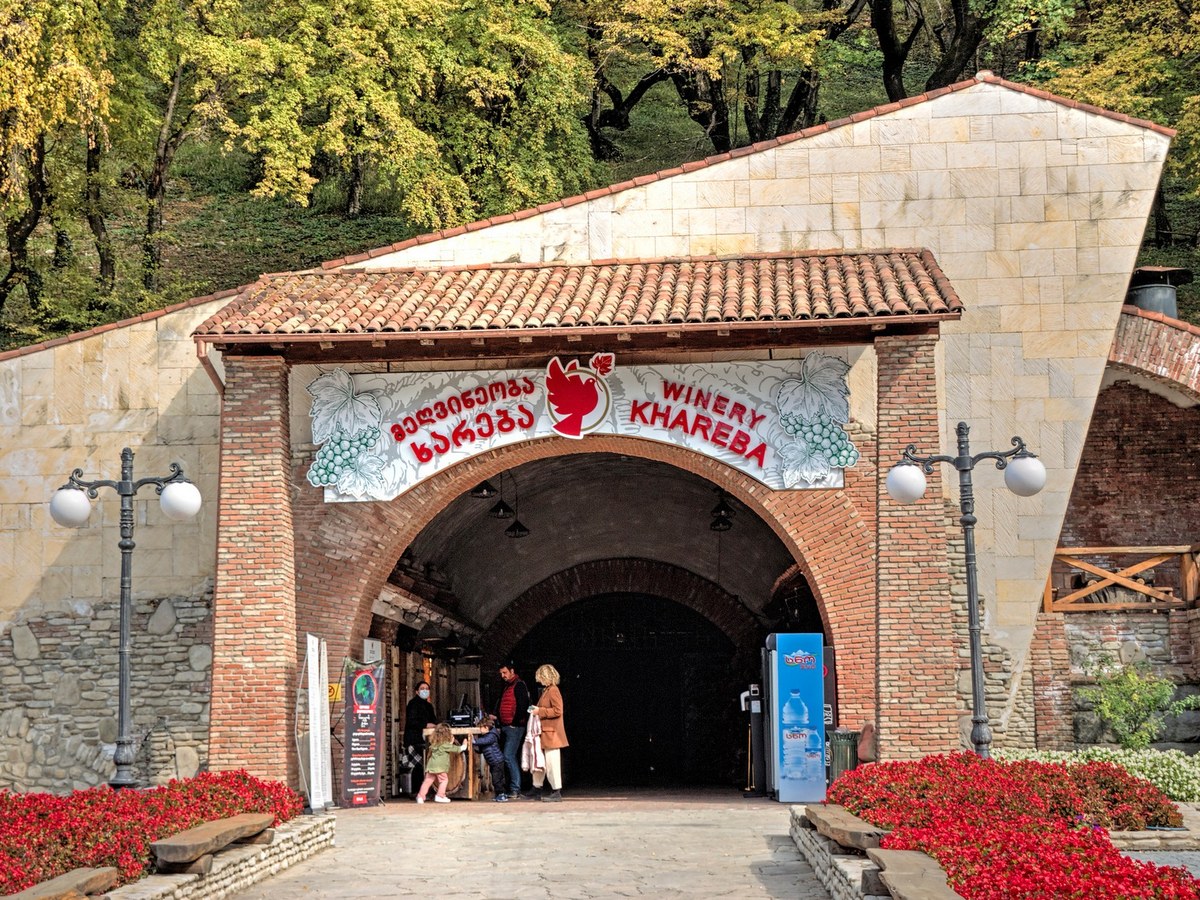
That exit, however painful at the time, has left Khareba in a structurally stronger position than producers still running 40 or 66 percent of their volume through Moscow.
The winery's tunnel cave system, carved into the Caucasus rock in Kakheti, has become a deliberate non-Russian revenue asset, anchoring a wine tourism operation that builds brand recognition outside the export channel entirely.
Visitors who walk those caves and taste through Khareba's range are not just buying bottles; they are building the kind of direct brand relationship that translates into international word-of-mouth, sommelier interest, and the slow accumulation of Western market presence that no export chart captures cleanly.
Among Georgia's top-five producers by volume, Teliani Valley is the clearest indicator of whether large Georgian producers can realistically execute a western pivot, because it is especially exposed to the dependency they need to escape. Roughly 40 percent of Teliani Valley's wine still goes to Russia, according to export manager Shota Natroshvili, who describes the industry's relationship with Russian market volatility with a kind of earned fatalism. He has said that the company is used to adapting to new rules every year, frustrating, but familiar.
That adaptation is now pointing West. Teliani Valley has added five importers in five new U.S. states, a concrete, measurable move in a market that rewards patience and relationship-building over volume. Natroshvili's observation that U.S. distributors who showed no interest two years ago are now actively seeking new sources captures something real about the current American market moment: with overall U.S. wine imports down 8 percent in late 2025 into early 2026, importers are hunting for differentiated stories rather than more of the same.
Georgian wine, with its 8,000-year winemaking history and a varietal lineup that no other country can replicate, offers exactly that differentiation, if producers can get the positioning right.
The structural challenge for Teliani Valley is volume. A top-five Georgian producer cannot replace Russian market share with five new U.S. importers on any timeline that matters in the short term. The U.S. three-tier distribution system, where producers must work through importers, who sell to distributors, who sell to retailers and restaurants, each layer adding margin and complexity, was not designed to absorb large volumes of unfamiliar wine quickly. Teliani Valley's U.S. expansion is real and directionally correct, but it is a multi-year project running against a dependency that could be disrupted by a single Moscow policy decision. The five-state importer network is the foundation; it is not yet the house.
At Tchotiashvili Family Vineyards, a 16-hectare estate in Kakheti run by brothers Kakha and Ucha Tchotiashvili, the western pivot is not a strategic response to the 2025 export crisis, it was the original plan. Kakha Tchotiashvili does not sell to Russia, though he has heard that his wines end up there anyway, purchased somewhere along the supply chain and redirected without his knowledge. His focus is elsewhere: his wines are in U.S. restaurants, and he travels personally to meet every sommelier who carries his bottles.
That personal-relationship model is the small-producer path to Western markets, and it works, slowly, selectively, and at a scale that cannot be replicated by a top-five volume producer. A 16-hectare Kakheti estate making qvevri-aged amber wines is exactly what U.S. natural-wine buyers are looking for: ancient vessel, indigenous variety, a family name and a face behind the label. The U.S. natural wine community has already demonstrated its appetite for Georgian amber wines, the qvevri-fermented, skin-contact whites that predate the contemporary natural wine movement by several millennia, and Kakheti's indigenous varieties are finding their way onto lists at the kind of wine-forward restaurants where Georgian wine earns its most credible American introductions.
The barrier is distribution, not demand. Getting a 16-hectare Kakheti estate into five U.S. cities requires an importer willing to invest in education, a distributor willing to carry a SKU that needs explanation, and a sommelier willing to put it on a list where it will require a conversation at every table.
Each of those steps is achievable, Tchotiashvili is clearly achieving them, but none of them scale quickly. The Georgian wine western pivot for small producers is real, but it is narrow, and it depends on the kind of hands-on market cultivation that only works when the producer is willing to get on a plane. Kakha Tchotiashvili is getting on the plane.
That is the signal.
Master of Wine Lisa Perrotti-Brown's assessment at the Tbilisi conference was especially useful framing among the American opportunity that Georgian producers have received from an outside voice. U.S. wine imports fell 8 percent in late 2025 into early 2026, and consumption is contracting. And yet the $15 to $49 price category is outperforming, and consumers are actively searching for something new. Georgia, she argued, has a genuine story of discovery to tell, indigenous varieties, an ancient winemaking tradition, a flavor profile that exists nowhere else, but it needs to focus. Too many choices overwhelm the consumer.
Her specific recommendation for anchoring the Georgian wine western pivot was Saperavi. "Just like Argentina has Malbec, just like France has Cabernet, Georgia has Saperavi," she said. "It is probably the grape that can go global. It has a name that is relatively easy to pronounce.
It has a meaning, Saperavi means dye in Georgian, a reference to the grape's extraordinary pigmentation. It has structure, it has balance. It is not hard to like." The Malbec comparison is instructive: Argentina spent decades building a single-variety identity in Western markets, and that focus created the platform for everything else.
Georgia has not yet made that commitment at scale.
Georgian wine exports to the U.S. grew at a 15.5 percent compound annual growth rate from 2021 to 2024, a foundation being built, not a market already won. The gap between that growth rate and Russia's 66 percent share of overall exports is the number that defines Georgia's current situation. The U.S. three-tier distribution system adds structural friction at every stage: importers require minimum volumes and marketing support, distributors need margin and turnover, and state-by-state licensing means that adding five new U.S. states, as Teliani Valley has done, is a meaningful operational achievement rather than a simple commercial decision.
The producers already positioned for Western markets share a common characteristic: they made the choice before the crisis, not because of it. In Kartli, natural winemaker Iago Bitarishvili has never exported to Russia, his wines go to Italy, France, the UK, Japan, and the U.S. His reasoning was precise: Russia grants wine registration only to large producers, the regulations are suffocating, and he prefers markets where wine culture is sophisticated enough to receive his wines honestly. When asked why he never sold to Russia, he looked slightly puzzled. "I don't even sell in Georgia," he said. "Why would I need Russia?"
That clarity of positioning is exactly what the U.S. market rewards, and exactly what is hardest to manufacture after a decade of Russian market dependency. For collectors and trade buyers tracking the Georgian wine western pivot, the early-mover signal is not the producers announcing U.S. expansion in 2025. It is the producers who were already there: the Kartli natural winemakers, the small Kakheti family estates, the labels that U.S. sommeliers already know by name. Those are the bottles to find now, before the broader Georgian pivot brings the rest of the country's wine into Western consciousness and makes the discovery feel less like one.
Georgia's winemaking history stretches back 8,000 years. Whether its wine industry can reduce a 66 percent Russian dependency before Moscow decides, again, that the lever is worth pulling, that is the question that will define the next decade of Georgian wine, and the answer will be written producer by producer, importer by importer, and bottle by bottle.

What is the Georgian wine western pivot and why does it matter now?
The Georgian wine western pivot refers to efforts by Georgian producers to shift export sales toward European and American markets rather than relying on Russia. It matters urgently because Russia currently absorbs 66 percent of all Georgian wine exports, and a 2025 excise tax hike already caused a 15.8 percent collapse in total export volume.
How much did Georgian wine exports fall in 2025?
Georgian wine exports fell 15.8 percent in the first eight months of 2025, according to Georgia's National Statistics Office. Shipments specifically to Russia dropped 24 percent year-over-year after Moscow raised excise taxes on imported alcohol.
What happened to Georgian wine exports during the 2006 Russian ban?
Russia's 2006 embargo caused an immediate 50 percent loss in Georgian wine exports, and the country did not recover its pre-ban volume until 2013 when Russia lifted the restrictions. That seven-year recovery period is the historical benchmark producers and collectors use to assess the risk of renewed market closure.
Which Georgian wine producers are genuinely executing a western pivot versus depending on Russia?
Château Mukhrani is one producer actively navigating this question, though its ownership by Marusia Beverages, a Swedish spirits-focused group, has hampered American market momentum. Winemaker Patrick Honnef has acknowledged the structural tension publicly, noting that leaning too far toward either market creates its own risks.
What is Tavkveri and why is it significant to the Georgian wine western pivot strategy?
Tavkveri is a rare indigenous red grape variety from Georgia's Kartli region, used by Château Mukhrani in wines like their 2019 vintage. Positioning rare indigenous varieties as prestige products is central to the western pivot argument, since differentiation on authenticity and terroir is one credible path to premium Western market placement.
Get the App
Take the shortlist into the En Primeur Club app for concierge access, saved places, and the next step after discovery.
Get Exclusive AccessMore from the editors