Sake Bar Decibel
One of the East Village's longest-running sake bars, Decibel has occupied its below-street-level address on East 9th Street since 1993, offering one of New York's most serious sake selections in a dim, graffiti-covered basement setting. The bar sits within a small peer group of American venues where sake curation, not cocktails or wine, drives the program.
Pearl is the En Primeur Club membership app — saves, bookings, and concierge access live there. Same editors, same standards.
- Address
- 240 E 9th St, New York, NY 10003
- Phone
- +1 212 979 2733
- Website
- sakebardecibel.com
- Directions
- Get directions
 Saves & bookings on Pearl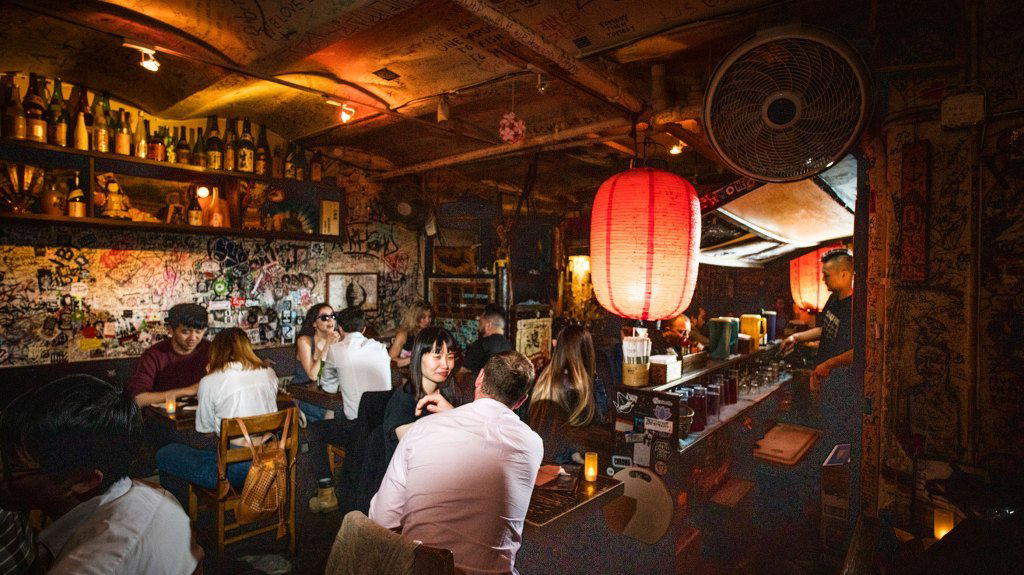
Thirty Years Below Street Level: East Village and the Sake Bar That Outlasted Every Trend
When Sake Bar Decibel opened on East 9th Street in 1993, sake was not a category that New York's bar scene took seriously. The wine world was moving toward Burgundy and Barolo; the cocktail revival was still a decade away. A basement bar in the East Village dedicated almost entirely to nihonshu occupied a position so niche it bordered on eccentric. That it survived, and that it survived long enough to watch sake gradually earn column inches in serious publications, says something meaningful about the category and about the tenacity of the lower-Manhattan neighbourhood bar as a format. For context on how New York's bar scene has developed across categories and neighbourhoods, see our full New York City restaurants guide.
The Sake List as the Point of the Room
Bars built around a single beverage category tend to succeed or fail on the depth and coherence of that category's curation. Decibel's program sits in a tier of American sake bars where the list is genuinely wide, running from accessible junmai and honjozo pours to aged koshu styles and limited-release daiginjo that rarely reach retail shelves in the United States. This is the editorial core of what Decibel represents: not a venue that serves sake alongside a full cocktail program, but one where sake is the organizing principle. In that respect, it resembles specialist operations like Kumiko in Chicago, where a single beverage tradition structures the entire experience, or Bar Leather Apron in Honolulu, where precision of curation defines the room.
The distinction between sake grades matters here and Decibel's list engages with those distinctions rather than flattening them for accessibility. Junmai daiginjo, milled to at least fifty percent of the original rice grain and fermented without added alcohol, sits at the top of the taxonomy for good reason: the category rewards careful temperature control and attentive service, both of which are easier to execute at a focused sake bar than at a general-audience restaurant offering sake as an afterthought. Koshu, aged sake that develops amber colour and deeper umami notes, remains rare on American lists because the category is unfamiliar and requires the operator to educate the guest rather than rely on existing demand. That Decibel has carried it consistently is a data point about the seriousness of the program.
What the Room Signals Before You Order
The physical space functions as an argument about atmosphere. The descent below street level onto East 9th Street, the low ceilings, the graffiti covering walls that have absorbed decades of use, the narrow stools along a bar running the length of a small room: none of this is accidental, and none of it resembles the polished-concrete aesthetic that has come to define the premium bar tier in Manhattan. Decibel's atmosphere belongs to an older East Village register, one that predates the neighbourhood's gentrification into boutique hotels and chef-driven tasting menus. In that sense the room carries its own trust signal, separate from any award or press citation: the signal is longevity in a neighbourhood that has turned over almost completely since 1993.
East Village bar scene now includes operations across a wide range of categories and formats. Amor y Amargo runs a focused amaro program a short walk away; Angel's Share, the Japanese-influenced cocktail bar that shares the neighbourhood's Japanese dining heritage, occupies a different format but comparable longevity. Decibel sits alongside these as part of a cohort of single-focus beverage bars that have outlasted multiple waves of trend cycling in lower Manhattan. Outside New York, analogues exist in cities where beverage programs have depth and point of view: Jewel of the South in New Orleans and Allegory in Washington, D.C. both operate with similar curatorial discipline in their respective categories.
Sake as a Beverage Tradition, Not a Novelty
American engagement with sake has followed a familiar arc. Early exposure came through sushi restaurants, where sake was served hot and treated as background beverage rather than the subject of a drink. The past decade has shifted that considerably. Specialist importers have expanded the range of styles reaching American shelves; sommeliers with sake credentials have started appearing in serious wine programs; and a small number of bars have started treating nihonshu with the same structured curation applied to wine or whisky. Decibel predates this shift by at least fifteen years, which means it built its program without a mainstream framework to reference and without a ready audience trained to appreciate the distinctions it was drawing.
That historical positioning distinguishes Decibel from the current generation of sake-forward venues, which enter a market where customer education has at least begun. The bar's longevity also gives it a specific kind of authority: it has remained coherent through multiple shifts in what the New York bar market considered serious or fashionable. That is a harder test than opening with critical momentum. For comparison, consider how Superbueno and Attaboy NYC have each built authority within their respective categories by maintaining program coherence over time, and how ABV in San Francisco and Julep in Houston demonstrate what sustained category focus looks like across different American cities. The Parlour in Frankfurt on the Main shows that the single-category specialist format is not limited to American bar culture either.
Planning Your Visit
Decibel is at 240 East 9th Street in the East Village, accessible by subway from the 6 train at Astor Place or the L at First Avenue. The bar runs late, which places it in a category of East Village operations leading treated as a second or third stop on an evening rather than a standalone dinner destination. Small plates are available and pair reasonably with the sake program, though the room's identity is built around the list rather than the kitchen. Reservations: walk-in is standard practice for the format, though the basement space is compact and fills on weekends. Dress: no code; the room is deliberately casual. Budget: sake by the glass pricing varies by grade, with premium daiginjo and aged styles at the higher end of the range; expect a spend in line with a serious wine-by-the-glass program at a neighbourhood bar rather than a high-volume cocktail operation.
Continue exploring
More in New York City
Bars in New York City
Browse all →

Restaurants in New York City
Browse all →
Hotels in New York City
Browse all →




At a Glance
- Intimate
- Trendy
- Cozy
- Late Night
- Casual Hangout
- Speakeasy
- Seated Bar
- Sake
Current opening hours
- Monday
- Closed
- Tuesday
- 6 PM–12 AM
- Wednesday
- 6 PM–12 AM
- Thursday
- 6 PM–1 AM
- Friday
- 6 PM–2 AM
- Saturday
- 6 PM–2 AM
- Sunday
- Closed
Hours can change for holidays and private events. Last verified .
Dark graffiti-covered basement with loud punk music, tea lights, vermillion lanterns, and crowded intimate atmosphere.
Know Before You Go
- Getting there
- 240 E 9th St, New York, NY 10003