
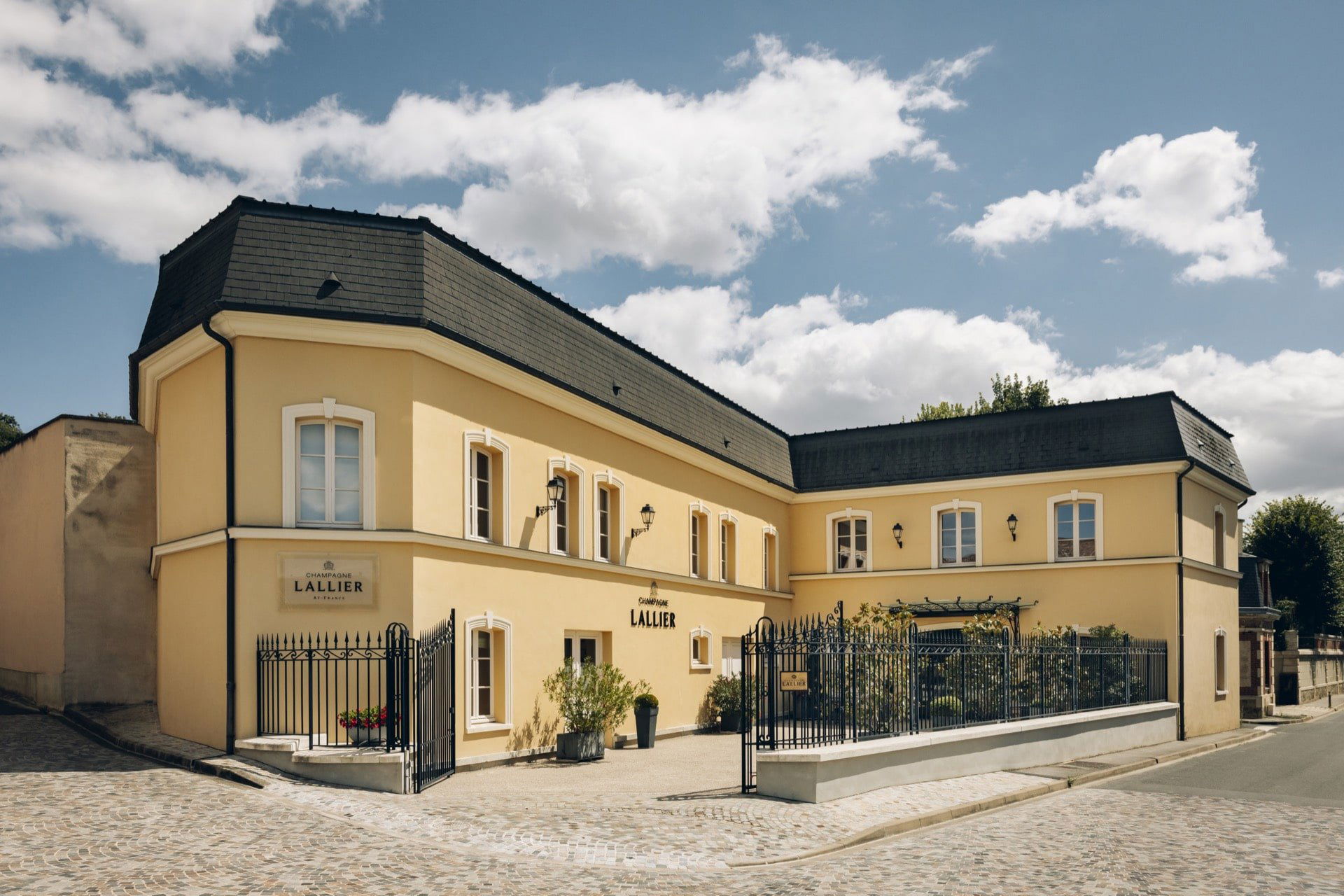
Lallier operates from the heart of Aÿ-Champagne, one of the region's most storied Grand Cru villages, earning a Pearl 3 Star Prestige rating in 2025. The house positions itself within a small cohort of grower-influenced Champagne producers who prioritise vineyard provenance over volume. For those tracing the Marne Valley's serious wine addresses, it belongs on the itinerary.
Aÿ and the Architecture of Grand Cru Champagne
The village of Aÿ sits in a short stretch of the Marne Valley where the geology tilts in Champagne's favour: south-facing chalk slopes, a microclimate buffered by the river, and a Grand Cru classification that dates back centuries. What happens here has shaped how the world understands Pinot Noir's role in sparkling wine. The grandes maisons that built their reputations in Reims and Épernay sourced fruit from this village; some, including Bollinger and Deutz, planted their flags in Aÿ itself. Lallier, addressed at 4 Place Libération in the village centre, is part of that concentration of serious Champagne production in a single Grand Cru commune.
The competitive context here matters. Aÿ hosts a cluster of houses that operate at entirely different scales but draw on the same classified terroir. Ayala sits nearby; Philipponnat, anchored in Mareuil-sur-Aÿ just minutes away, has built its identity around the Clos des Goisses monopole. The competition is not for visibility but for credibility among a buyer cohort that reads vintage charts and pays attention to disgorgement dates. Lallier's 2025 Pearl 3 Star Prestige recognition places it inside this serious tier.
Viticulture at the Core: What Champagne's Leading Terroir Demands
Argument for terroir-led Champagne production rests on a specific premise: that the soil, slope, and microclimate of a classified site can express themselves in the glass, provided the viticulture does not interrupt the signal. In Champagne, that argument has been complicated for decades by the sheer industrial scale of the region's output. The volumes required to supply the global non-vintage market have historically pushed yields high and chemical inputs wide. The counter-movement, gathering pace since the early 2000s, has been led by growers and smaller houses willing to accept lower yields in exchange for fruit that carries a genuine address.
Grand Cru villages of the Marne Valley sit at the centre of this shift. Producers in Aÿ, Ambonnay, and Bouzy have the advantage of exceptional raw material: chalk subsoils that stress vines productively, old vine parcels with natural canopy balance, and aspect angles that allow Pinot Noir to ripen fully without sacrificing acidity. Sustainable and organic viticulture in this context is not a marketing position. It is the logical response to owning or sourcing from parcels that took generations to classify. The approach aligns with what peers elsewhere in France have demonstrated: at Albert Boxler in Niedermorschwihr, meticulous attention to individual vineyard plots has produced Alsace wines that track directly to their classified lieux-dits. The discipline is the same.
Broader European fine-wine world is converging on this position. Houses as varied as Abadía Retuerta in Sardón de Duero and Château Bastor-Lamontagne in Preignac have made vineyard stewardship a central element of how they position themselves to collectors. In Champagne, where the finished wine's identity has long been shaped in the cellar rather than the vineyard, the shift of emphasis back toward the vine is a structural change in how producers signal quality.
The 2025 Pearl 3 Star Prestige Recognition
Pearl 3 Star Prestige award Lallier received in 2025 places it within a cohort of Champagne producers that have earned recognition not for volume or commercial visibility, but for the quality signals embedded in their production approach. In the context of Aÿ, where several of the region's most awarded addresses operate, this tier of recognition carries weight precisely because the peer set is strong. Houses like Billecart-Salmon have spent decades building their reputations on consistent prestige cuvée production; the standards that accreditation bodies apply in this village reflect that history.
For buyers and visitors using award data to orient their Champagne exploration, a Prestige-tier recognition in Aÿ is a meaningful signal. It suggests production decisions, whether in the vineyard, the cellar, or the disgorgement programme, that align with what serious collectors expect from a Grand Cru address in the Marne Valley.
Reading Aÿ Alongside the Wider Region
Aÿ does not stand alone as an argument for terroir-expressive Champagne. The Marne Valley cluster, taken as a whole, represents the clearest case in the region for place-specific production. What distinguishes individual houses within it is the combination of vineyard access, cellar philosophy, and the willingness to let the vintage character speak rather than smooth it into a consistent house style. Producers who commit to this approach tend to attract a buyer who cross-references with the same discipline they bring to Burgundy premiers crus or Northern Rhône single-vineyard whites.
The analogy extends geographically. The kind of attention to provenance and process that defines the serious end of Aÿ production has parallels in aged spirits and fortified wine: Aberlour in Aberlour and Chartreuse in Voiron both operate in categories where production method and provenance have become primary quality signals rather than secondary marketing claims. The pattern across these producers is consistent: constraint as a quality mechanism, place as identity.
Planning a Visit to Aÿ
Aÿ is not a destination that requires elaborate logistics. The village sits roughly five kilometres from Épernay, making it accessible by car from either direction along the D1 river road. Visitors spending more than a day in the Champagne region should use Épernay as a base and fold Aÿ into a morning or afternoon rather than treating it as a separate trip. For accommodation, dining, and the broader scope of what the village offers, the Aÿ hotels guide and Aÿ restaurants guide provide practical orientation. The Aÿ wineries guide maps the full producer landscape in the village, and for those building a complete itinerary, the Aÿ experiences guide and Aÿ bars guide round out the picture.
Visiting Champagne houses in small Grand Cru villages generally rewards advance planning. Many operate appointment-only tastings with limited weekly capacity, particularly during harvest in September and October and during the busy spring tourism window. The autumn period, after harvest, tends to offer the most engaged cellar visits, when the season's work is fresh and the technical team is available to discuss what the year produced. Timing a visit to Aÿ in that window, when the 2025 vintage's character begins to be understood, gives the visit a specificity that summer tourism rarely matches.
The Argument for Aÿ as a Champagne Reference Point
Among the villages that define what Grand Cru Champagne can be, Aÿ makes a concentrated case. The density of serious producers within a single commune, the historical classification of its slopes, and the current shift toward viticulture that respects rather than overrides that classification, together create an address that functions as a reference point rather than a stop on a tourist route. Lallier, at Place Libération with its 2025 Prestige recognition, sits within that reference cluster. The village rewards the kind of visitor who arrives with questions about how chalk and slope and production philosophy interact, and leaves with answers that change how they open a bottle.
Budget and Context
A fast peer set for context, pulled from similar venues in our database.
| Venue | Classification | Awards | First Vintage | Notes |
|---|---|---|---|---|
| Lallier | 1 awards | This venue | ||
| Philipponnat | World's 50 Best | 1522 | ||
| Billecart-Salmon | World's 50 Best | 1818 | ||
| Bollinger | World's 50 Best | 1829 | ||
| Ayala | 1 awards | 1882 | ||
| Deutz | 1 awards |
Access the Cellar?
Our members enjoy exclusive access to private tastings and priority allocations from the world's most sought-after producers.
Access the Concierge