King Estate Winery

King Estate Winery sits on a substantial organic estate in the hills southwest of Eugene, Oregon, producing Pinot Noir and Pinot Gris that have made the southern Willamette Valley's cooler, wetter margins a subject of serious attention. Recognised with a Pearl 3 Star Prestige award in 2025, the property combines working vineyard, restaurant, and event space at a scale rare in the region.
 Discover on Pearl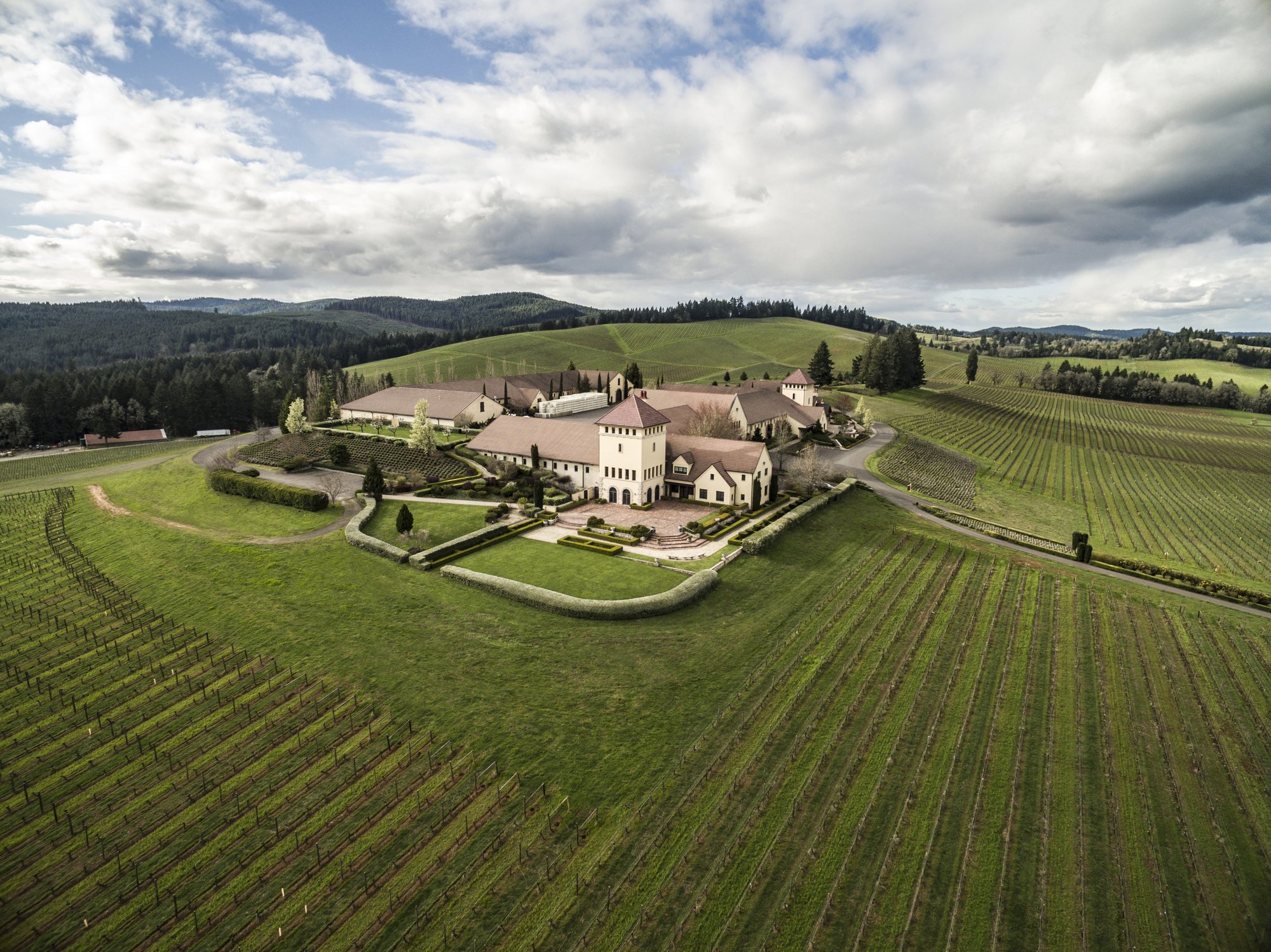
Where the Southern Willamette Begins to Speak for Itself
Drive southwest out of Eugene on Territorial Highway and the valley floor gives way to a rolling, forested upland that feels categorically different from the better-publicised Dundee Hills to the north. The elevation shifts, the canopy closes, and the light arrives at a cooler angle. King Estate Winery sits inside this geography at 80854 Territorial Hwy, and understanding what the estate produces means starting with what that geography actually does to a vine. This is the southern Willamette in a register that doesn't often make the headline comparisons — cooler growing seasons, higher rainfall, and a clay-heavy soil profile that forces roots to work harder and longer for their water. The result, in the hands of a producer serious about organic farming, is Pinot Noir and Pinot Gris shaped by constraint rather than abundance. For context on how Oregon's Pinot-focused estates position themselves across the state's diverse appellations, see Adelsheim Vineyard in Newberg, where the northern Willamette expresses a different set of variables entirely.
Terroir as Argument, Not as Marketing
The Willamette Valley's reputation was built on Pinot Noir, and the grape's sensitivity to site is precisely why the valley's internal geography matters so much. Pinot amplifies everything the soil and climate give it: too warm and it reads as jammy and soft; too wet without drainage and the fruit flattens. The southern reach of the valley around Eugene sits at the edge of what the appellation's consensus calls optimal, and that marginality is either a liability or an asset depending on the vintage and the farming philosophy. Producers who farm organically at this latitude are, in effect, committing to a longer game — organic viticulture in a high-rainfall environment requires more attention, not less, and the decision to do it at scale signals a particular kind of institutional patience.
King Estate has pursued certified organic farming across its estate vineyards, a commitment that in the context of southern Oregon's climate is operationally harder than the same certification would be in, say, Paso Robles. For comparison, Adelaida Vineyards in Paso Robles operates with organic certification in a far drier Mediterranean climate where disease pressure is substantially lower. The difficulty of the task in a maritime-influenced Oregon context is worth factoring into any assessment of what the estate's wines represent as expressions of place.
Pinot Gris is the other grape where the estate's terroir argument gets interesting. Oregon Pinot Gris occupies a distinct stylistic lane from Alsatian versions , less phenolic weight, more immediate stone fruit, and a leaner acid profile that reflects the valley's maritime influence. The grape arrived in the Willamette Valley largely as a complement to Pinot Noir, but a handful of producers have given it standalone attention. At King Estate's scale, Pinot Gris is not a secondary offering but a primary identity, and the estate's elevation and soil type push it toward a structure that holds better with food than much of the category does at lower price points.
Scale, Setting, and What Both Mean for the Visit
King Estate is large by Oregon standards , the estate encompasses hundreds of acres, and the winery complex is built to receive visitors at a volume that most small-production Oregon producers cannot accommodate. This matters for how you plan a visit. The experience here is not the eight-seat tasting room model common to Burgundy-influenced small producers; it is closer to what the Napa Valley has normalised with estate properties that combine tasting, dining, and grounds into a half-day proposition. For a sense of how that model plays out at a California estate with a comparable footprint, Artesa Vineyards and Winery in Napa offers a useful comparison in terms of visitor architecture, though the wine programs differ substantially.
The estate restaurant draws from the farm and from relationships with regional producers, and the food program is not an afterthought bolted onto a winery visit. Restaurants anchored to working farms in the Willamette Valley tend to have a genuine seasonal logic because the supply chain is short and the kitchen has little reason to import what surrounds it. That said, the restaurant operates on its own schedule and booking windows, so visitors planning around a meal rather than a tasting should confirm availability before arrival. The address , 80854 Territorial Hwy , is roughly a 20-minute drive from central Eugene, and the highway is well-signposted heading southwest from the city.
Pearl 3 Star Prestige: What the Recognition Signals
King Estate holds a Pearl 3 Star Prestige award (2025), which places it in the upper tier of EP Club's recognition framework. Within the context of Oregon wine, this positions the estate alongside producers who have earned sustained critical attention across multiple vintages rather than a single standout year. The award reflects the program's scope and consistency rather than a single bottling, which is relevant given that King Estate produces at a scale where vintage variation across a large organic estate is a genuine winemaking challenge.
For comparison, premium Rhône-variety producers on the California coast , such as Alban Vineyards in Arroyo Grande or Andrew Murray Vineyards in Los Olivos , operate with recognition profiles built around the distinctiveness of their varietal focus. King Estate's recognition rests on a different axis: the argument for southern Willamette terroir expressed through organic farming at a scale that makes the commitment verifiable across the full range rather than at the boutique level only.
Napa-focused collectors accustomed to the prestige architecture of estates like Accendo Cellars in St. Helena or Alpha Omega Winery in Rutherford will find King Estate operating in a different register entirely , lower price points, a cooler-climate grape focus, and a visitor experience oriented around landscape and farming rather than cellar theatre. Internationally, the comparison to an estate winery with deep terroir commitment and significant visitor infrastructure might land closer to Abadía Retuerta in Sardón de Duero, where the estate model similarly integrates hospitality with a serious wine program rooted in a specific geography.
Planning Your Visit
Eugene is a practical base. The city sits roughly 110 miles south of Portland along I-5, with regional air service into Eugene Airport for those travelling from outside the Pacific Northwest. King Estate is accessible only by car from Eugene, with the Territorial Highway drive itself offering a read on the terrain before you arrive at the estate. Visitors combining the estate with broader Willamette Valley wine exploration would do well to check our full Eugene wineries guide for context on how King Estate sits relative to the valley's other producers.
Eugene's food and hospitality scene has developed enough character to merit a proper itinerary. Our full Eugene restaurants guide, our full Eugene hotels guide, our full Eugene bars guide, and our full Eugene experiences guide cover the city's full range, from lodging in the university-adjacent neighbourhoods to the handful of serious dining rooms that have made the city more than a corridor stop between Portland and the coast.
For winery visits, early autumn is the period when the estate is most operationally active and when the harvest context gives the tasting experience its fullest dimension. Spring visits are quieter and offer a different visual read on the estate's farming , cover crops still green, the vineyard rows showing the character of organic management in the months before canopy close. Both seasons reward visitors who book ahead for any dining component and arrive with enough time to walk the property rather than simply moving through the tasting room.
Frequently Asked Questions
Peer Set Snapshot
These are the closest comparables we have in our database for quick context.
| Venue | Awards | Notes |
|---|---|---|
| King Estate Winery | Pearl 3 Star Prestige | This venue |
| Robert Mondavi Winery | 50 Best Vineyards #39 (2025); Pearl 3 Star Prestige | Geneviève Janssens, Est. 1966 |
| Jordan Vineyard & Winery | 50 Best Vineyards #13 (2025); Pearl 3 Star Prestige | |
| Brooks Winery | 50 Best Vineyards #35 (2025); Pearl 2 Star Prestige | |
| Aperture Cellars | 50 Best Vineyards #14 (2025); Pearl 2 Star Prestige | |
| Joseph Phelps Vineyards | 50 Best Vineyards #37 (2025); Pearl 4 Star Prestige | Ashley Hepworth, Est. 1973 |
Access the Cellar?
Our members enjoy exclusive access to private tastings and priority allocations from the world's most sought-after producers.
Get Exclusive Access