Inverroche Distillery

Inverroche Distillery sits on Laurenskirk Estate outside Still Bay, drawing directly from the fynbos-covered Overberg coastline that surrounds it. Its botanical gins are shaped by the same Cape Floral Kingdom that defines this remote stretch of the Garden Route fringe. A Pearl 2 Star Prestige rating in 2025 places it among South Africa's credentialed craft producers.
 Discover on Pearl
Pearl is the En Primeur Club membership app — saves, bookings, and concierge access live there. Same editors, same standards.
- Address
- Laurenskirk Estate R323, Old, Riversdale Road, Still Bay, 6674
- Phone
- +27 28 754 2442
- Website
- inverroche.com
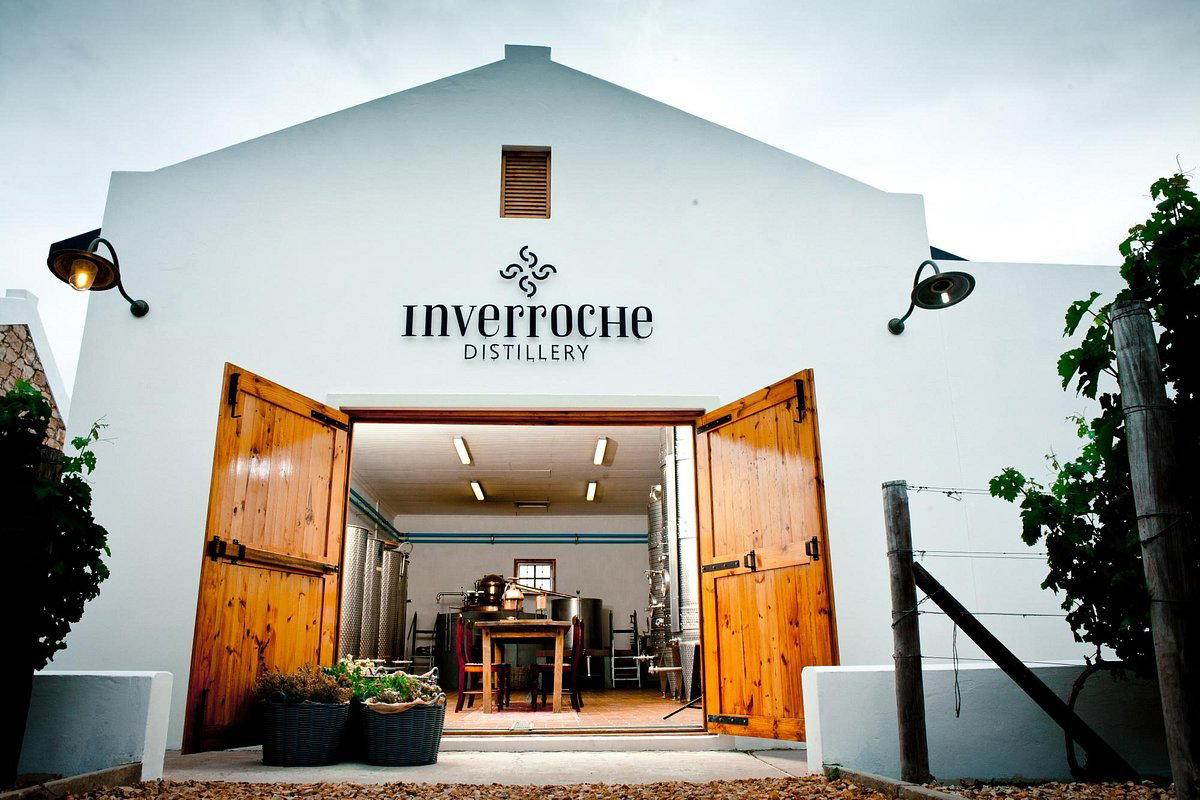
Where the Fynbos Ends and the Still Begins
The R323 out of Still Bay runs through a landscape that shifts between coastal scrub and low fynbos plains before arriving at Laurenskirk Estate, the address that anchors Inverroche Distillery. This corner of the Western Cape sits well outside the conventional wine-route circuit, no Stellenbosch weekend crowds, no Franschhoek coach parties. The nearest major town is Riversdale, and the nearest wine-focused peer is probably Boplaas Winery & Distillery in Calitzdorp, a Port-country operation some distance east along the Klein Karoo edge. That geographic remove is not incidental. It is the central fact that shapes what Inverroche does and why it matters.
Still Bay sits within the Cape Floristic Region, one of the world's most biodiverse plant zones, where an estimated 9,000 plant species are compressed into a relatively small coastal belt. Fynbos, the fine-leaved, fire-adapted shrubland that defines this region, does not appear elsewhere on earth in this density or variety. For a distillery drawing botanical character from the land immediately around it, that is not a scenic backdrop. It is the raw material.
Terroir in a Botanical Context
The concept of terroir is usually applied to wine, mapping how soil composition, drainage, aspect, and microclimate translate into the character of a grape and ultimately a glass. South Africa's wine regions have spent decades building that vocabulary, from the granitic decomposition soils of Swartland, where Sadie Family Wines pursues a dry-farmed, low-intervention approach, to the clay-rich valley floors of Bot River that give Beaumont Family Wines its structural weight. At Inverroche, the same question applies but the medium is gin, and the botanical sourcing from local fynbos creates a direct, traceable connection between place and product that few distilleries anywhere can claim with comparable specificity.
Fynbos encompasses over 7,000 plant species unique to the Cape Floristic Region, including restios, ericas, and proteas, each with distinct aromatic profiles. The act of working with these botanicals is, in practical terms, an exercise in reading and responding to the land in the same way a winemaker reads a specific block of vines. Creation Wines in Hermanus and Constantia Glen in Cape Town translate their respective cool-climate coastal positions into wine character. Inverroche translates the fynbos plains of the Overberg coast into spirit character. The editorial logic is the same even if the category differs.
The Craft Distillery Tier in South Africa
South Africa's craft spirits sector has grown considerably in the past decade, moving from a handful of small operations to a recognized production category with its own award structures and critical attention. The Pearl Awards, which assessed Inverroche with a 2 Star Prestige rating in 2025, recognize the distillery's standing in the South African premium products space. A 2 Star Prestige result positions Inverroche within the upper tier of that system, alongside credentialed producers who have demonstrated consistent technical execution and product distinctiveness.
That credential matters in context. The South African gin category has expanded rapidly, and differentiation has become harder to establish without either a clear geographic story or demonstrable award recognition. Inverroche holds both. Compare this to Oude Molen Distillery in Grabouw, which operates in a different stylistic register with brandy as its primary focus. The two producers occupy distinct positions within South African craft spirits, with Inverroche's fynbos-botanical approach representing a geographic specificity that Grabouw's fruit-brandy tradition does not replicate and does not try to.
For context on what award-level craft production looks like across the broader South African drinks landscape, Graham Beck Wines in Robertson offers a useful wine-side parallel: a producer whose credentialed output is linked clearly to a specific regional identity. The principle holds across categories.
The Still Bay Setting
Still Bay, known locally as Stilbaai, is a small coastal town on the Western Cape's southern shore, positioned between the more visited Garden Route towns to the east and the broader Overberg wine country to the west. Its tourism footprint is modest relative to Hermanus or Knysna, which means that visitors arriving at Inverroche are largely doing so with a specific intention rather than as part of a general tourist sweep. The drive from Cape Town takes roughly three hours, tracking east along the N2 before dropping south toward the coast. Those coming from the Garden Route direction approach through a different set of landscapes entirely, arriving via the Riversdale connection.
The Laurenskirk Estate address on the old Riversdale Road places the distillery on agricultural land rather than in a town-centre setting, a detail that reinforces the estate character and the sense that the botanical sourcing is happening in the same environment where visitors find themselves, not transported from somewhere distant. Babylonstoren in Franschhoek and Val de Vie Estate in Paarl both operate on this estate-visit model, where the land itself is part of the experience rather than merely a backdrop. Inverroche occupies a quieter, less trafficked version of the same format.
Placing Inverroche in the Wider South African Drinks Map
South Africa's premium drinks geography is dominated by the Cape Winelands corridor running through Stellenbosch, Franschhoek, Paarl, and Constantia. Producers like Neethlingshof Estate in Stellenbosch and Vergelegen Wine Estate in Somerset West operate within that well-established visitor infrastructure. Bezalel Wine & Brandy Estate in Upington sits at the opposite geographic extreme, in the Northern Cape's semi-arid interior.
Inverroche occupies a middle geography, on the southern coastal fringe that does not belong to either the Winelands cluster or the Karoo interior tradition. That positioning is both a logistical challenge for visitors and a source of the distillery's distinctiveness. The fynbos biome that supplies its botanical character is not replicated in Stellenbosch or Paarl. The terroir argument is, in this case, geographically defensible in a way that a producer in a more heavily farmed and modified landscape could not easily claim.
For visitors considering a dedicated southern Cape spirits itinerary, Boplaas in Calitzdorp to the east covers Port-style fortifieds and brandy, while Inverroche covers the aromatic botanical gin category. The two producers, separated by the Langeberg range, represent different expressions of the same broad southern Cape production region. An informed visitor could construct a route that takes in both without significant overlap in what they encounter.
Planning the Visit
Specific booking requirements, operating hours, and tasting formats for Inverroche are not confirmed in the current record, so advance contact is advisable before traveling. The R323 from Still Bay is the primary access route. There is no confirmed public transport connection, and the estate-road address suggests private transport is necessary. Given the Pearl 2 Star Prestige recognition achieved in 2025, demand for distillery visits may have increased relative to prior years, making advance contact more important than it might have been for a lower-profile producer.
Those building a multi-stop southern Cape drinks itinerary will also find relevant depth in the profiles for Boplaas Winery & Distillery and Oude Molen Distillery, each representing a different production tradition within the same broadly defined region.
Comparable Spots, Quickly
Comparable venues nearby, for context on price, style, and recognition.
| Venue | Cuisine | Price | Awards | Notes |
|---|---|---|---|---|
| Inverroche DistilleryThis venue — the venue you are viewing | Winery | $$$ | 1 recognition | |
| Copper Republic Distilling Co. | Cape | $$ | 1 recognition | Johannesburg |
| Klipdrift Distillery | Chenin Blanc, Colombard | $$ | 1 recognition | Robertson |
| Monks Gin Distillery | Winery | , | 1 recognition | Wilderness |
| Knysna Distillery | Winery | $$ | 1 recognition | Knysna Industrial Area |
| Cape Saint Blaize Distillery | Winery | $$ | 1 recognition | CBD |
At a Glance
- Scenic
- Elegant
- Rustic
- Sophisticated
- Group Outing
- Wine Education
- Special Occasion
- Family
- Estate Grounds
- Garden
- Private Tasting
- Historic Building
- Sustainable
- Organic
- Garden
Professional yet relaxed atmosphere with luxurious bar areas, natural lighting from the coastal setting, and a welcoming environment that balances sophistication with warmth.