Cloudy Bay Vineyards


Set on Jacksons Road in the heart of Marlborough's Wairau Valley, Cloudy Bay Vineyards holds a Pearl 4 Star Prestige rating (2025) and offers visitors a grounded encounter with one of New Zealand's most recognised wine regions. Land, sea, and sky experiences frame the estate's increasingly organic farming approach, placing it firmly within Marlborough's shift toward regenerative viticulture.
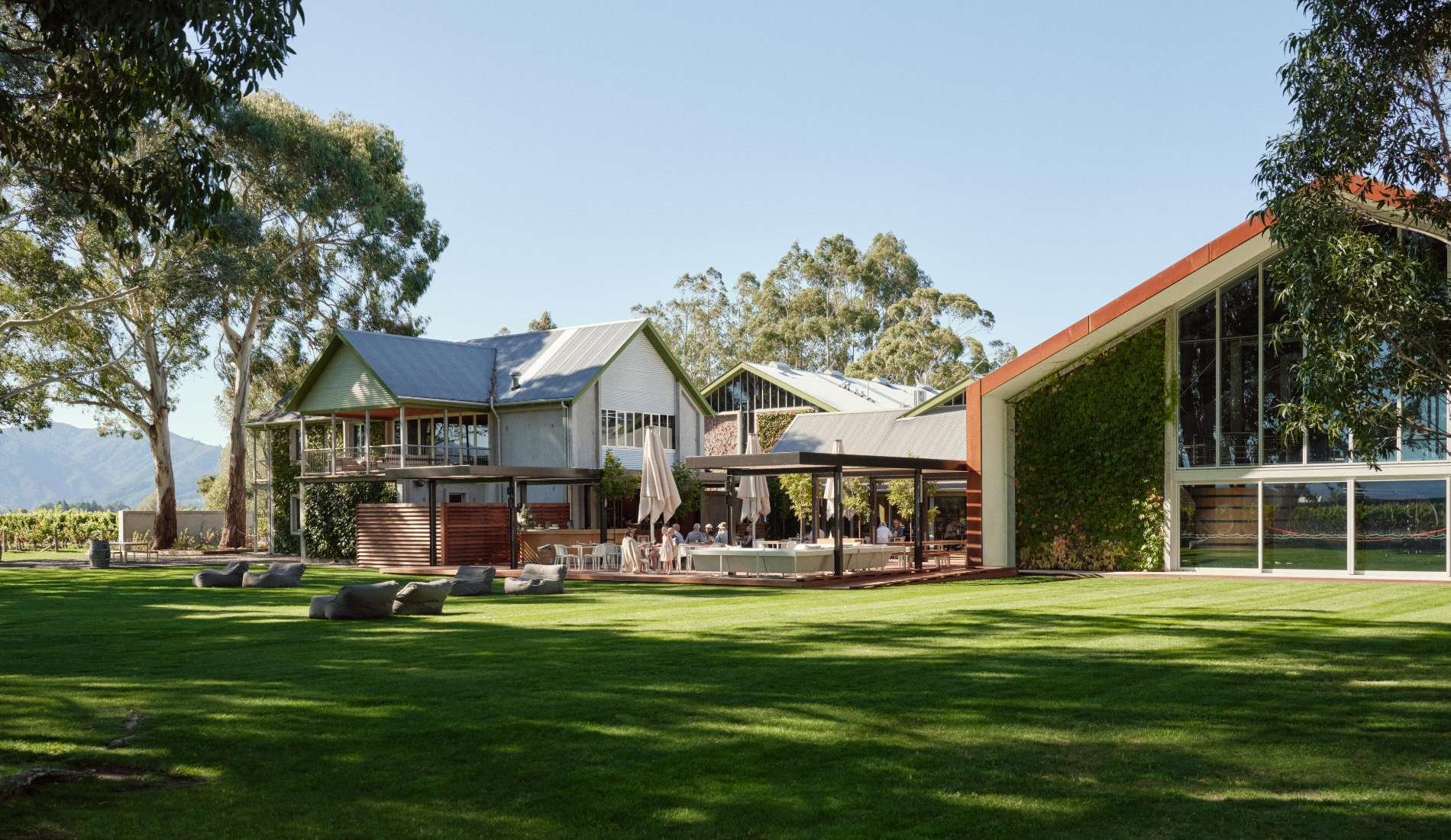
Where the Wairau Valley Speaks for Itself
There is a particular quality of light in Marlborough that photographers and viticulturists alike notice before anything else. It arrives hard and flat off the valley floor, bounces between the Richmond Range to the south and the hills above Renwick to the north, and settles into the kind of UV intensity that accelerates flavour development in ways that warmer, more obviously dramatic wine regions rarely achieve. At 230 Jacksons Road, Cloudy Bay Vineyards sits at the centre of that story, surrounded by vineyards that are progressively being farmed organically as the estate responds to a broader industry reckoning with soil health and long-term land stewardship.
For visitors arriving from Blenheim, the approach along Jacksons Road frames the experience before the cellar door comes into view. The Wairau Plain stretches wide and dry, with rows of vines organised with the kind of precision that signals serious production, and beyond them, the ranges that give Marlborough its diurnal temperature swings: warm days that push ripeness, cold nights that lock in acidity. That tension between heat and cool is not incidental to why Sauvignon Blanc found its global identity here. It is structural, written into the topography. See our full Blenheim wineries guide to understand how Cloudy Bay sits within the wider regional offering.
Marlborough's Terroir Argument, Made in Concrete
New Zealand's wine industry has spent decades defending the idea that its extreme southerly latitude, combined with relatively young, free-draining soils and persistent maritime influence from the Marlborough Sounds, produces conditions with no exact parallel elsewhere in the Southern Hemisphere. Cloudy Bay, as an estate that has been associated with Marlborough Sauvignon Blanc's international breakthrough, sits at the centre of that argument. The soils on Jacksons Road vary from the stonier, free-draining alluvial fans favoured for Sauvignon Blanc to heavier, silt-influenced patches further toward the valley floor, and this variation matters more than the single appellation label suggests.
The estate's move toward organic farming is part of a regional pattern. Across Marlborough, a growing cohort of producers has concluded that the conventional chemistry of high-volume viticulture degrades the very soil complexity that makes the region's wines worth drinking. Wairau River Wines in Rapaura operates nearby on the same valley floor, offering a useful point of comparison for visitors trying to read the differences between sub-zones. Further afield, Greystone Wines in Waipara has built its entire identity around biodynamic farming on limestone-rich soils in Canterbury, and the contrast between Waipara's clay-limestone and Marlborough's alluvial gravels is a useful education in how geology shapes style even within the same country.
What Cloudy Bay's increasing organic footprint signals, at a practical level, is an estate investing in the longevity of its land rather than its next harvest cycle. That is a meaningful choice when you are farming one of the most commercially pressured wine appellations in the world.
Land, Sea, and Sky: How the Estate Structures the Visit
Cloudy Bay's visitor experience is framed around Marlborough in full, not just the cellar door. The estate's 2025 Pearl 4 Star Prestige recognition reflects a visitor proposition that extends to the wider landscape: land tours of the vineyards, sea access through the Marlborough Sounds, and aerial perspectives by helicopter or light plane. This multi-format approach is relatively uncommon among New Zealand cellar doors, which tend to be anchored firmly to the table and the glass. At Cloudy Bay, the wine is the starting point of a regional orientation rather than the entirety of the offer.
Vineyard tours allow visitors to walk rows that are progressively being converted to organic management, giving context to what is in the glass in a way that a tasting note cannot. The Marlborough Sounds excursions extend the idea of terroir outward: the maritime influence that shapes the region's climate is not abstract when you are on the water looking back at the ranges. These are not tourist add-ons but extensions of the same question the wines ask, which is what it means for a place to taste like itself.
For practical planning, Cloudy Bay is located at 230 Jacksons Road, Blenheim 7201, approximately ten minutes by car from central Blenheim. Contact details and current opening hours are leading confirmed directly, as seasonal variations apply. The estate's full experiences, including guided tours and off-site excursions, should be arranged in advance, particularly during the summer harvest period from January through March when Marlborough draws its highest visitor volumes. If you are building a wider itinerary, our full Blenheim experiences guide covers the region comprehensively, and our Blenheim hotels guide addresses where to stay.
Placing Cloudy Bay in New Zealand's Premium Winery Tier
New Zealand's winery visitor economy has consolidated around a smaller group of estates that offer more than a pour and a view. That tier is defined by its experience architecture: structured tastings with genuine regional education, accommodation or food integration, and some form of landscape immersion beyond the cellar. Cloudy Bay's Pearl 4 Star Prestige rating places it within that cohort, alongside estates like Craggy Range in Hastings, which operates a luxury lodge and restaurant on Te Mata Estate's slopes, and Ata Rangi in Martinborough, where the emphasis is on small-lot Pinot Noir produced with long-standing organic principles.
Further south, Felton Road Wines in Bannockburn and Rippon Vineyard in Wānaka operate in Central Otago's schist and loess terrain, where the terroir argument is entirely different: lower yields, harder winters, and a Continental rather than maritime influence. Comparing Marlborough and Central Otago Pinot Noir is one of the more instructive exercises New Zealand wine offers, and Cloudy Bay's geographic position at the northern edge of the South Island places it naturally as the starting point for that itinerary. Outside New Zealand, estates like Kumeu River Wines in Kumeu and Bosman Family Vineyards in Wellington represent adjacent points of comparison for visitors tracking how different southern-hemisphere regions handle estate-level winemaking with strong terroir convictions.
What Marlborough's Moment Looks Like From the Ground
Marlborough's position in global wine has always been built on a single dominant variety, which makes it either commercially exposed or editorially focused depending on how you look at it. The region produces around seventy-five percent of New Zealand's total wine volume, and the majority of that is Sauvignon Blanc. That concentration could be read as a limitation, but it also means that the craft of differentiating between sub-regions, soil types, and farming approaches within a single variety is more developed here than almost anywhere else in the New World.
Visitors who arrive expecting uniform gooseberry and cut-grass Sauvignon Blanc consistently leave surprised by the range: the textural difference between Wairau Valley floor wines and hillside Southern Valleys fruit, the shift in aromatics that organic or biodynamic farming introduces, the way barrel-fermented examples from the same appellation read almost as a different variety. Cloudy Bay's estate-level position within this conversation, reinforced by its progressive organic programme, puts it in the part of the Marlborough story that is moving forward rather than repeating itself.
For visitors extending beyond the cellar door, our Blenheim restaurants guide and Blenheim bars guide cover where to continue the conversation over a table or a glass in town.
Frequently Asked Questions
- What's the atmosphere like at Cloudy Bay Vineyards?
- The atmosphere is grounded in landscape rather than luxury theatre. Marlborough's wide, flat valley floor and the surrounding ranges create a visual openness that the estate's setting reflects. Because visitor experiences extend to vineyard walks, sea excursions, and aerial tours, the mood is active and place-focused rather than purely contemplative. The Pearl 4 Star Prestige rating (2025) indicates a structured, quality-assured visitor environment rather than an informal drop-in cellar door.
- What do visitors recommend trying at Cloudy Bay Vineyards?
- Guided vineyard tours are consistently the recommended starting point, particularly as the estate's organic farming transition gives those walks genuine educational content beyond what a standard tasting delivers. The wider land, sea, and sky experience programme is what distinguishes Cloudy Bay from most Marlborough cellar doors, and visitors prepared to book those excursions in advance leave with a more complete understanding of why this specific valley produces wine the way it does.
- Why do people go to Cloudy Bay Vineyards?
- Cloudy Bay occupies a specific position in Marlborough's wine story: it is an estate closely associated with the region's international reputation, now operating within an increasingly organic farming framework and offering a multi-format visitor experience that goes beyond tasting. The Pearl 4 Star Prestige recognition (2025) and its Jacksons Road address, at the centre of the Wairau Valley's prime growing land, make it a logical anchor for any serious Marlborough wine itinerary. It is the kind of visit that contextualises everything else you drink in the region.
- How far ahead should I plan for Cloudy Bay Vineyards?
- For standard cellar door visits, lead times are shorter outside peak season, but Marlborough's harvest period (roughly January to March) draws significant visitor numbers and the estate's more structured experiences benefit from advance booking regardless of time of year. Given that phone and booking details are subject to change, confirm current availability directly with the estate. Building your visit around Blenheim as a base adds flexibility; see our Blenheim hotels guide for accommodation options across different price points.
- Is Cloudy Bay Vineyards worth visiting if you already know the wines well?
- The estate's value for experienced Cloudy Bay drinkers is primarily in the landscape and farming context rather than the wines themselves. Seeing the organic conversion programme on the ground, understanding how the Wairau Valley's soil variation maps onto different parcels, and combining the visit with the Marlborough Sounds sea experience adds a layer of terroir literacy that is difficult to get from the bottle alone. The Pearl 4 Star Prestige recognition (2025) signals that the estate has invested in making that educational dimension genuine rather than incidental.
Quick Comparison
These are the closest comparables we have in our database for quick context.
| Venue | Cuisine | Price | Awards | Notes |
|---|---|---|---|---|
| Cloudy Bay Vineyards | Pearl 4 Star Prestige (2025); Experience the spectacular Marlborough scenery by land, sea or sky at Cloudy Bay. With increasing amounts of the land farmed organically, vineyard tours are con | This venue | ||
| Greystone Wines | ||||
| Wairau River Wines | ||||
| James Sedgwick Distillery (Three Ships & Bain’s) | ||||
| Ata Rangi | ||||
| Craggy Range |
Access the Cellar?
Our members enjoy exclusive access to private tastings and priority allocations from the world's most sought-after producers.
Access the Concierge