
One of Montalcino's oldest continuously operating estates, Argiano has been producing Brunello since 1888 under successive owners who have each reshaped its direction. Today, winemaker Bernardo Bossi Bonilla guides the cellar, and the estate holds a Pearl 4 Star Prestige rating from EP Club (2025). The property sits at Sant'Angelo in Colle, a southwest-facing subzone that produces some of the appellation's warmer, more structured expressions.
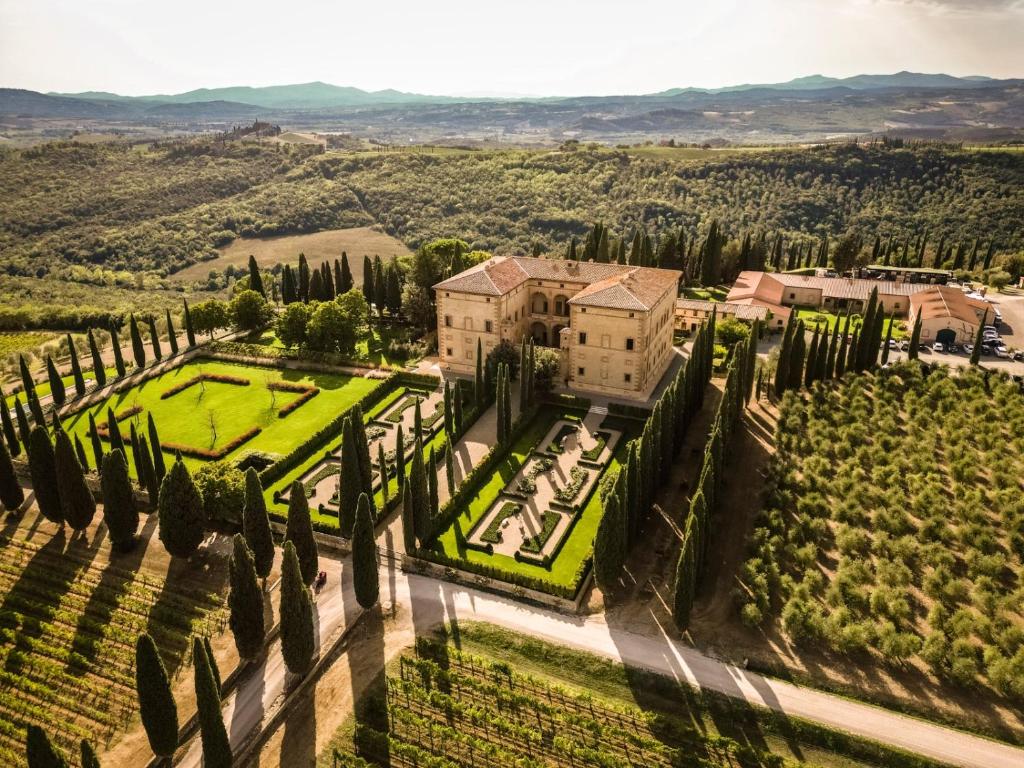
Sant'Angelo in Colle and the southwestern arc of Brunello
Montalcino's reputation rests on a single grape and a single appellation, but the hill itself is not uniform. Elevation, aspect, and soil type shift the character of Sangiovese Grosso considerably depending on where a vine sits. The southwestern slopes around Sant'Angelo in Colle run warmer and drier than the northern faces, producing wines with more immediate structure and a density that distinguishes them from the mineral-leaning expressions grown closer to the town. Argiano occupies this subzone, at Località Sant'Angelo in Colle, a position that has shaped its house style across more than a century of production.
That longevity matters more than it might appear. Most Montalcino estates that count their first vintages in the nineteenth century have passed through significant ownership changes, each bringing a recalibration of viticulture, cellar approach, and commercial ambition. Argiano's first recorded vintage dates to 1888, placing it among the oldest documented producers in the appellation, a peer group that includes Biondi-Santi Tenuta Greppo, the estate that effectively established Brunello di Montalcino as a category. Comparing the two is an exercise in how differently a single appellation can be interpreted across its geography.
Bernardo Bossi Bonilla and the winemaker's role in a historic estate
In Montalcino's premium tier, winemaker identity carries significant weight. The appellation's most closely watched estates are often defined less by their historical ownership structures and more by the technical vision operating in the cellar at any given time. Argiano's current direction runs through Bernardo Bossi Bonilla, whose presence in the cellar places the estate within a broader shift that has occurred across several Tuscany properties over the past two decades: the arrival of winemakers with international formation working within deeply local appellations.
That tension between tradition and technical range is a productive one in Brunello. The DOCG's regulations impose extended aging requirements, with Riserva wines requiring considerably longer barrel and bottle time than most other Italian denominations. Within those constraints, the winemaker's decisions about vessel size, wood origin, and extraction approach become the primary variables distinguishing one producer's style from another. The decisions Bossi Bonilla has made at Argiano position it within a Montalcino cohort that takes the appellation's structure seriously without over-engineering the wines toward international palatability. This is relevant context when comparing Argiano with estates like Casanova di Neri, whose richer, more concentrated style has attracted a different audience, or Altesino, one of the estates that introduced French oak barriques to Brunello in the 1980s and reshaped the stylistic debate in the process.
What the EP Club rating signals about Argiano's position
EP Club's Pearl 4 Star Prestige rating for 2025 places Argiano in the category's upper-middle tier, distinguishing it from the bulk of Montalcino producers without positioning it at the absolute apex occupied by a small number of single-vineyard specialists. That placement is an accurate read of where the estate sits in the market. Argiano produces across a range that includes Brunello di Montalcino, Rosso di Montalcino, and IGT wines, a portfolio breadth that reflects the commercial realities of a large estate and creates multiple entry points for different buyers.
For reference, estates like Il Poggione operate at similar scale with comparable portfolio width and occupy a peer tier that values consistency and vineyard provenance over limited-release prestige pricing. L'Enoteca Banfi, operating out of the Castello Banfi estate, represents a different model entirely: a large-scale operation with international distribution reach and a visitor infrastructure that few Montalcino producers can match. Argiano sits between these reference points, with the historical depth to support serious engagement and the production volume to maintain a presence across multiple export markets.
The southwestern terroir in practice
Understanding Argiano's wines requires understanding what Sant'Angelo in Colle actually delivers. The southwestern exposure means longer afternoon sun hours and soils that drain efficiently, reducing water stress risk and concentrating flavours in the fruit. Vintages that produce elegant, nervous Brunello in the cooler northern zones can yield wines of considerable density and tannic grip from this part of the hill. This is not a criticism of either style; it is simply a geographic reality that experienced buyers account for when building a cellar.
Sangiovese Grosso, the clone specifically associated with Montalcino, responds to terroir variation with considerable sensitivity. The same grape that produces the taut, cedar-inflected Brunello of estates on higher ground becomes something denser and darker-fruited in the warmth of the southwest. For buyers who prefer Brunello with grip and age-worthy structure, the southwestern subzone is frequently the right address. Argiano's 1888 starting point also suggests deep root systems in old vineyard blocks, a factor that adds complexity regardless of stylistic direction. Comparing Argiano's approach to Tuscany-wide ambition, Antinori nel Chianti Classico illustrates how large historic estates manage variety across appellations, while Argiano remains focused on the Montalcino identity.
Visiting Argiano: what to plan for
The estate sits outside the town of Montalcino at Sant'Angelo in Colle, which requires transport of your own. Montalcino itself is reached most practically by car from Siena, a drive of roughly 40 kilometres south through the Crete Senesi. Direct public transport from Siena exists but is infrequent, and the estate's rural position means a hire car is close to essential for any serious tasting visit to the southwestern subzones. Booking directly with the estate in advance is standard practice across Montalcino's premium tier; walk-in visits are rarely accommodated at this level, and contact details are leading confirmed via the estate's current website before travelling.
Planning a broader Montalcino visit around Argiano makes sense for anyone interested in the appellation's geographic range. The southwest cluster, which includes Argiano's immediate neighbours, offers a distinct contrast to the northern and eastern estates. Allowing two to three days in the zone gives enough time to compare subzone expressions meaningfully. For planning beyond the cellar door, our full Montalcino restaurants guide, full Montalcino hotels guide, full Montalcino bars guide, full Montalcino wineries guide, and full Montalcino experiences guide cover the full range of the area. For those building a longer Italian wine itinerary, comparable historic estate visits include Aldo Conterno in Monforte d'Alba and Bruno Giacosa in Neive, where the conversation about terroir, tradition, and winemaker identity runs along similar lines. For those curious about other historic estate experiences across Europe, Abadía Retuerta in Sardón de Duero offers an instructive parallel in a Spanish context.
Frequently asked questions about Argiano
- What wine is Argiano famous for?
- Argiano is primarily associated with Brunello di Montalcino, the DOCG appellation that defines the town and commands the most serious critical and collector attention. The estate's winemaker Bernardo Bossi Bonilla oversees production across the range, and the estate's EP Club Pearl 4 Star Prestige rating (2025) reflects its standing within the appellation's upper-middle tier.
- What makes Argiano worth visiting?
- The combination of a first vintage in 1888 and a location in the southwestern Sant'Angelo in Colle subzone gives Argiano a specific geographic and historical argument that few estates in Montalcino can replicate. The EP Club Pearl 4 Star Prestige rating (2025) confirms its position within the appellation's premium cohort rather than its entry-level production. Visitors interested in subzone comparison will find this part of the hill a productive counterpoint to the estates clustered near the town itself.
- How far ahead should I plan for Argiano?
- Montalcino's premium producers routinely require advance booking for tastings, and the estates in the Sant'Angelo in Colle area are no exception. Given the estate's standing and the logistical realities of a rural Tuscan location, booking at least two to four weeks ahead is a reasonable minimum. Contact and availability details should be confirmed via the estate's current website before travelling.
- Is Argiano better for first-timers or repeat visitors?
- The estate works for both cohorts but for different reasons. First-time Montalcino visitors will find Argiano's historical depth and southwestern terroir a clear illustration of how the appellation's geography shapes style. Repeat visitors who already know the appellation's northern expressions will find the density and structure of the Sant'Angelo in Colle position the most instructive contrast. The EP Club Pearl 4 Star Prestige rating (2025) means expectations are appropriately set for a serious rather than introductory encounter with Brunello.
- How does Argiano's 1888 founding date affect its vineyard character today?
- Estates with documented production dating back to the late nineteenth century typically hold some of the oldest vineyard blocks in their appellation, and old vines in Montalcino translate directly into naturally lower yields and increased concentration in Sangiovese Grosso. Argiano's 1888 first vintage places it in the same founding generation as Brunello's earliest documented producers, giving Bossi Bonilla access to vineyard material that newer estates, however well-resourced, cannot replicate. That age factor is one reason the EP Club Pearl 4 Star Prestige rating carries the weight it does.
Price and Positioning
Comparable venues for orientation, based on our database fields.
| Venue | Price | Awards | Notes |
|---|---|---|---|
| Argiano | Pearl 4 Star Prestige (2025) | This venue | |
| Biondi-Santi Tenuta Greppo | |||
| L'Enoteca Banfi | |||
| Valdicava Az Agr | |||
| Cerbaiona | |||
| Poggio di Sotto |
Access the Cellar?
Our members enjoy exclusive access to private tastings and priority allocations from the world's most sought-after producers.
Access the Concierge