Our verdict
Maxwell Food Centre and the Enduring Logic of the Hawker Counter The approach to Maxwell Food Centre on a weekday morning tells you most of what you need to know about Singapore's hawker culture. Overhead fans push warm air through the...

Pearl is the En Primeur Club membership app, where members save venues, book tables and use the concierge.
The menu
What to order
- Mixed porridge
Maxwell Food Centre and the Enduring Logic of the Hawker Counter
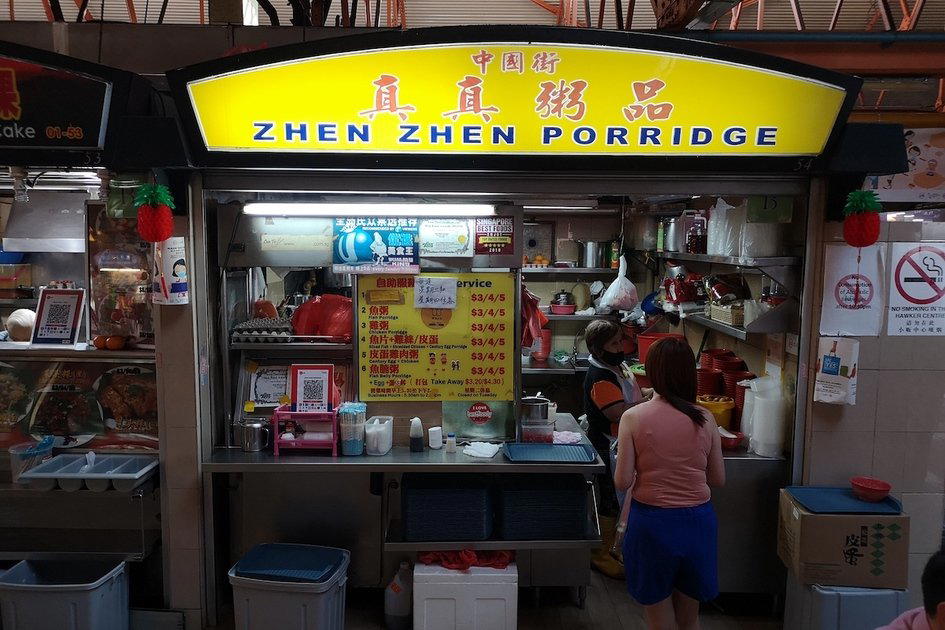
The approach to Maxwell Food Centre on a weekday morning tells you most of what you need to know about Singapore's hawker culture. Overhead fans push warm air through the open-sided hall. Plastic stools scrape against tiled floors. The smell of stock and soy arrives before the stalls do. Stall 54, where Zhen Zhen Porridge has occupied its corner of this Tanjong Pagar institution for decades, draws a queue that forms early and doesn't shorten until mid-morning. That queue is not a function of novelty. It is the accumulated habit of a neighbourhood that has decided, through long repetition, that this is where congee should be eaten.
Maxwell Food Centre itself sits at the intersection of Kadayanallur Street in the Tanjong Pagar district, a short walk from the Tanjong Pagar MRT station. This is a part of Singapore where colonial-era shophouses abut newer commercial towers, and where the hawker centre functions as a social anchor in ways that a restaurant cannot replicate. Arriving before 8am on any given morning gives you the leading reading of the stall's rhythm, and the most reasonable chance of a short wait.
Congee as a Category: Where Zhen Zhen Sits in Singapore's Porridge Tradition
Singapore's porridge scene has always operated on a clear hierarchy, not by price or prestige, but by technique and consistency. Cantonese-style congee, the style associated with the stall's name (the Chinese characters 中国街真真粥品 reference its origins in the old Chinatown street food tradition), is built around long-cooked, broken-grain rice that reaches a near-silky texture. The grain should be indistinguishable from the liquid. The stock underneath should carry weight. These are the two technical benchmarks against which any Cantonese congee stall in Singapore is measured.
Within that tradition, Zhen Zhen has maintained a position that hawker enthusiasts in Singapore treat as a reference point rather than a discovery. That status is earned through repetition and stability, the hallmarks of a hawker counter that has outlasted trends rather than chased them. In a city where Imperial Treasure Fine Chinese Cuisine in Downtown Core represents the formal, banquet-register end of Cantonese cooking, and where the broader Chinese dining tradition spans from street-level hawker stalls to white-tablecloth institutions, Zhen Zhen sits firmly at the foundation: unforced, practised, and specific.
The Scene at the Stall
Hawker culture in Singapore is frequently described in general terms. The specific reality of eating at Zhen Zhen is more instructive. The stall operates within the conventions of the Maxwell hawker format: you order at the counter, you find your own seat, and the food arrives quickly. There is no service theatre, no printed menu with narrative. The communication is efficient, you name your protein, you receive your bowl.
What distinguishes the experience is what the format strips away. Without the surrounding apparatus of a restaurant, the congee itself carries the full weight of the visit. Either the stock is deep and the texture is right, or it isn't. Regulars at Zhen Zhen have made a sustained judgment that it is. The queue, which has been observed and noted by food writers covering Singapore's hawker circuit for years, is the most verifiable trust signal available in the absence of formal awards data.
For visitors approaching Singapore's eating culture from the fine-dining direction, those who have booked counters at Odette (French Contemporary) or Zén (European Contemporary) for their evening sessions, Maxwell Food Centre offers a useful counterpoint. The craft at work in a long-running congee stall is different in kind from what happens in a Michelin-starred kitchen, but it is not different in seriousness. The consistency required to hold a queue over decades is its own form of discipline.
Placing Zhen Zhen in the Broader Singapore Eating Map
Singapore's dining culture is genuinely two-track. On one track: a cluster of fine-dining restaurants that benchmark against international peers, including Les Amis (French), Jaan by Kirk Westaway (British Contemporary), and Meta (Innovative). On the other: a hawker infrastructure that the government has actively preserved and that UNESCO recognised in 2020 as Intangible Cultural Heritage. Zhen Zhen operates on the second track, but it is not incidental to Singapore's food identity, it is central to it.
The Tanjong Pagar district, where Maxwell sits, has seen significant gentrification pressure over the past decade. Newer cafes and restaurant concepts have opened within walking distance. The hawker centre has held its ground, partly because of institutional support and partly because demand from both residents and food-focused visitors has not softened. For visitors mapping a day that includes Béni in Orchard for dinner, a morning session at Maxwell offers a logical contrast within the same city's eating range.
Further afield in Singapore's hawker and neighbourhood dining circuit, comparable formats, long-running stalls with sustained local reputations, appear across districts. KTMW chicken rice tea-cafe in Bedok and Fu He Delights in Rochor occupy analogous positions in their respective neighbourhoods: stalls that have accumulated authority through consistency rather than through formal recognition. Our full Singapore restaurants guide maps the broader eating picture across these registers.
Timing, Planning, and Practical Orientation
The practical calculus for visiting Zhen Zhen is direct. Maxwell Food Centre is open through the day, but the congee counter is a morning operation. Arriving after 10am on weekends carries a real risk of the congee selling out, a pattern that has been reported consistently by visitors and locals over multiple years. Weekday mornings are slightly more manageable but still draw a crowd before 9am. The nearest MRT access is Tanjong Pagar station (EW line), and the walk is under ten minutes. Payment is cash-based, as is standard at most traditional hawker stalls in Singapore, though the broader shift to digital payment options (PayNow, NETS) has reached many Maxwell stalls. Confirming at the counter is advisable. Prices sit within the standard hawker range, making this one of the most cost-accessible eating experiences in a city where fine-dining covers at Atomix in New York City or Le Bernardin in New York City might serve as a spending reference point for context.
For visitors building a morning in the Tanjong Pagar area, Etna Restaurant in Outram sits within the same general neighbourhood for an entirely different register later in the day. The area rewards extended time.
Frequently asked questions
Where exactly is Zhen Zhen Porridge 中国街真真粥品?
Zhen Zhen Porridge 中国街真真粥品 is located at Stall 54, Maxwell Food Centre (1 Kadayanallur St.), 069184, Singapore.
Is Zhen Zhen Porridge at Maxwell Food Centre worth visiting for a Singapore hawker breakfast?
Maxwell Food Centre at 1 Kadayanallur Street is one of the most concentrated hawker sites in central Singapore, and Zhen Zhen's Stall 54 is among the counters that justify an early arrival. Cantonese congee at this level of consistency is a morning-specific proposition: the stall operates on hawker hours, and the congee runs out. For visitors mapping a hawker breakfast around Chinatown, the stall sits in a centre that also covers a cross-section of Singapore's other major hawker categories in a single visit.
What should I order at Zhen Zhen Porridge 中国街真真粥品?
Zhen Zhen is a Cantonese congee counter, so the porridge itself is the point. The stall at Maxwell Food Centre (Stall 54) runs a focused menu of rice-based congee with protein toppings, pork, fish, and century egg combinations are the standard anchors of this style. Arrive with a specific bowl in mind rather than browsing; the operation moves fast and the queue expects it.
Do they take walk-ins at Zhen Zhen Porridge 中国街真真粥品?
Zhen Zhen operates as a hawker stall at Maxwell Food Centre, there are no reservations, no bookings, and no phone line to call ahead. Walk-in is the only option. The practical consequence is that timing matters: the stall draws a serious morning queue, and arriving after the peak hour risks finding the congee sold out before you reach the front.
What's the standout thing about Zhen Zhen Porridge 中国街真真粥品?
Consistency across decades at a single counter in a competitive hawker environment is the credential that counts here. Zhen Zhen holds Stall 54 at Maxwell Food Centre, one of Singapore's most-visited hawker centres, and maintains a queue that functions as its own form of public review. The congee follows the Cantonese method: long-cooked to a smooth, starch-rich texture that most hawker operations cut corners on.
Can Zhen Zhen Porridge 中国街真真粥品 handle vegetarian requests?
Cantonese congee at this style of hawker stall is typically built around animal-based stocks and protein toppings, which means a fully vegetarian bowl is not the natural fit for the format. Vegetarians should confirm directly at the counter before ordering.
Should I splurge on Zhen Zhen Porridge 中国街真真粥品?
There is nothing to splurge on in the conventional sense. Zhen Zhen is a hawker stall at Maxwell Food Centre, and hawker pricing in Singapore means a bowl of congee costs a fraction of what a café or restaurant charges for the same category of dish. The calculation here is not about budget, it is about whether you are willing to queue on a weekday morning for a bowl that represents the working standard of Singapore's Cantonese porridge tradition.
Peers You’d Cross-Shop
Comparable options at a glance, pulled from our tracked venues.
| Venue | Cuisine | Price | Awards | Notes |
|---|---|---|---|---|
| Zhen Zhen Porridge 中国街真真粥品This venue (the venue you are viewing) | Cantonese Porridge | $1–10 | Not listed | Not listed |
| Zén | Neo-Nordic with Japanese Influences | $500+ | 3 Michelin Stars · Michelin Guide 3 Stars | European Contemporary |
| Jaan by Kirk Westaway | Modern British Fine Dining | $200–300 | 2 Michelin Stars · Michelin Guide 2 Stars | British Contemporary |
| Born | Contemporary Fusion Fine Dining | $200–300 | 1 Michelin Star · Michelin Guide 1 Star | Creative Cuisine, Innovative |
| Burnt Ends | Modern Australian Barbecue | $100–150 | 1 Michelin Star · Michelin Guide 1 Star | Australian Barbecue, Barbecue |
| Iggy's | Modern European with Japanese Influence | $150–200 | 1 Michelin Star · Michelin Guide 1 Star | Modern European, European Contemporary |