
Yoshoku Bistro Awano gives Osaka’s Western-influenced comfort cooking a compact, urban frame: a small Bingomachi room, a 20-seat scale, and a 2025 Tabelog 100 Yoshoku WEST selection anchoring its reputation. It belongs to the city’s quieter lunch-and-dinner tradition rather than the spectacle circuit, with yoshoku treated as a serious local category rather than nostalgia alone.
Pearl is the En Primeur Club membership app — saves, bookings, and concierge access live there. Same editors, same standards.
- Address
- 1 Chome-2-12 Bingomachi, Chuo Ward, Osaka, 541-0051, Japan
- Phone
- +81 6-6202-7377
- Website
- tabelog.com
 Saves & bookings on Pearl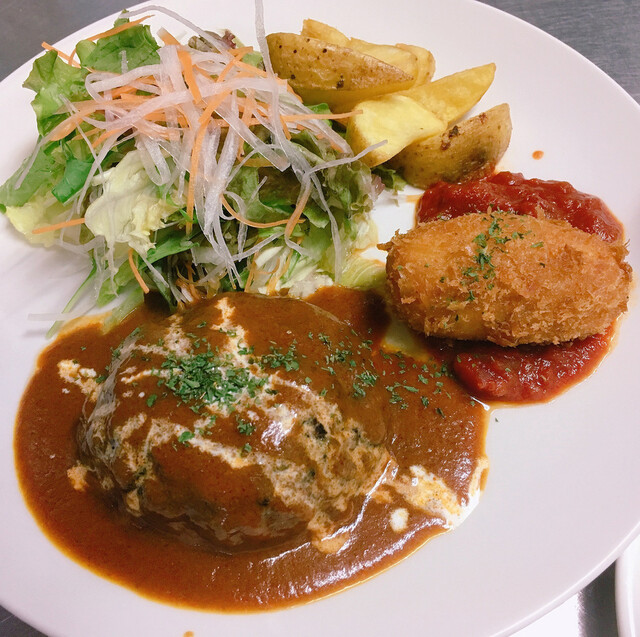
In Bingomachi, dining rhythms change block by block: office towers, low-rise commercial buildings, and compact ground-floor restaurants for regulars who know what they want before sitting down. Yoshoku works in this part of Osaka because it needs no theatre. The form is familiar: Western-influenced Japanese cooking shaped by lunch sets, sauces, frying technique, rice, and the discipline of a small kitchen. Yoshoku Bistro Awano matches that civic scale: 20 seats, a non-smoking room, and a category reputation strong enough for the 2025 Tabelog 100 Yoshoku WEST selection.
Osaka is often read through takoyaki, okonomiyaki, and counter drinking, but its deeper appeal is how seriously it treats everyday genres. Yoshoku is one of them. It borrows from European restaurant grammar without becoming French or Italian, keeping value close to the ground. In Chuo Ward, that means serving office workers at lunch and committed diners at night without changing identity. The point is not ceremony; it is calibration.
A compact room for Osaka's serious everyday Western cooking
The physical container matters. A 20-seat room limits distraction: sightlines are short, service has little distance to cover, and the meal reads as neighborhood bistro rather than destination dining room. In yoshoku, that intimacy suits the food. Sauces, frying, omelet work, stews, and cutlet-adjacent cooking depend on timing and temperature more than tasting-menu suspense. The scale keeps the genre close to its origins as restaurant comfort, not luxury performance.
The 2025 Tabelog 100 Yoshoku WEST selection gives the address a clear trust signal in a category visitors may struggle to parse. Yoshoku rarely announces itself with the international cues attached to sushi counters or kaiseki rooms. Recognition within a regional yoshoku list is more useful than a generic popularity claim: it places the restaurant among Western Japan’s notable examples, where consistency, execution, and local demand matter.
Category also explains the pricing. Yoshoku Bistro Awano sits around JPY 1,000–1,999 at lunch and JPY 3,000–3,999 at dinner, far below Osaka’s formal tasting-menu economy and above the quick-serve snack lane. By comparison, Curry Rice operates below JPY 1,000, Tachinomi Sakaba Kakedashi sits in a standing-bar price band, Spice Ryori Nallamanam overlaps on lunch-to-dinner spend, and Sumibi Yakitori Nakao moves into a higher evening bracket. The comparison shows where yoshoku lands in Osaka’s value map: more composed than a quick curry stop, less financially loaded than specialist counter dining.
For readers mapping the city by category rather than hype, this Osaka address pairs well with broader research. Our full Osaka restaurants guide gives the wider dining frame, while Our full Osaka hotels guide, Our full Osaka bars guide, Our full Osaka wineries guide, and Our full Osaka experiences guide help separate a food-led stay from a generic city break.
Yoshoku as design: formality without grand dining signals
The design story is compression, not decoration. Osaka has many restaurants where the room works as a practical machine: limited seats, short distances, and service assuming diners understand the category. Here, Western-derived Japanese food loses retro novelty and becomes urban infrastructure. The bistro label helps only partly. This is not a European bistro transplanted to Kansai; it is a Japanese reading of Western restaurant cooking, scaled to a business district’s habits.
That is why the address should be read beside genre specialists rather than grand restaurants. Osaka’s pleasure lies in moving between tight formats: bakery runs, café pauses, pork buns, pizza, Italian counters, curry specialists, sake bars, and small Japanese rooms with their own rules. Nearby planning can include.cafe, 52CHO-ME BAKERY, 551 Horai (551蓬莱), 99 Pizza Napoletana Gourmet, and a canto (Italian), not because they are interchangeable, but because Osaka rewards category-hopping when each stop has a defined role.
The lack of private rooms and private-use format clarifies the experience. This is a public dining room, not a sealed-off occasion venue. Credit cards are accepted for JCB, AMEX, and Diners; electronic money and QR payments are not part of the setup. Those details are logistics and operating signals: small room, conventional payment spine, and a format built for regular restaurant use rather than event dining.
Travelers comparing Japanese regional food cities often over-index on named dishes. Osaka asks for formats: the stand-and-drink bar, department-store basement counter, neighborhood bakery, curry shop, yoshoku room. Cross-city comparisons sharpen that lens: -Grilled beef Sukiyaki- KAMAKURA TANUKIAN 鎌倉 たぬき庵 in Kamakura. 鮪と炭火焼き うお炭 秋葉原店 in Tokyo.know in Kumamoto, (Shoku) Vietnam in Kawasaki, [Curry Senmon Ten] Maruyama Kyoju. in Sapporo, [ki:] in Kyoto, Jōdo Saké Bar in Los Angeles, and Onigiri Time in Pasadena each show how a narrow format can carry a city’s dining personality.
Who should put it on an Osaka itinerary
Yoshoku Bistro Awano suits diners who want Osaka without reducing it to street-food shorthand. It is strongest for lunch or a low-key dinner built around Japanese-style Western cooking, especially for travelers staying or working around Sakaisuji Hommachi and Chuo Ward. The Tabelog 100 Yoshoku WEST 2025 selection supplies external validation; the small-seat format makes it a focused meal rather than a casual fallback.
The editorial read is simple: choose it to understand a Japanese comfort-cooking tradition in a compact Osaka setting. Skip it if the trip is built around chef-counter theatre, private-room entertaining, or long tasting-menu pacing. Yoshoku is more revealing when judged by restraint, execution, and how naturally the room serves its neighborhood. On those terms, this address belongs in the city’s serious everyday dining conversation.
Quick Comparison
Comparable venues at a similar level for quick context.
| Venue | Cuisine | Price | Notes |
|---|---|---|---|
| Yoshoku Bistro AwanoThis venue — the venue you are viewing | Yoshoku (Japanese-style Western bistro) | $$ | Not listed |
| Sobabito Aki | Traditional Soba & Japanese Small Plates | $$ | Chūō |
| RAMU-NO-LOVESONG | Lamb-focused Modern Japanese Stand Bar | $$ | Kita |
| Ramen Shuki | Japanese Ramen | $$ | Higashinari |
| Yasuda | Traditional Shabu-shabu & Beef Hotpot | $$ | Miyakojima |
| Negiyaki Yamamoto Honten | Japanese Negiyaki | $$ | Yodogawa |
Recognition history
Dated appearances from independent guides and award organizations, with the underlying list record or original source where available.
Tabelog 100 #52 · No. 52
Tabelog · Tabelog 100 - Yoshoku - WEST - 2025
Continue exploring
More in Osaka
Restaurants in Osaka
Browse all →




Bars in Osaka
Browse all →

Hotels in Osaka
Browse all →



Wineries in Osaka
Browse all →
At a Glance
- Cozy
- Classic
- Intimate
- Solo
- After Work
- Casual Hangout
- Standalone
Current opening hours
- Monday
- 11:15 AM–2:30 PM, 6–8:30 PM
- Tuesday
- 11:15 AM–2:30 PM
- Wednesday
- 11:15 AM–2:30 PM, 6–8:30 PM
- Thursday
- 11:15 AM–2:30 PM, 6–8:30 PM
- Friday
- 11:15 AM–2:30 PM, 6–8:30 PM
- Saturday
- 11:15 AM–2:30 PM, 6–8:30 PM
- Sunday
- Closed
Hours can change for holidays and private events. Last verified .
A compact, non-smoking bistro with about 20 seats on the first floor of a mixed-use building, offering a relaxed, casual atmosphere that feels like a neighborhood Western-style Japanese diner rather than a formal restaurant.