"One of the Oldest Diners: Wilensky's Wilensky’s is sort of an institution in the Mile End. Family-owned since its opening in 1932, the place is famous for its extremely cheap snacks, no-nonsense approach, and retro decor. Pressed tin ceiling, Kik Cola clock, ring-up cash register, old-fashioned soda fountain, this place sometimes feels like a time warp or, at the least, a museum. what makes Wilensky’s so special is, incidentally, the Special ($3.90): “All-beef salami with all-beef baloney grilled to appealing perfection on a tasty roll with a hint of mustard.” But don’t try to change anything in it, the owner, Ruth, will not have it. The Special is what it is, and no amount of money will make Ruth change it. Hell, she even wrote a poem about it: When ordering a Special, you should know a thing or two. It is always served with mustard; it is never cut in two. Don’t ask us why; just understand that this is nothing new. This is the way that it’s been done since 1932. Amen to that."
Pearl is the En Primeur Club membership app — saves, bookings, and concierge access live there. Same editors, same standards.
- Address
- 34 Av. Fairmount O, Montréal, QC H2T 2M1, Canada
- Phone
- +1 514 271 0247
- Website
- wilenskys.com
- Directions
- Get directions
 Saves & bookings on Pearl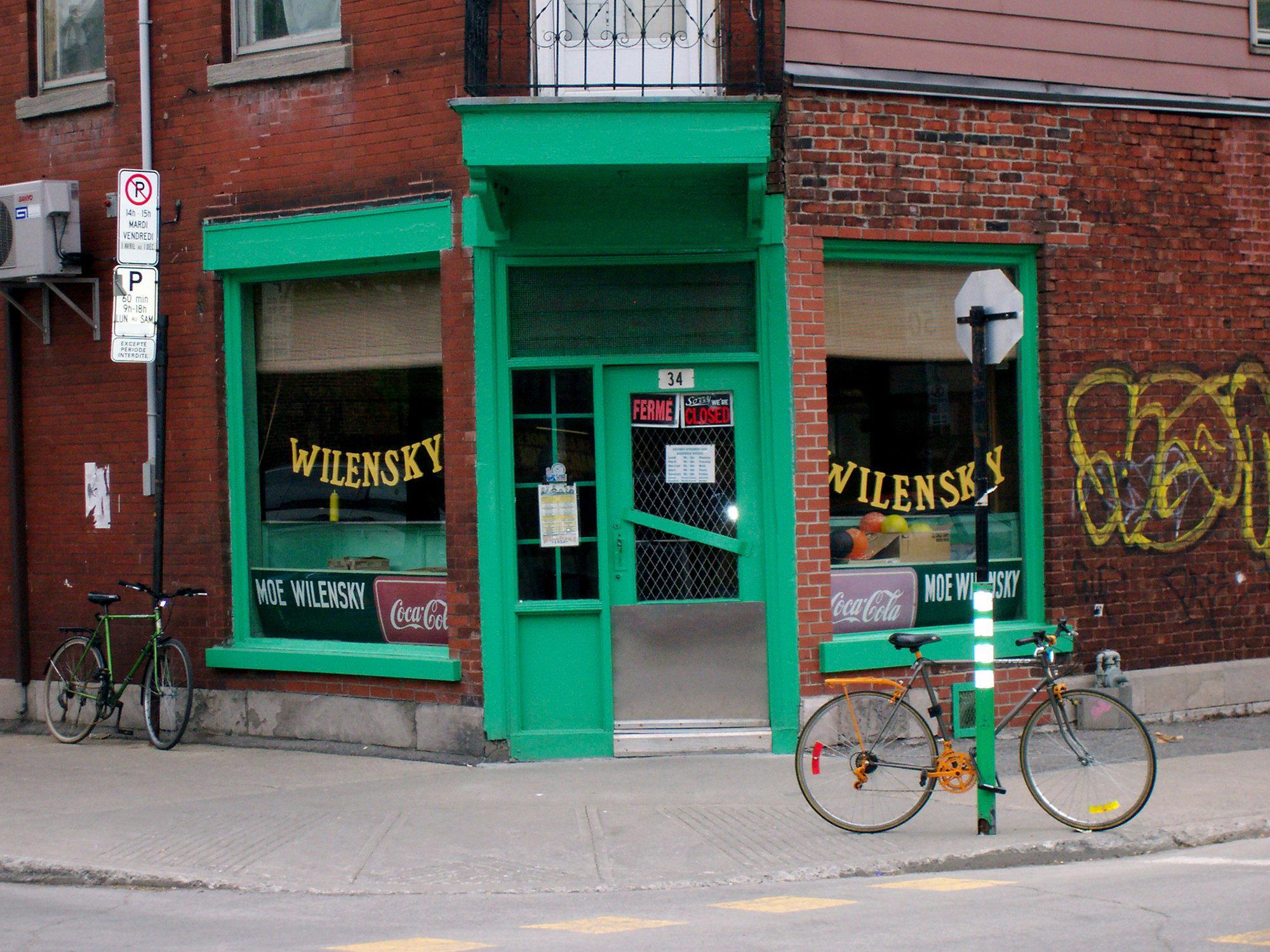
Fairmount Avenue and the Logic of the Lunch Counter
The Plateau-Mont-Royal stretches along Fairmount Avenue with the kind of low-rise density that resists redevelopment almost on principle. Wilensky's Light Lunch, at 34 Avenue Fairmount Ouest, is a Classic Montreal Deli with. Montreal retains more of this tradition than most North American cities its size, with Schwartz's holding the smoked meat position and Wilensky's occupying a different, quieter corner of the same cultural memory. Where Schwartz's operates at high volume and tourist-friendly hours, Wilensky's functions closer to a neighbourhood fixture, a place that rewards those who already know it rather than those arriving for the first time with a guidebook.
The lunch counter as a format carries its own logic. It is a daytime institution by nature, built around a midday rhythm that evening dining has never replaced. The format collapses at night not because the food changes but because the social contract does: counters are about efficiency, familiarity, and the ordinary pleasure of eating well without ceremony. That distinction matters in a city where evening dining increasingly anchors itself in tasting menus, extended service, and the architecture of occasion. Venues like Jérôme Ferrer's Europea and Mastard define one end of Montreal's dining spectrum. Wilensky's defines another, and the distance between them is not a matter of quality but of purpose.
The Lunch Counter Tradition and Where It Stands Now
Montreal's Jewish deli heritage draws from the waves of Eastern European immigration that shaped the Plateau and Mile End neighbourhoods through the late nineteenth and early twentieth centuries. The lunch counter was a practical institution: fast, cheap, sustaining, and built around a small menu executed without variation. That last element is the one that separates places like Wilensky's from the broader deli category. A small, fixed menu, repeated daily without substitution, is a specific operational philosophy. It signals confidence in the product as it is, and it defines the experience for anyone who walks in.
That philosophy has become rarer as hospitality culture has shifted toward customization and dietary accommodation as standard expectations. The lunch counter model that Wilensky's represents predates those expectations and has not absorbed them. This is less a service gap than a statement of identity. The counter format operates on its own terms, and those terms have not shifted to meet the current moment. For a segment of Montreal's dining public, that consistency is precisely the point. For others, it may present a practical constraint.
The Fairmount corridor itself has changed considerably around Wilensky's. The neighbourhood now includes natural wine bars, destination bakeries, and a density of food-focused retail that draws visitors from across the city. Against that backdrop, a deli lunch counter that has operated without material change reads as an artifact of a particular urban moment, one that Montreal has preserved better than comparable cities. Sabayon and 3 Pierres 1 Feu represent the neighbourhood's newer register; Wilensky's represents its longer memory.
Lunch vs. Evening: Why This Format Only Works in One Direction
The editorial angle of the lunch versus dinner divide matters here more than at most venues. Wilensky's is a lunch counter in the literal and functional sense: it operates during daytime hours and the format does not extend into an evening service that transforms the mood or menu. This is not a casual restaurant with a lunch special. The counter is the format, and the counter belongs to the midday. In cities where lunch has been progressively deprioritized in favour of dinner as the primary dining event, a place that exists exclusively in the daytime occupies a distinct and increasingly narrow position.
Practical consequence for visitors is direct: this is a midday stop, planned accordingly. The value proposition of the counter, a fast, affordable, historically grounded meal in the middle of the day, is one that dinner cannot replicate and does not attempt to. Montreal's evening dining scene, which runs from neighbourhood bistros like L'Express to destination kitchens such as Tanière³ in Quebec City (a short drive east) and draws comparisons to ambitious Canadian programs at Alo in Toronto or AnnaLena in Vancouver, operates in a completely different register. Wilensky's does not compete with that tier. It occupies the daytime space that those venues leave entirely unaddressed.
Where Wilensky's Sits in the Montreal Picture
Montreal's food scene is often read through its French-influenced fine dining and its smoked meat tradition. Both narratives are accurate, but they crowd out a third strand: the Jewish deli counter, which shaped the Plateau's midday eating culture for generations and now persists in a small number of addresses. Wilensky's is the clearest surviving example of that third strand in its original form. Abu el Zulof represents a different layer of the city's multicultural food history; Wilensky's represents a specific chapter that has fewer active participants each decade.
For visitors moving through the full range of Montreal dining, the counter sits at the practical and historical opposite of the city's tasting-menu restaurants. It requires no booking, no dress consideration, and no extended time commitment. It asks only that you arrive during its operating hours and accept the menu as it stands. That ask is smaller than it sounds, and the payoff, eating at a counter that has functioned this way for decades, in a neighbourhood that was shaped by exactly the community that built places like this, is one that evening dining cannot offer regardless of its ambition. For context on the broader Canadian dining conversation, Restaurant Pearl Morissette, Eigensinn Farm, and Fogo Island Inn each represent a kind of destination dining anchored in place and tradition. Wilensky's operates by the same principle at a radically different price point and scale.
Planning Your Visit
Wilensky's sits at 34 Avenue Fairmount Ouest in the Mile End district of the Plateau-Mont-Royal. The venue operates as a daytime counter, which means planning around midday rather than evening. No reservation is required or possible in the counter format; arrival and queue define the experience. The Fairmount address is walkable from several of the neighbourhood's other food destinations and sits within the city's core transit coverage. Visitors arriving from further afield will find this a viable midday anchor before or after a more expansive evening program. Comparable daytime counter culture in other Canadian cities is sparse; regional alternatives like Cafe Brio in Victoria or Busters Barbeque in Kenora operate in different registers. For those passing through the northeast, Narval in Rimouski and The Pine in Creemore round out a picture of Canadian dining that stretches well beyond the urban centre. Wilensky's holds its position in that picture not through ambition or expansion but through the opposite: decades of refusal to change.
Quick Comparison
Comparable venues nearby, for context on price, style, and recognition.
| Venue | Cuisine | Price | Notes |
|---|---|---|---|
| Wilensky's Light Lunch IncThis venue — the venue you are viewing | Classic Montreal Deli | $ | Not listed |
| Sunny's Dinette | Diner-Style North American Brunch | $$ | Petit Bourgogne |
| Deli Planet | American Deli | $ | Golden Square Mile |
| Restaurant Miami Déli | American Deli & Comfort Food | $$ | Prefontaine |
| Beautys | Classic Diner Breakfast | $$ | Mile End |
| CASGRAIN BBQ - Poulet Frit au Levain - Vin Nature Livraison - Takeout | BBQ Fried Chicken & Natural Wine | $ | La Petite-Italie |
At a Glance
- Classic
- Well Known
- Cozy
- Casual Hangout
- Historic Building
Current opening hours
- Monday
- Closed
- Tuesday
- 10 AM–4 PM
- Wednesday
- 10 AM–4 PM
- Thursday
- 10 AM–4 PM
- Friday
- 10 AM–4 PM
- Saturday
- 10 AM–4 PM
- Sunday
- Closed
Hours can change for holidays and private events. Last verified .
Retro time-warp luncheonette with pressed tin ceiling, old-fashioned soda fountain, and unchanged 1930s decor evoking nostalgic charm.