Tabelog 100 #6
Our verdict
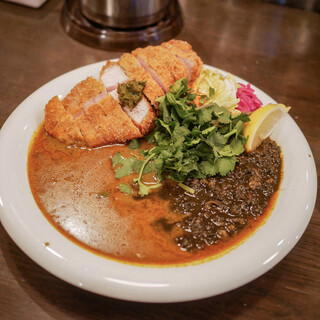
Osaka’s curry culture rewards compact rooms, quick turnover, and serious spice work as much as ceremony. Watanabe Curry Umeda honten fits that lane: a Kitashinchi curry counter with Tabelog Curry WEST 100 selection in 2024, approachable pricing, and a small-room format that suits a focused lunch or early dinner rather than a long occasion.

Pearl is the En Primeur Club membership app, where members save venues, book tables and use the concierge.
The menu
What to order
- Spiced Pork Cutlet Curry
- Premium Pork Cutlet Curry
- Original WATANABE Curry
- Black Curry
- Dry Lamb Curry
- Spinach Keema Curry
Osaka changes by the hour. By day, it feels compressed and businesslike: office workers moving through station exits, building directories stacked with small restaurants, sauce and spice slipping from upper floors. Curry belongs to this rhythm in Osaka: fast enough for a workday, personal enough to create repeat habits, and judged precisely by locals who know convenience from control.
Watanabe Curry Umeda honten sits inside that compact urban grammar, not the grand-restaurant circuit. The category is curry, and the appeal is not ceremony but concentration: a short-format meal and a dining style that suits Osaka, where commuters, office workers, and destination eaters overlap in a practical dining city.
Osaka curry, judged by regulars rather than theatre
Curry is often treated overseas as comfort food, but Osaka gives everyday food a sharper competitive edge. The city takes casual formats seriously, from quick counters to snack shops and department-store basement sweets. Curry fits because it can be casual without being careless. A good shop must manage spice, rice, texture, timing, and service speed under pressure, usually in a room with little margin for error.
The comparison is not a tasting-menu restaurant but Osaka’s dense middle, where a meal can be affordable yet heavily scrutinized. In the same city, London Tea Room Doujima honten occupies a similar everyday price lane, while il PePe moves into a higher dinner bracket and Yakitori Matsuri belongs to a different, charcoal-led night-out economy. Curry is judged less by luxury signals than by consistency and repeatability.
The 2024 Tabelog Hyakumeiten recognition gives this address a credible marker. Tabelog’s Hyakumeiten lists matter in Japan because they capture specialist categories international awards often overlook. For curry, that places the shop among closely watched curry rooms, not Osaka’s fine-dining temples. Expect a serious specialist, not a hushed splurge.
Price reinforces that reading. The listed lunch and dinner budget is JPY 1,000 to JPY 1,999, keeping the meal in Osaka’s practical dining tier while inviting comparison with other category specialists. In a city where premium counters climb quickly, curry is a clean way to read local taste without making the meal an expense-account decision.
A small-format meal in Osaka's vertical dining map
Osaka dining rewards people willing to look up. Restaurants fill upper floors, basements, and narrow buildings that do not announce themselves like street-front venues elsewhere. The city layers lunch counters, evening bars, small dining rooms, and specialist shops into a vertical map. The experience starts before the plate: finding the right entrance, reading the floor directory, and stepping from the lift or stairwell into close quarters rather than spectacle.
Format shapes the meal. Watanabe Curry Umeda honten fits the compact Osaka model: enough movement to feel efficient, not enough ceremony to feel anonymous. The appeal suits solo diners, pairs, and small groups who want a focused curry stop rather than a long, formal reservation. That is part of why curry can work as both a lunch decision and a deliberate destination.
The shop’s 2024 Tabelog Hyakumeiten recognition and 3.71 score show sustained local attention without turning the meal into a luxury signal. For curry, that is more meaningful than one burst of online attention. Regulars are not patient with inconsistency, and Osaka’s casual dining culture tends to reward places that deliver the same clear pleasure repeatedly.
The city explains the appeal. Osaka is not only a transit zone; it is a practical dining engine. A visitor can build a day here without forcing one formal reservation: coffee, bread, sweets, snacks, or a longer dinner elsewhere can all sit around a focused curry stop. Curry fills the gap between snack culture and reservation dining: decisive, local, and finished before the day loses momentum.
How it fits a sharper Osaka itinerary
For travelers mapping Osaka through food, this address balances the city’s more performative meals. It does not replace yakitori, sushi, small counter cooking, or high-end Italian; it explains another Osaka instinct, the refusal to separate everyday food from exacting taste. A better itinerary pairs curry lunch with a more deliberate dinner elsewhere rather than treating every meal as a trophy slot.
The broader Osaka spread is wide. Other Osaka dining rooms show the city’s affection for imported formats handled with local discipline, while Ichioka 45 and Iroha sit in higher-priced or more formal lanes. For a fuller city read, use Our full Osaka restaurants guide alongside Our full Osaka bars guide, Our full Osaka hotels guide, Our full Osaka wineries guide, and Our full Osaka experiences guide. Osaka rewards cross-category planning: a casual curry can say as much as a counter dinner.
Japan’s curry map stretches well beyond Osaka, but the point here is local. Specialist dining across Japan often thrives outside obvious luxury frames, and curry is one of the clearest examples: affordable, repeatable, and still capable of serious scrutiny. Even when Japanese casual forms travel abroad, Osaka’s version is best understood at source, where everyday dining is treated as a matter of taste rather than convenience alone.
The final read is simple: Watanabe Curry Umeda honten is for diners who want Osaka’s seriousness without posture. It belongs to the city’s compact specialist tradition, backed by 2024 Tabelog Hyakumeiten recognition and built for focus. Around it, the itinerary can move several ways: charcoal-led cooking, a higher-priced counter, tea, Italian, or another Osaka meal before the last train. The curry slot has its own logic: quick, precise, and rooted in the city’s appetite for everyday excellence.
Frequently asked questions
Is Watanabe Curry Umeda honten expensive?
Pricing at Watanabe Curry Umeda honten is listed as JPY 1,000 - JPY 1,999 JPY 1,000 - JPY 1,999.
Where exactly is Watanabe Curry Umeda honten?
Osaka.
How far ahead should I plan for Watanabe Curry Umeda honten?
The available details place it in Osaka’s practical curry tier, with lunch and dinner both listed at JPY 1,000 - JPY 1,999. Plan as you would for a focused specialist stop rather than a long formal meal.
What's the standout thing about Watanabe Curry Umeda honten?
Its clearest credential is the 2024 Tabelog Hyakumeiten recognition for curry, supported by a listed score of 3.71. That places the focus on category strength rather than luxury signals.
Do they accommodate allergies at Watanabe Curry Umeda honten?
Those details are not provided here. The price range sits at JPY 1,000–JPY 1,999, which makes that call worth making before ordering. Check the venue's official channels for the latest details.
Is Watanabe Curry Umeda honten suitable for children?
Those details are not provided here. Treat it as a practical curry specialist in Osaka and check the venue's official channels for the latest details before visiting with children.
A Pricing-First Comparison
Comparable venues to place this listing in its category.
| Venue | Cuisine | Price | Awards | Notes |
|---|---|---|---|---|
| Watanabe Curry Umeda hontenThis venue (the venue you are viewing) | Japanese–Sri Lankan Curry House | $10–20 | Tabelog 100 #6 | Not listed |
| Onomichi Murakami | Japanese Teppan-Yaki / Okonomiyaki | $30–50 | Tabelog 100 #36 | Kita, Japanese Teppan-Yaki / Okonomiyaki |
| Udo An | Handmade Soba & Seasonal Izakaya | $30–50 | Tabelog 100 #99 | Chūō, Handmade Soba & Seasonal Izakaya |
| New Babe | Tonkatsu | $20–30 | Tabelog 100 #25 | Chūō, Tonkatsu |
| Grill Baranoki | Japanese-style Western (Yoshoku) | Not listed | Tabelog 100 #21 | Chūō, Japanese-style Western (Yoshoku) |
| Jikaseimen Tsukiyomi | Japanese Ramen / Tsukemen | $10–20 | Tabelog 100 #68 | Higashiyodogawa, Japanese Ramen / Tsukemen |
Recognition history
Dated appearances from independent guides and award organizations, with the underlying list record or original source where available.
Tabelog 100 #6 · No. 6
Tabelog · Tabelog 100 - Curry - WEST - 2024