Village Café

In Gravesend, Brooklyn, Village Café sits at the back of a small parking lot off Coney Island Avenue, easy to miss and known mainly to those who follow Azerbaijani food seriously. The plov, saffron-fragrant rice pilaf topped with stewed fruit and browned lamb, and the handmade dushbara dumplings have earned it, placing it among the city's most credible addresses for this cuisine.
Pearl is the En Primeur Club membership app — saves, bookings, and concierge access live there. Same editors, same standards.
- Address
- 1968 Coney Island Ave, Brooklyn, NY 11223
- Phone
- (718) 975-3373
- Website
- villagecafeny.com
- Directions
- Get directions
 Saves & bookings on Pearl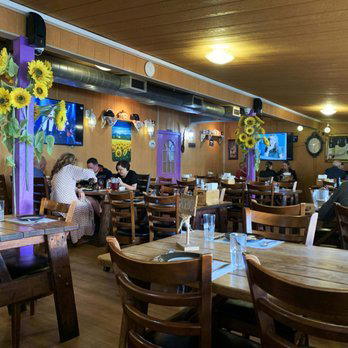
The Case for Making the Trip to Gravesend
If you eat one meal in a Brooklyn neighbourhood that most Manhattan-focused dining guides overlook entirely, make it at Village Café on Coney Island Avenue. That is not a casual endorsement. New York has absorbed successive waves of Azerbaijani immigration, and with them a scattered but serious set of restaurants that serve the food of the South Caucasus with considerably more fidelity than the city's better-publicised dining rooms tend to bring to their own regional traditions.
The address itself signals the culinary geography accurately. Gravesend, in southern Brooklyn, has absorbed significant immigration from the former Soviet republics since the 1990s, and the stretch of Coney Island Avenue between Avenue P and Kings Highway is lined with Uzbek, Georgian, and Azerbaijani restaurants, grocery stores selling dried fruit and sour plums, and bakeries whose windows fill with flatbreads in the early morning. Village Café occupies an unglamorous spot at the rear of a parking lot, the kind of location that filters out visitors who aren't already looking for it, and that concentrates the clientele among people for whom the food is the only point.
What the Food Communicates
Azerbaijani cuisine sits at a crossing point between the Persian, Turkish, and Russian culinary traditions, and its characteristic register is neither the sharp heat of Georgian cooking nor the overt simplicity of much Uzbek food. Saffron runs through the rice dishes in quantities that are rare at this price tier. Dried fruits, barberries, dried apricots, sometimes prunes, appear not as decoration but as structural elements in pilafs and stews, adding acidity and a faint sweetness that counterbalances the fat from slow-cooked meat. The result is a table that reads as warm, aromatic, and dense with accumulated technique.
The plov at Village Café is the dish that draws consistent attention, and it earns that attention. Azerbaijani plov differs from its Uzbek counterpart in that the rice is often cooked separately and then combined with a distinct toppings layer, in this case, stewed fruit and browned lamb, rather than cooked together in a single pot. The saffron fragrance that distinguishes a properly made version is present here in the way it should be: woven into the rice rather than dropped on leading as an afterthought. This approach to plov, time-consuming, technique-dependent, is not the kind of dish that scales easily, and finding a version made with this level of care in a city with New York's pace and real estate pressures is genuinely uncommon.
The soup programme is an equal argument for the kitchen's seriousness. Dushbara, the Azerbaijani dumpling soup, involves handmade wrappers so small they are measured by how many fit on a single spoon. The labour involved is precisely why the dish has become a marker of quality in Azerbaijani home cooking and restaurant contexts alike: it cannot be faked quickly. The borscht on offer takes a different direction, a deep magenta version built with vegetables and meat, closer in spirit to the Eastern European preparation that arrived in Brooklyn with successive immigrant populations, but adjusted here with a generosity of ingredient that keeps it firmly in the category of serious eating.
Placing Village Café in the Broader New York Context
Conversation about New York dining at its formal end involves restaurants like Le Bernardin, Atomix, Eleven Madison Park, Masa, and Per Se, kitchens where the investment per cover reflects decades of institutional prestige. The restaurant operates in a completely different tier and by a different logic. Its authority comes not from awards infrastructure or tasting menu format but from community trust: the 764 reviews that underpin its 4.4 rating represent a constituency of Azerbaijani and Soviet-diaspora diners who left their own kitchens to eat here, which is a different and more demanding standard. Across the United States, the restaurants that have most consistently earned that kind of trust in specific immigrant communities, places like Emeril's in New Orleans for its regional Creole base, or Lazy Bear in San Francisco for its hyper-local following, share this quality of being sustained by the people who understand the food most deeply.
Contrast extends internationally. Kitchens at Alinea in Chicago, The French Laundry in Napa, Single Thread Farm in Healdsburg, Providence in Los Angeles, 8½ Otto e Mezzo Bombana in Hong Kong, and Alain Ducasse at Louis XV in Monte Carlo all operate inside formal Western fine-dining structures where critical apparatus validates quality. The restaurant operates entirely outside that system and doesn't require it. Its cuisine is not well represented in mainstream New York food media, which means the gap between the quality on offer and the attention it receives remains wide, a gap that works in the informed diner's favour.
Getting There and What to Expect
That journey is part of the experience of understanding how the city's most serious ethnic dining actually works: it is distributed across boroughs, concentrated in neighbourhoods built around specific immigrant populations, and largely invisible from the hotel corridors of Midtown or the tasting-menu circuit of the Lower East Side.
Restaurant sits at 1968 Coney Island Avenue, at the back of a parking lot, which means arriving on foot requires a moment of commitment, walking past the parked cars to a space that does not announce itself. The seating is not elaborate; this is a neighbourhood restaurant whose investment is entirely in the food. For anyone building a picture of New York's full dining range, this is a necessary coordinate.
Peers in This Market
Comparable venues nearby, for context on price, style, and recognition.
| Venue | Cuisine | Price | Notes |
|---|---|---|---|
| Village CaféThis venue — the venue you are viewing | Authentic Azerbaijani | $$ | Not listed |
| Ariston Floral Boutique | Floral Cafe with Coffee and Pastries | $$ | East Midtown-Turtle Bay |
| Crown Finish Caves | Artisanal Cheese Affinage Facility | $$ | Crown Heights (North) |
| Buenos Aires | Authentic Argentine Steakhouse | $$ | East Village |
| SAPERAVI | Authentic Georgian | $$ | Gramercy |
| Industria Argentina | Authentic Argentine Steakhouse | $$ | Tribeca-Civic Center |
Recognition history
Dated appearances from independent guides and award organizations, with the underlying list record or original source where available.
New York Times Best Restaurants in New York City
New York Times
Continue exploring
More in New York City
Restaurants in New York City
Browse all →
Bars in New York City
Browse all →
Hotels in New York City
Browse all →







At a Glance
- Cozy
- Rustic
- Intimate
- Family
- Group Dining
- Casual Hangout
- Byob
Current opening hours
- Monday
- 10 AM–10 PM
- Tuesday
- 10 AM–10 PM
- Wednesday
- 10 AM–10 PM
- Thursday
- 10 AM–10 PM
- Friday
- 10 AM–10 PM
- Saturday
- 10 AM–10:30 PM
- Sunday
- 10 AM–10 PM
Hours can change for holidays and private events. Last verified .
Cozy and rustic with pleasant decor, homey artifacts, lively ethnic music, and picnic-style tables creating a welcoming, authentic atmosphere.