Tabelog 100 #45
Our verdict
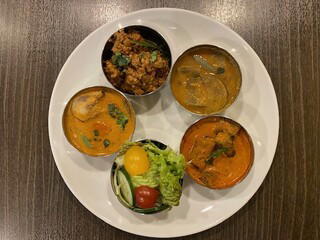
Kinshichō’s South Indian dining scene sits outside Tokyo’s usual luxury corridors, which is exactly the point here. Venu's South Indian Dining Kinshichou ten brings Tabelog 100 recognition, a curry-and-Indian focus, vegetarian-friendly cooking, and a compact neighbourhood-room format to a category where planning matters more than polish.

Pearl is the En Primeur Club membership app, where members save venues, book tables and use the concierge.
The menu
What to order
- South Indian lunch buffet
- Chicken curry
- Aloo korma
- Dosa
- Biryani
Tokyo shifts the rhythm of dining before the table appears. Away from the luxury restaurant circuit, the city has working-day directness: rail traffic, office workers, families, and small dining rooms competing on repeat custom rather than ceremony. Here, Indian curry plays a different role from sushi counters or tasting menus: less theatrical scarcity, more whether a kitchen can deliver a clear point of view consistently enough to pull diners across town.
Venu's South Indian Dining Kinshichou ten belongs to a useful Tokyo category: a specialist restaurant with recognition but without high-end dining codes. Its 2024 listing from Tabelog’s Hyakumeiten record gives it public credibility in a field where many good Indian restaurants remain known through local loyalty. The point is not trophies; the listing signals that Tokyo’s serious curry audience treats this room as more than a convenient local option.
Indian cooking in a Tokyo curry city
Tokyo has long been a curry city, but the category spans Japanese curry shops built around roux and rice, Indian restaurants with many different formats, and curry specialists where spice, texture, and pacing often carry the meal. A restaurant like Venu's South Indian Dining Kinshichou ten asks a different question from generic curry comfort: how much range can a kitchen create within a focused Indian and Indian-curry identity?
That distinction matters in Tokyo because the city rewards restaurants legible to regulars. The public categories here are Indian and Indian curry, with a Tabelog score of 3.49 and listed budgets of Dinner: JPY 4,000 - JPY 4,999; Lunch: JPY 1,000 - JPY 1,999. Those details put the restaurant in a practical Tokyo lane: a meal can work for curry-focused diners who care less about ceremony than about a specialist format with a clear reason to visit.
On the broader dining map, the comparison is less with luxury rooms than with focused specialists that draw people for a specific craving. A curry-focused reader might cross-reference other Tokyo dining rooms, while a low-friction Tokyo dining day might pair this part of the city with the broader options in Our full Tokyo restaurants guide. The useful distinction is format: this is a specialist, not a status restaurant trying to be everything to everyone.
The room favors repeat diners over ceremony
The stronger Tokyo restaurants in this price-and-format tier remove friction without losing point of view. Venu's South Indian Dining Kinshichou ten is best understood through its public record: Indian and Indian curry categories, a 2024 Hyakumeiten source listing, and a budget that keeps it outside the expensive fine-dining bracket. These practical signals also describe the dining culture: accessible enough for everyday planning, serious enough to appear in a recognized curry and Indian-dining context.
Longevity claims are less useful than the evidence that is actually visible. The 2024 recognition places the restaurant inside a current Tokyo conversation about curry and Indian dining rather than relying on vague reputation. That widening conversation matters: Tokyo diners now make finer distinctions among curry specialists, Indian restaurants, and other casual formats. A focused Indian-curry restaurant benefits from that literacy.
Booking experience should be read accordingly. This is not a meal defined by a months-long waitlist or chef’s-counter ritual. The planning value is knowing its category and why it has a following: recognized Hyakumeiten context, Indian-curry credentials, and a Tokyo setting outside the usual hotel-and-department-store dining loop. For travelers, it is a useful counterweight to a Tokyo itinerary heavy on omakase, kappo, and cocktail bars.
How to place it in a Tokyo itinerary
Tokyo is not only a city of prestige districts, which is part of the appeal for anyone trying to understand its dining beyond the most obvious names. The city shows everyday demand clearly: people eat close to transit, return to reliable rooms, and reward consistency over performance. Indian curry fits because the format can be casual without being simple.
For a broader Tokyo arc, this meal works as a corrective. Pair it mentally with the precision of other counter restaurants, the ease of casual grill rooms, or a quick stop elsewhere in the city. These comparisons are not rankings; they show Tokyo’s strength in narrow specialization. A city that sustains curry specialists, yakitori counters, seafood grills, and character cafés is a city where category knowledge matters.
The same logic applies beyond restaurants. Travelers building a fuller trip can map meals against Our full Tokyo hotels guide, after-dinner routes through Our full Tokyo bars guide, drinks context in Our full Tokyo wineries guide, and cultural pacing from Our full Tokyo experiences guide. The value is clearest when the restaurant is treated not as a sightseeing detour, but as part of Tokyo’s deeper habit of rewarding specialists in ordinary dining contexts.
For readers tracking regional Japanese dining more broadly, the same specialist logic appears across many kinds of focused rooms in Tokyo and beyond. Even when the format changes, the editorial lesson is consistent: a restaurant with a defined identity is usually easier to understand than one built around generic ambition. Venu's South Indian Dining Kinshichou ten sits in that more useful camp because its public record is specific without needing overstatement.
The verdict is clear without exaggeration. In Tokyo, where premium attention often flows toward counters with strict rituals, Venu's South Indian Dining Kinshichou ten offers another kind of intelligence: 2024 Hyakumeiten-backed credibility, Indian-curry focus, and the confidence of a specialist restaurant. It suits diners who plan around category and context rather than status alone.
Frequently asked questions
What price level is Venu's South Indian Dining Kinshichou ten?
Pricing at Venu's South Indian Dining Kinshichou ten is listed as Dinner: JPY 4,000 - JPY 4,999; Lunch: JPY 1,000 - JPY 1,999.
When can I go to Venu's South Indian Dining Kinshichou ten?
Check the venue's official channels for current opening hours before visiting Venu's South Indian Dining Kinshichou ten.
Where is Venu's South Indian Dining Kinshichou ten in Tokyo?
Tokyo.
What's the standout thing about Venu's South Indian Dining Kinshichou ten?
Its clearest credential is a 2024 Tabelog Hyakumeiten listing. The public record also lists the categories as Indian and Indian curry, with dinner budgeted at JPY 4,000 - JPY 4,999 and lunch at JPY 1,000 - JPY 1,999.
Can Venu's South Indian Dining Kinshichou ten adjust for dietary needs?
Discuss any dietary needs directly with Venu's South Indian Dining Kinshichou ten before booking or visiting. Check the venue's official channels for the latest details.
Just the Basics
Side-by-side context: comparable cuisine and price.
| Venue | Cuisine | Price | Awards | Notes |
|---|---|---|---|---|
| Venu's South Indian Dining Kinshichou tenThis venue (the venue you are viewing) | Authentic South Indian Dining | $20–30 | Tabelog 100 #45 | Not listed |
| Coffee Senmon Ten Tomii | Not listed | $10–20 | Tabelog 100 | JPY 999 JPY 1,000 - JPY 1,999 View spending breakdown |
| Tori Ki | Yakitori Omakase Counter | $100–150 | Tabelog 100 #7 | JPY 10,000 - JPY 14,999 |
| sugahara | Homestyle Italian | $50–100 | Michelin Bib Gourmand | Italian |
| Jun Teuchi Sanuki Udon Goro | Not listed | Not listed | Tabelog 100 #30 | JPY 999 |
| Genki | Okonomiyaki / Teppanyaki / Izakaya | Not listed | Tabelog 100 #74 | JPY 4,000 - JPY 4,999 |
Recognition history
Dated appearances from independent guides and award organizations, with the underlying list record or original source where available.
Tabelog 100 #45 · No. 45
Tabelog · Tabelog 100 - Asian cuisine / Ethnic cuisine - TOKYO - 2024