
Tabelog 100 #69
Our verdict
A compact Haruta ramen counter with tsukemen at the centre of its reputation, Tsukemen Maruwa Haruta honten belongs to Nagoya’s serious everyday noodle culture rather than its expense-account dining circuit. Its 2025 Tabelog 100 Ramen Aichi selection, 17-seat format, and walk-in orientation make it a useful marker for how much craft can sit inside a quick, low-cost meal in suburban Nagoya.

Pearl is the En Primeur Club membership app, where members save venues, book tables and use the concierge.
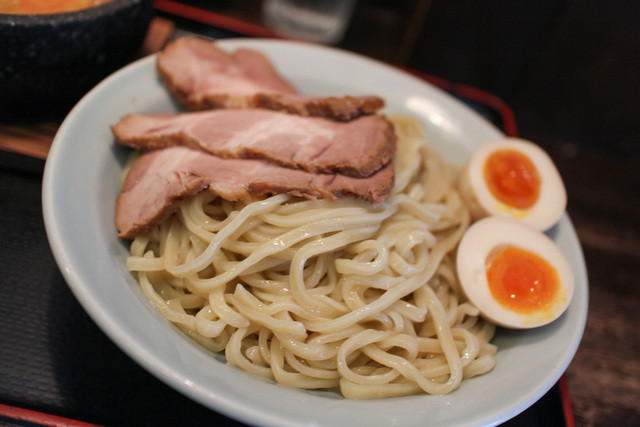
The menu
What to order
- Maruwa tsukemen
- Karoku tsukemen
- Chuka soba
- Taiwan mazesoba
- Jirunashi ebi-shio (soupless shrimp salt noodles)
Approaching a compact ramen shop in Nagoya differs from entering the city’s more polished dining rooms. The rhythm is smaller and functional: a short meal, a counter-style mindset if luck holds, and a room built for noodles, not ceremony. That matters. Tsukemen, with noodles and dipping broth served separately, rewards temperature, timing, and texture more exactingly than a standard ramen bowl, even at an everyday price.
Tsukemen Maruwa Haruta honten fits that Nagoya pattern: serious food without luxury theatre. Its categories tell the story plainly: tsukemen, ramen, and Taiwanese mixed noodles, placing the shop where national ramen craft meets the city’s appetite for punchier mixed-noodle formats. Its inclusion in Tabelog 100 Ramen Aichi 2025 gives the restaurant a clear credential in a prefecture where noodle shops compete on repeat custom as much as destination dining. For the city’s wider restaurant range, start with Our full Nagoya restaurants guide.
Haruta's noodle counter makes more sense when lunch and dinner are read differently
Daytime ramen in Japan often works like a precision pit stop: solo diners, quick turnover, and sharp value. Evening loosens the mood, even when the menu architecture stays similar. The same bowl or dipping-noodle set shifts from workday refuel to casual Nagoya dinner. That divide matters here because the format is not tasting-menu escalation. It is a choice: tsukemen for concentration and chew, ramen for immediacy, Taiwanese mixed noodles for Nagoya’s spicier local register.
The shop helps travellers understand Nagoya through meals locals repeat. The city’s dining identity is not only higher-spend counters and special-occasion rooms. It is also the everyday calculus of a focused ramen stop, where the meal depends on speed, clarity, and consistency. In spirit, it can be read alongside Nagoya peers such as Kodawari Men Kobo Tago, Ramen, or Manpuku without forcing them into the same role. The point is not hierarchy, but use case: different dining brackets serve different kinds of eating day.
The low-cost ramen tier also resists luxury-restaurant language. A Tabelog score of 3.56 and a 2025 Tabelog 100 Ramen Aichi selection place it inside a competitive local conversation. The better question is not whether the shop is grand, but why an inexpensive format carries such scrutiny. In Japan, ramen is judged by small variables: broth concentration, noodle texture, serving temperature, and repetition across service. Tsukemen adds another layer because dipping broth must season noodles forcefully without collapsing into heaviness.
Tsukemen, ramen, and Taiwanese mixed noodles point to Nagoya's casual dining grammar
Nagoya’s noodle culture holds both inherited ramen forms and local hybrids. Taiwanese mixed noodles sit naturally beside ramen and tsukemen because all three fit compact, high-turnover dining. The menu categories at Tsukemen Maruwa Haruta honten show that range without needing a long chef résumé. The craft is embedded in the format: separate noodles and broth for tsukemen, full-bowl integration for ramen, and sauce-driven mixing for the Taiwanese style.
Here lunch and dinner split again. At lunch, tsukemen can be the more deliberate choice because it asks the diner to manage the meal: dip, eat, repeat, watching how the broth coats the noodles. At dinner, the same format becomes a casual anchor for diners looking for a straightforward Nagoya noodle meal. The point is that a serious noodle shop can still function as an everyday restaurant, not only as a specialist destination for ramen obsessives.
For visitors building a Nagoya itinerary, this stop pairs better with everyday plans than with a formal night out. The shop is in Nagoya, so it rewards travellers already moving through the city or willing to make a focused noodle detour. For contrast across the city’s hospitality scene, compare the restaurant map with Our full Nagoya hotels guide, Our full Nagoya bars guide, Our full Nagoya wineries guide, and Our full Nagoya experiences guide. The point is not to force ramen into a luxury frame, but to see where it sits in the day: efficient, exacting, and often more revealing than a longer meal.
How to place it inside a Nagoya eating day
The strongest case for this restaurant is editorial rather than decorative. It shows how Nagoya’s casual dining can be low-cost and closely judged, with a recognized ramen selection attached to a focused noodle shop in the city. Timing matters more than planning theatrics. The format means fitting into the flow rather than controlling it. That is common to many serious ramen shops in Japan, and part of the appeal: the meal is brief, but standards are not loose.
Travellers mapping a fuller Japan dining route can use it as a Nagoya counterpoint to different formats, from other unnamed casual counters and hotel restaurants to regional dining stops elsewhere in Japan. Within Nagoya, the comparison is most useful when kept close to the local field: Curry Senmon Ten cafe New Delhi, Kodawari Men Kobo Tago, Manpuku, Pont-l'Eveque, Ramen, and Tsukemen Maruwa Haruta honten each show a different way that everyday dining, budget, and recognition can intersect. For Japanese food culture abroad, the broader lesson is how different the same national vocabulary can feel once it leaves Japan.
The verdict is simple: Tsukemen Maruwa Haruta honten is for travellers who take casual food seriously. Lunch highlights speed and value; dinner lets the everyday Nagoya function come forward. Either way, the draw is not spectacle. It is the discipline of a small Nagoya noodle shop with enough recognition to justify the detour and enough everyday utility to explain why the format endures.
Frequently asked questions
How much does it cost to eat at Tsukemen Maruwa Haruta honten?
Pricing at Tsukemen Maruwa Haruta honten is listed as - JPY 999 - JPY 999.
Where exactly is Tsukemen Maruwa Haruta honten?
Nagoya.
Can I walk in to Tsukemen Maruwa Haruta honten?
Tsukemen Maruwa Haruta honten is a casual noodle restaurant in Nagoya, so visitors should plan around the rhythm of a compact ramen shop rather than a formal dining room.
What has Tsukemen Maruwa Haruta honten built its reputation on?
Its main credential is the Tabelog 100 - Ramen - AICHI - 2025 selection. The menu focus is clear: tsukemen, ramen, and Taiwanese mixed noodles, with a price range listed at JPY 999 or less.
Can Tsukemen Maruwa Haruta honten accommodate dietary restrictions?
The menu centers on noodles, so diners with specific restrictions should check carefully before going. The confirmed categories are tsukemen, ramen, and Taiwanese mixed noodles.
Is Tsukemen Maruwa Haruta honten a family-friendly restaurant?
The available venue details do not provide a specific family-friendly policy. For mixed-age groups, it is best treated as a compact Nagoya noodle shop and planned accordingly.
Reputation Context
Comparable venues to place this listing in its category.
| Venue | Cuisine | Price | Awards | Notes |
|---|---|---|---|---|
| Tsukemen Maruwa Haruta hontenThis venue (the venue you are viewing) | Tsukemen and ramen shop | $10–20 | Tabelog 100 #69 | Not listed |
| coffee house KAKO Hanaguruma honten | Traditional Nagoya kissaten & coffeehouse | $10–20 | Tabelog 100 | Nakamura |
| Komugi to Yakiago Sugure | Ramen and Tsukemen | $1–10 | Tabelog 100 #40 | Mizuho |
| Ramen mellow | Ramen shop | Not listed | Tabelog 100 #3 | Midori |
| tokyo miso style IKEDA | Tokyo-style miso ramen shop | $1–10 | Tabelog 100 #68 | Nakamura |
| Ichiyoken | Nagoya tonkotsu ramen shop | $10–20 | Tabelog 100 #80 | Tenpaku |
Recognition history
Dated appearances from independent guides and award organizations, with the underlying list record or original source where available.
Tabelog 100 #69 · No. 69
Tabelog · Tabelog 100 - Ramen - AICHI - 2025
Continue exploring
More in Nagoya
Restaurants in Nagoya
All restaurants in Nagoya →




Details
- Lively
- Casual
- Cozy
- Solo
- Casual Hangout
- After Work
- Family
- Standalone
- Beer Program
- A La Carte
- Counter Dining
- Beer
Compact neighborhood noodle shop with counter‑focused seating and a casual, bustling atmosphere typical of popular ramen and tsukemen spots.