The Palm

The Palm on Campos Elíseos brings a particular strain of American steakhouse tradition to Polanco, one that predates the farm-to-table era and has no interest in pretending otherwise. Dark wood, dim lighting, and a menu anchored in prime cuts and whole lobster position it as a deliberate counterpoint to Mexico City's contemporary dining scene. For those who return regularly, the draw is precisely that nothing changes.
 Discover on Pearl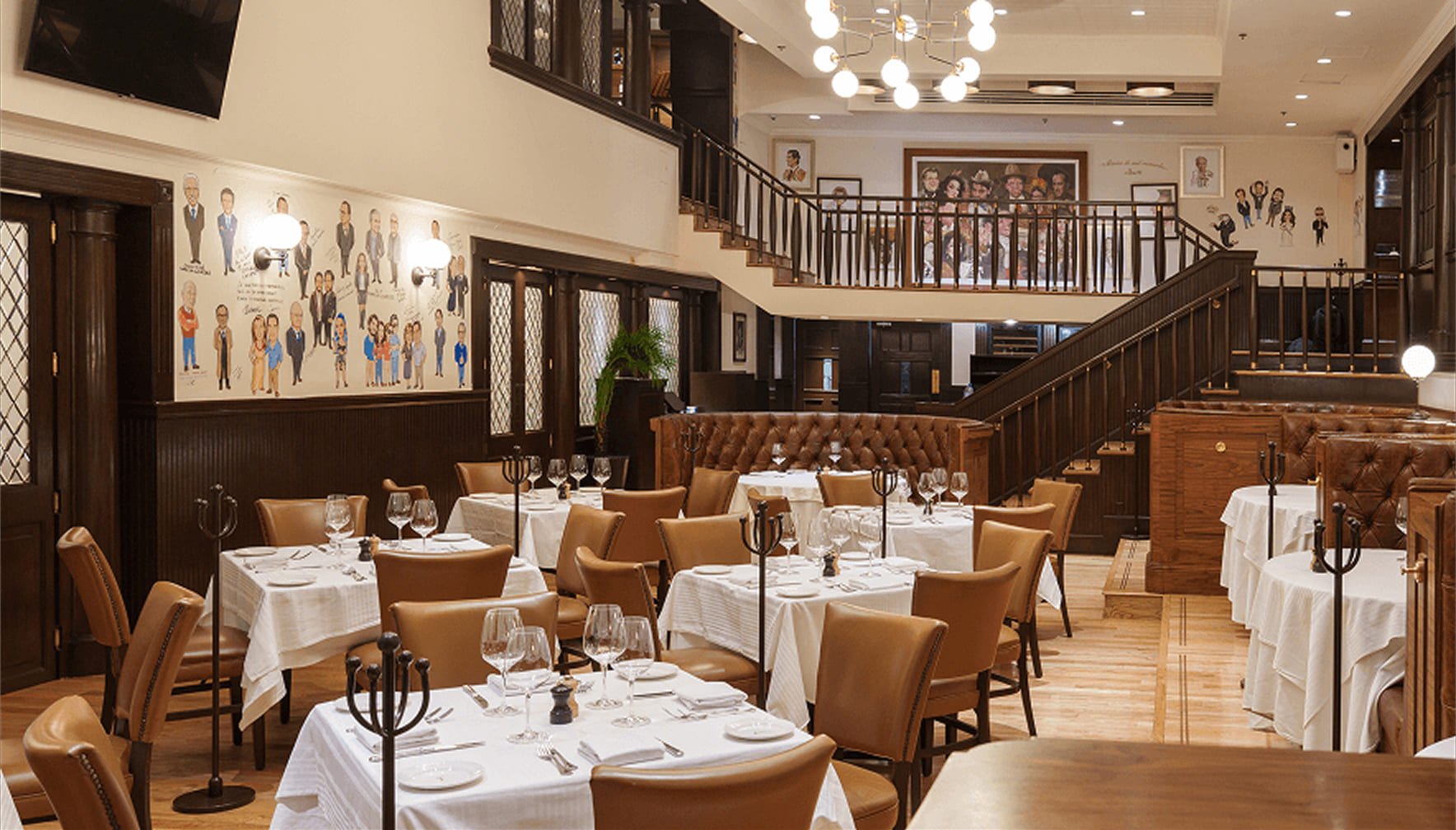
The Room That Time Built
Polanco operates as Mexico City's most concentrated stretch of international dining, where Pujol and Quintonil represent the apex of the contemporary Mexican canon and European imports hold serious ground on Campos Elíseos and its surrounding blocks. Inside this competitive corridor, The Palm occupies a position that almost none of its neighbours can claim: it is aggressively, deliberately unchanged. The dining room carries the visual grammar of a mid-century American steakhouse, dim lighting, dark wood panels, and that particular atmosphere where the walls seem to absorb sound and slow the pace of a meal down to something that feels closer to an event than a transaction. The effect is less about nostalgia and more about conviction. Some rooms are built to last.
The comparison that surfaces most reliably among the restaurant's regulars is old New York, specifically the kind of room where a deal might close over a ribeye and a martini, where the formality is understood rather than enforced, and where the staff know returning guests by their drink order. That sensibility, which has largely retreated from Manhattan itself, survives with some consistency in outposts like this one. For the international business community concentrated in Polanco, and for the Mexico City regulars who have been coming here for years, that consistency is the product.
The shortlist, unlocked.
Hard-to-book tables, cellar releases, and concierge-planned trips.
Get Exclusive Access →What the Menu Actually Promises
The Palm's format belongs to a specific and durable American tradition: the steak and lobster house. This is not a genre that Mexico City has in abundance. The broader restaurant scene here skews toward creative tasting menus, regional Mexican cooking refined through fine-dining technique (as at Em or Sud 777), and European bistro formats. The classic American chophouse sits in a separate category entirely, and The Palm is one of the few places in the city where that format is executed without apology or irony.
Menu's anchors are prime steaks and whole lobster, the twin pillars of the American steakhouse at its most traditional. Regular guests tend to operate from a mental shortlist rather than reading the menu fresh each visit, which is one of the more reliable signals that a restaurant of this type is doing something right. The kitchen's job in a room like this is not to surprise; it is to deliver what the regular already knows is coming, cooked the way they specified, without variation. That is a different discipline from tasting-menu creativity, and the clientele here are not arriving in search of discovery.
For those exploring Mexico's broader dining geography, the contrast is instructive. Restaurants like Levadura de Olla in Oaxaca, Animalón in Valle de Guadalupe, or KOLI Cocina de Origen in Monterrey are deeply embedded in regional Mexican tradition. The Palm makes no such claim. It is an American institution operating on Mexican soil, and it does not attempt to resolve that tension.
The Regulars' Calculus
What brings people back to a restaurant like this, repeatedly, over years, is rarely the food in isolation. It is the accumulation of a relationship with the room itself: the knowledge that your table will be where you expect it, that the staff will remember your preference, that the evening will unfold along familiar lines. Mexico City's dining scene rewards adventurousness, and there is no shortage of reasons to eat at Rosetta or to work through the current tasting menu at Quintonil. But the regulars who anchor a place like The Palm are making a different calculation. They are trading novelty for reliability, and at this level of the market, reliability is genuinely difficult to maintain.
The American steakhouse format has its own unwritten codes. Portions run large by any standard. The wine list at properties like this tends toward the recognizable: Napa Cabernet, classic Bordeaux, the kind of bottles that read clearly to a corporate dining room. Timing is structured around the main course rather than built around a succession of small plates. These conventions extend across the format globally, from Emeril's in New Orleans to Le Bernardin in New York City's immediate neighbourhood in Midtown, where the business dining infrastructure still runs on chophouse time. The Palm in Polanco operates within that same tradition.
The dress code at this kind of establishment tends toward smart casual at minimum, with business attire still common among the core clientele. The atmosphere is formal enough to signal occasion without requiring it, which is precisely the balance that makes it useful for a range of purposes: client dinners, celebrations, the kind of meal that needs a room that will do some of the work for you.
Polanco as Context
Neighbourhood itself matters here. Polanco is Mexico City's most internationally legible dining district, the area a foreign visitor is most likely to have a restaurant recommendation for before landing. Campos Elíseos in particular sits at the higher end of the area's pricing tier, where the address carries its own signal. The Palm's location on that street places it in a peer set defined less by cuisine type and more by positioning: places where the room, the service register, and the price point all communicate a particular kind of seriousness.
For a fuller picture of what Polanco and Mexico City's broader dining geography have to offer, our full Mexico City restaurants guide maps the scene across neighbourhoods and formats. Those planning a longer stay will also find value in our Mexico City hotels guide, our bars guide, our wineries guide, and our experiences guide for a complete orientation. For those moving beyond the capital, the restaurant programming at HA' in Playa del Carmen and Le Chique in Puerto Morelos and Lunario in El Porvenir represent the kind of destination-specific dining that rewards advance planning.
The Palm sits at Campos Elíseos 218, in the Polanco IV Secc section of Miguel Hidalgo. Reservations are advisable for weekday dinner, and more so for weekend evenings when the business crowd gives way to a broader range of guests. It occupies a specific and largely unchallenged position in Mexico City's dining ecology: the room you go to when you want the meal to feel like a transaction well completed, or a relationship well maintained, rather than a discovery in progress.
The shortlist, unlocked.
Hard-to-book tables, cellar releases, and concierge-planned trips.
Get Exclusive Access →Frequently Asked Questions
Just the Basics
A compact peer snapshot based on similar venues we track.
Need a table?
Our members enjoy priority alerts and concierge-led booking support for the world's most difficult tables.
Get Exclusive AccessThe shortlist, unlocked.
Hard-to-book tables, cellar releases, and concierge-planned trips.
Get Exclusive Access →