The Black Bull
Our verdict
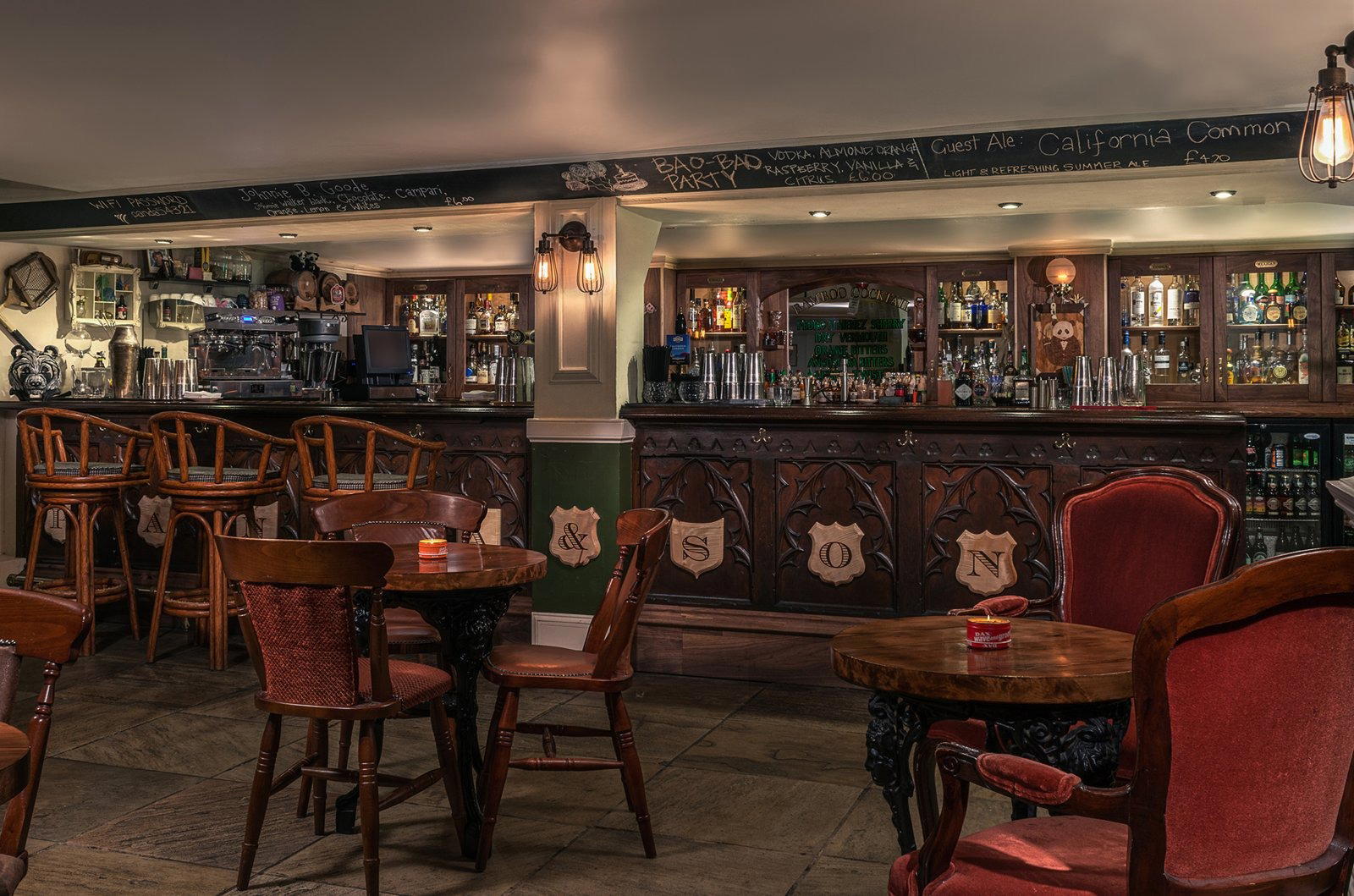
The Black Bull sits on the Grassmarket, one of Edinburgh's oldest trading squares, where the pub tradition runs deeper than almost anywhere in the city. As a landmark address in a neighbourhood that has defined Scottish public drinking for centuries, it represents the kind of place where the room itself does the talking, stone walls, low ceilings, and a location that has seen more of Edinburgh's history than most guidebooks cover.

Pearl is the En Primeur Club membership app, where members save venues, book tables and use the concierge.

Where the Grassmarket Sets the Terms
The Grassmarket is one of Edinburgh's most historically loaded addresses. For centuries it functioned as the city's primary market square, a site of public execution, cattle trading, and the kind of street-level commerce that shaped urban Scottish life long before the New Town was even planned. The pubs that occupy it today are not decorative reconstructions of that past, they are, in many cases, continuous with it. The Black Bull at 12 Grassmarket sits inside that continuum, occupying a position in Edinburgh's pub geography that is defined less by interior design choices than by the weight of the location itself.
That distinction matters when you're orienting yourself among Edinburgh's drinking and dining options. The city's higher-end restaurant tier, places like The Kitchin, Martin Wishart, and Condita, operates in a different register entirely, with tasting menus, formal service structures, and price points that signal a specific kind of occasion dining. The Grassmarket addresses occupy a separate and equally legitimate tier: neighbourhood anchors where the room's age and the street's character do most of the editorial work.
Scottish Sourcing and the Pub Kitchen Tradition
Scotland's pub kitchens have historically occupied an awkward position between the country's exceptional larder and the pressures of a format designed around drink rather than food. The central tension is real: Scotland produces some of the most sought-after raw ingredients in the northern hemisphere, Aberdeen Angus beef, West Coast shellfish, Highland game, Speyside smoked fish, yet translating that sourcing quality into pub food that remains accessible in price and approachable in format has never been direct.
The more considered Grassmarket pubs have moved toward a model where local and regional sourcing is the visible argument on the menu, even when the cooking style stays resolutely unfussy. This aligns with what has happened across Edinburgh's broader food scene, where ingredient provenance has become a shared value across price tiers. Timberyard made Scottish and Nordic sourcing central to its identity at the ££££ level; at the street-level pub end, the same impulse shows up differently, with blackboard specials built around what's arrived from particular farms or fishing ports rather than around a chef's tasting narrative.
This sourcing orientation connects Edinburgh's pub culture to a wider British conversation. At the fine-dining end of that conversation, places like L'Enclume in Cartmel and Moor Hall in Aughton have made hyper-local sourcing the structural basis of the entire menu. In Edinburgh's historic pub addresses, the same principle applies at a different scale and price point, but the underlying argument, that where food comes from matters as much as what's done to it, is consistent across the spectrum.
The Grassmarket as a Dining and Drinking District
Understanding The Black Bull requires understanding the Grassmarket as a hospitality district in its own right. The square sits at the base of the Castle Rock, beneath the shadow of Edinburgh Castle's western wall, and the geography creates a particular atmosphere: enclosed, slightly sunken relative to the surrounding Old Town, and oriented around a central space that still reads as a gathering point. Visitors arriving from the Royal Mile descend into it; those coming from the Cowgate approach from the east along what was historically one of the city's most congested urban corridors.
The result is a neighbourhood that draws both tourists navigating the Old Town and locals who have used it as a base for evening drinking for generations. This dual audience is worth noting because it shapes what the better Grassmarket venues choose to be. The ones that have lasted are not exclusively tourist traps nor purely local institutions, they operate across both registers, which requires a menu and a room that can serve both sets of expectations without collapsing into either.
Edinburgh's pub culture in this district has also been shaped by the festival effect. During August, the Grassmarket becomes one of the most densely visited parts of the city, and the operational demands on venues shift significantly. The pubs that manage the Festival period well are generally those with enough structural depth, physical space, sourcing relationships, kitchen capacity, to absorb the volume without abandoning the character that makes them worth visiting in the first place.
Placing The Black Bull in the Edinburgh Eating Map
For visitors already familiar with Edinburgh's tasting-menu tier, AVERY on the creative end, or The Kitchin at the more classically grounded end of modern Scottish cooking, The Black Bull operates in a deliberately different register. It is not competing with those addresses, and the reader who understands that distinction will use it correctly.
Within the UK pub dining context, this tier has produced some genuinely significant venues, Hand and Flowers in Marlow is the most cited example of what pub-format dining can achieve at the leading end, but the Grassmarket addresses are not reaching for that level, and they are more useful precisely because they are not.
For international visitors arriving from dining cultures where pub food is either irrelevant or unfamiliar, the reference point matters. Edinburgh's Old Town pub at its finest is comparable in function, if not in format, to the kind of neighbourhood bistro anchors that define districts in Paris or the market-adjacent tavernas that anchor Greek old towns. The room, the location, and the availability of Scottish-sourced food in an informal setting are the offer, not a progression of courses or a chef's singular vision.
Venues at the international end of the dining register, Le Bernardin in New York City or Atomix in New York City, represent a fundamentally different proposition, and the reader calibrating between those and a Grassmarket pub address should do so with that gap clearly in mind. Both are valid choices; they answer different questions about how to spend an evening.
For a broader orientation across Edinburgh's restaurants, see our full Edinburgh restaurants guide, which maps the city across price tiers, neighbourhoods, and cuisine traditions.
Know Before You Go
Planning Notes
- Address: 12 Grassmarket, Edinburgh EH1 2JU
- District: Grassmarket, Old Town
- Getting There: The Grassmarket is a 10-minute walk from Edinburgh Waverley station via the Cowgate, or accessible from the Royal Mile by descending Victoria Street
- Timing: The square is significantly busier during the Edinburgh Festival (August) and around Hogmanay; midweek visits outside peak season offer a different, quieter experience of the space
Frequently asked questions
Where exactly is The Black Bull?
The Black Bull is located at 12 Grassmarket, Edinburgh EH1 2JU, United Kingdom, Edinburgh.
Is The Black Bull a good base for exploring the Edinburgh Old Town?
The address at 12 Grassmarket places it squarely at the base of Edinburgh Castle, within easy reach of the Royal Mile and the wider Old Town without requiring any neighbourhood-crossing. For visitors working through Edinburgh on foot, the Grassmarket functions as a natural pause point between sightseeing and an evening of eating and drinking in the same square.
What do regulars order at The Black Bull?
The Black Bull sits in a pub tradition built around approachable Scottish staples rather than elaborate kitchen ambition. At a Grassmarket address like 12 Grassmarket EH1, the draw is reliable, unfussy cooking that reflects Scotland's larder without overreaching the format. Think the kind of menu where haggis, pies, and hearty mains do the work that a tasting counter would leave to technique.
Do they take walk-ins at The Black Bull?
Grassmarket pubs at this address have historically operated on a walk-in basis through most of the day. Capacity tightens on weekend evenings and during Edinburgh's festival periods, when the square draws significantly heavier foot traffic. Arriving before peak evening hours gives the best chance of a seat without a booking.
What It’s Closest To
Comparable venues nearby, for context on price, style, and recognition.
| Venue | Cuisine | Price | Notes |
|---|---|---|---|
| The Black BullThis venue (the venue you are viewing) | Traditional Scottish Gastropub | $20–30 | Not listed |
| Slug & Lettuce | British Gastropub | $20–30 | New Town |
| Commons Club Edinburgh | Modern Scottish Brasserie | $50–100 | Old Town |
| Greenwoods | Scottish/Dutch Brunch Fusion | $10–20 | New Town |
| Wedgwood The Restaurant | Modern Scottish | $50–100 | St. Leonard's |
| Cafe Marmalade | Scottish Cafe | $10–20 | Leith |