Storstad


1 Michelin Star · Star Wine List
Our verdict
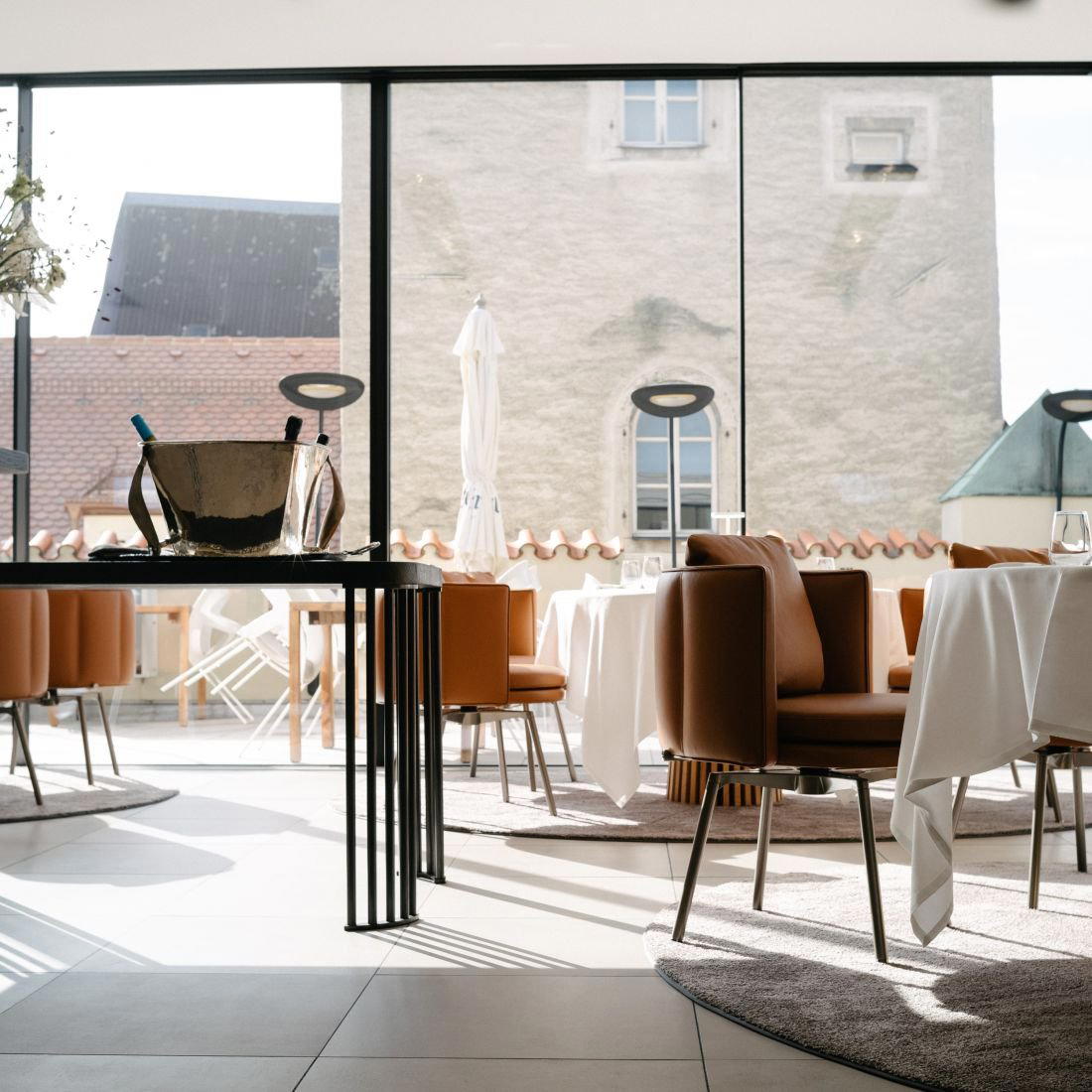
Storstad holds a Michelin star in the historic centre of Regensburg, operating from a medieval side street off Watmarkt. Chef Anton Schmaus named the restaurant after Stockholm, where he trained, and that northern European influence shapes a creative menu structured around precision and restraint. At the €€€€ tier, it occupies Regensburg's upper bracket alongside a small handful of ambitious kitchens.

Pearl is the En Primeur Club membership app, where members save venues, book tables and use the concierge.
The menu
What to order
- Sea bass grilled on charcoal
- Beef tartare with kombu
- Duroc pork with fennel and pimiento de piquillo
- Swordfish ceviche
A Medieval Street, a Stockholm Name, and a Kitchen Built Around Architecture
Regensburg is a city defined by its medieval core and Danube setting. Its reputation runs on Roman history, Gothic spires, and the dense medieval streetplan that earned it UNESCO World Heritage status in 2006. Dining in the city's old centre tends to mean Bavarian tradition in stone-vaulted rooms, and the supply of serious creative kitchens is thin. That context matters when locating Storstad, which sits on Watmarkt 5, one of the narrow lanes threading through the old town's core. The surroundings are centuries-old masonry. The cooking inside is not.
The name is Swedish for "city", a direct reference to Chef Anton Schmaus's time at F12 in Stockholm, one of Scandinavia's more technically demanding restaurants before its closure. That lineage frames how you should read the menu: not as Bavarian cooking with garnishes, but as a creative programme shaped by northern European precision and a structural philosophy that Schmaus brought back to his home region. For diners travelling to Regensburg from Munich, Nuremberg, or further afield, the combination of location and approach makes Storstad the city's most discussed serious table. Its Michelin star has remained intact, giving the restaurant continuity rather than novelty in a city this size.
What the Menu Architecture Reveals
Creative-format restaurants at the €€€€ price tier tend to fall into one of two structural camps. The first prioritises produce provenance as the organising principle, each course named for its origin, the menu reading like a regional map. The second uses technique and composition as the frame, with provenance appearing as supporting context rather than headline. Storstad's Stockholm reference suggests the latter orientation. Scandinavian-influenced kitchens of the F12 generation built menus around restraint of presentation and precision of flavour layering, where courses are designed as a cumulative sequence rather than individual showpieces.
That approach has direct implications for how you experience a meal here. Courses are likely to reward attention to detail rather than immediate visual drama. The progression through a menu at this tier and in this tradition tends to build in intensity and complexity, with earlier courses functioning almost as calibration for the palate. Sauces and reductions carry more weight than at produce-first kitchens; technique is not hidden but is framed as a tool serving coherence rather than spectacle. For a peer comparison, consider how JAN in Munich uses a similar structural discipline to build a menu that rewards course-by-course attention, or how ES:SENZ in Grassau applies Bavarian-adjacent creativity within a similarly tight, sequenced format.
What distinguishes Storstad within the narrow field of Regensburg fine dining is the absence of direct local competition at this structural level. Ontra's Gourmetstube operates at the same price tier and holds its own ambition, while ROTER HAHN by Maximilian Schmidt brings a different modern approach to the city's upper bracket. Below that, the €€ tier, represented by places like Kreutzer's and Ontra, operates in a different register entirely. Storstad does not have a direct structural twin in the city, which gives it a position that is more clearly defined than it might be in a larger market.
Regensburg as a Fine Dining Address
Germany's Michelin-starred kitchen count is concentrated in a familiar geography: Munich, Hamburg, Berlin, the Rhineland, and a handful of destination restaurants in smaller towns that draw travelling diners specifically. Regensburg sits outside that primary circuit. A city of around 160,000 people, it draws visitors primarily for its medieval architecture and its position on the Danube, not for its restaurant scene. That creates both a constraint and an opportunity for a kitchen like Storstad. The constraint is a local market that is smaller and less habituated to high-commitment tasting format dining than audiences in Munich or Frankfurt. The opportunity is that a single Michelin-starred address in a historic city becomes the reference point for the entire category in that city, a position that is structurally harder to achieve in, say, Berlin, where CODA Dessert Dining operates within a far more competitive field.
For context on where Storstad sits within Germany's broader creative-format kitchen conversation, it occupies a tier below two- and three-star addresses like Aqua in Wolfsburg, Schwarzwaldstube in Baiersbronn, or Vendôme in Bergisch Gladbach, but its consistent one-star retention across multiple years puts it in the company of Germany's more stable mid-tier creative kitchens. Internationally, a structural comparison to Alléno Paris au Pavillon Ledoyen or Enrico Bartolini in Milan illustrates the difference in scale and resource available to large-city creative programmes, which makes Storstad's consistent recognition more, not less, significant.
The Role of Chef Anton Schmaus
German creative kitchens at this tier are frequently shaped by a defining international training period, an apprenticeship or stage that provides both technical vocabulary and a point of differentiation from the local tradition. Schmaus's time at F12 in Stockholm is the evident reference for Storstad, right down to the name. F12 was known for its clean, disciplined approach to Scandinavian-inflected fine dining, and that influence reads in how Storstad positions itself relative to the Bavarian culinary baseline. It is worth noting that current day-to-day kitchen responsibility sits with Chef Sascha Kurgan, whose role in maintaining the Michelin star through both the 2024 and 2025 cycles signals operational depth beyond any single figure. That kind of kitchen continuity is a marker of programme maturity.
The Stockholm connection also positions Storstad within a pan-European conversation about what Nordic influence has done to fine dining over the past two decades. The shift away from butter-heavy French classical foundations toward cleaner acid, fermentation, and produce-focused approaches has filtered into German creative kitchens at varying speeds and degrees. Storstad represents one node of that shift in a city where the default culinary register remains much closer to traditional Bavarian cooking. In that sense, the restaurant is doing something more pointed than simply cooking well, it is operating a different culinary language in a context that does not automatically reward that choice.
Planning a Visit
Storstad sits at Watmarkt 5 in the old town, walkable from the main train station and within the dense historical centre that most visitors to Regensburg already intend to cover. Regensburg is served by direct rail connections from Munich (roughly an hour) and Nuremberg (around 45 minutes), making it accessible as a day or overnight trip from either city. Given its position as the only Michelin-starred creative kitchen operating in the city, booking ahead is advisable, particularly for weekend sittings when the limited local supply of this format meets heightened demand from visitors. The €€€€ price tier places it at the top of the local market; diners who want to explore the city's broader food scene at a different register will find options at Kreutzer's or Ontra without the commitment of a tasting format evening. For a fuller picture of what Regensburg offers across categories, our full Regensburg restaurants guide covers the range in detail, alongside hotels, bars, wineries, and experiences across the city.
For travellers building a Germany itinerary around serious restaurant experiences, Regensburg is underrepresented on most circuits. The historic centre alone warrants the stop, and Storstad provides the dining anchor that makes an overnight stay make sense. Diners flying into Munich and looking for a format-consistent evening before a longer trip might also consider Aska as a point of comparison for how different creative traditions at similar price points read against each other.
Frequently asked questions
What's Storstad known for in terms of accolades?
Storstad has received recognition including: Storstad - Swedish for “city” - is a throwback to Chef Anton Schmaus’s time in Stockholm when he worked at F12, and is located in one of the small, mediaeval streets of Regensburg. This was his first...; Michelin 1 Star (2025); Michelin 1 S….
What dish is Storstad famous for?
Storstad does not anchor its identity to a single signature preparation. Chef Anton Schmaus runs a creative kitchen format that rotates its focus rather than building a fixed menu around one marquee dish. The restaurant's consistent Michelin recognition in 2024 and 2025 reflects the overall programme rather than any one plate. Guests booking at the €€€€ price tier should expect a composed tasting structure rather than a dish-led reputation.
What's Storstad's location?
Storstad is located at Watmarkt 5, 93047 Regensburg, Germany, Regensburg.
Who's behind the kitchen at Storstad?
The chef associated with Storstad is Sascha Kurgan.
Comparable Spots, Quickly
| Venue | Cuisine | Price | Awards | Notes |
|---|---|---|---|---|
| StorstadThis venue (the venue you are viewing) | Nordic-Influenced Creative Fine Dining | $150–200 | 1 Michelin Star · Star Wine List | Not listed |
| Aska | Authentic Japanese Omakase | $150–200 | 1 Michelin Star | Japanese |
| Ontra's Gourmetstube | Modern European Fine Dining | $50–100 | Michelin Plate | Modern Cuisine |
| Sticky Fingers | Contemporary Fusion | $30–50 | Michelin Bib Gourmand | Contemporary |
| Kreutzer's | Premium Steakhouse with International Grill | $50–100 | Michelin Plate | International |
| Ontra | Farm to table | Not listed | Not listed | Not listed |
Recognition history
Dated appearances from independent guides and award organizations, with the underlying list record or original source where available.
Michelin 1 Star
Michelin
Star Wine List
Star Wine List
Full recognition history (4 entries)
Michelin 1 Star
Michelin
Michelin 1 Star
Michelin
Continue exploring
More in Regensburg
Restaurants in Regensburg
All restaurants in Regensburg →
Bars in Regensburg
All bars in Regensburg →
Hotels in Regensburg
All hotels in Regensburg →
Wineries in Regensburg
Browse all →
Storstad
The wine
- Wine program
- Deep wine list
- Extensive wine list
- Sommelier-led
Details
- Elegant
- Modern
- Sophisticated
- Minimalist
- Date Night
- Business Dinner
- Special Occasion
- Celebration
- Rooftop
- Terrace
- Open Kitchen
- Historic Building
- Design Destination
- Panoramic View
- Extensive Wine List
- Sommelier Led
- Farm To Table
- Local Sourcing
- Street Scene
- Tasting Menu
- Set Menu
- Wine Pairing
- French And German Whites
- Vegetarian Friendly
- Vegan Options
Current opening hours
- Monday
- Closed
- Tuesday
- 6:30 PM–12 AM
- Wednesday
- 6:30 PM–12 AM
- Thursday
- 12–4 PM, 6:30 PM–12 AM
- Friday
- 12–4 PM, 6:30 PM–12 AM
- Saturday
- 12–4 PM, 6:30 PM–12 AM
- Sunday
- Closed
Hours can change for holidays and private events. Hours as of .
Minimalist Scandinavian design with warm, welcoming atmosphere; modern and refined with open kitchen views and a beautiful bar area overlooking the old town.