
Spice Shokudo Nikki is a compact Osaka curry and Asian-ethnic counter in Itachibori, selected for Tabelog’s Asian cuisine / Ethnic cuisine WEST 100 in 2024, with a typical spend of JPY 1,000–1,999. The appeal is practical as much as culinary: a small-room format, solo-friendly rhythm, and a no-reservations setup that rewards flexible timing.
Pearl is the En Primeur Club membership app — saves, bookings, and concierge access live there. Same editors, same standards.
- Address
- 大阪府大阪市西区立売堀1-8-6 星和シティビル本町西 101
- Phone
- +81665759730
- Website
- tabelog.com
 Saves & bookings on Pearl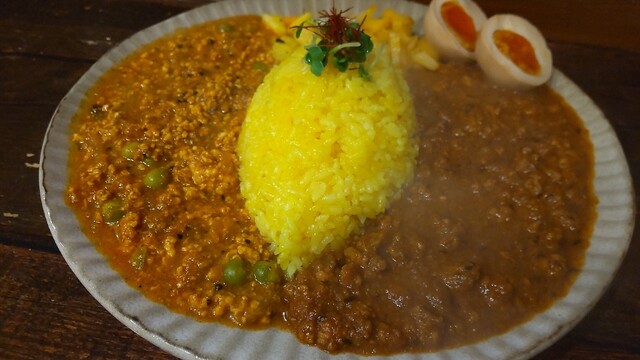
Itachibori sits just west of Osaka’s commercial core, where office blocks, design studios, and low-key lunch counters give the neighbourhood a working-day pulse rather than nightlife gloss. Here, spice cooking feels different from the city’s takoyaki-and-kushikatsu shorthand: quicker, leaner, more personal, built around rice, curry, heat, and sequence rather than tasting-menu theatre.
Osaka has serious curry culture, but not one style. There is inherited Japanese curry, the South Asian grammar of lentils and masala, the café-adjacent spice plate, and the hybrid Osaka style where pickles, grains, and sauces carry progression. Spice Shokudo Nikki belongs to that last conversation. Its logic is contrast, not luxury escalation: aroma and colour first, then the way condiments, rice, and sauce change each bite.
Osaka spice cooking, measured by rhythm rather than ceremony
The city’s stronger restaurant stories often happen outside formal dining rooms. Curry counters and small shokudo formats suit Osaka because one plate can hold the structure of a multi-course meal without a parade of dishes. Heat, acidity, grain, texture, and cooling elements do the work of separate courses. That compact sequencing is the point.
Spice Shokudo Nikki’s public classification, Asian, Ethnic, Curry, and Indian curry, sounds broad. In Japan, “ethnic” often acts as a catch-all for food cultures outside the washoku and Western-yoshoku mainstream. Better Osaka examples use that looseness as permission, not confusion, borrowing curry-and-rice architecture while letting the plate move in small stages: sauce, spice, relief, return.
Tabelog’s Asian cuisine / Ethnic cuisine WEST 100 selection in 2024 gives the restaurant a useful signal in a crowded regional field. It was also selected for the same Asian and ethnic category in 2022 and 2023, and for Curry WEST 100 in 2020. Those recognitions matter less as trophies than as proof of durability in a genre where openings can draw attention quickly and fade just as fast. Consistency is harder than heat.
Against Osaka peers, the distinction is scale and category position. Los Sitios and DENDA sit in a higher spend bracket at JPY 6,000–7,999, while Ichiju Nisai Ueno Minoten and LOUISE occupy more formal Japanese and French registers. Spice cooking at this level asks not how much ceremony can be added, but how much complexity a small plate and short sitting can carry.
The plate works like a compressed tasting progression
The mistake is to treat restaurants like this as casual because the format is compact. A curry plate can be as sequenced as a tasting menu when the kitchen understands pace. Rice sets the structure; sauce supplies the main line; pickles, aromatics, and vegetables punctuate. Heat need not arrive all at once. It can build, recede, and sharpen as the plate is mixed.
That is why the shokudo model has force in Osaka. It rejects the false divide between everyday dining and serious cooking. A 12-seat room, including counter seating, changes the tempo: little distance separates kitchen and table, and the meal depends on turnover, timing, and concentration. For solo diners, that helps. For groups seeking a drawn-out evening, the format points elsewhere.
The price tier also shapes expectation. This is not for linen, sommelier choreography, or architectural spectacle. The value is focus: curry and Asian-ethnic cooking treated as the main event rather than a side alley off the city’s better-known food canon. Osaka’s strength has always been appetite without excessive ceremony; this room fits that temperament.
The no-smoking policy and children-welcome note broaden the audience, but the appeal remains narrow in the useful sense: diners who care about spice structure, rice balance, and efficient meals will understand it faster than those looking for a long night out. In a city where premium dining often means sushi counters, kappo rooms, French menus, or beef-led formats, precision can also arrive at lunch-counter speed.
How to place it within an Osaka itinerary
For travellers mapping Osaka by appetite, Itachibori works as a daytime or early-evening counterpoint to heavier dining rituals. Proximity to Honmachi and Nishi-Ohashi makes it easy to pair with shopping, galleries, or a slower walk through Nishi-ku rather than treating the meal as a standalone pilgrimage. Curry in Osaka often works well folded into the day, not isolated as a grand occasion.
The practical read is clear. The room is small, reservations are not taken, and payment flexibility is narrower than many visitors expect in Japan’s larger cities. Plan around timing, patience, and a nearby backup, not a confirmed table. That is not a flaw; it is part of the small-format curry economy, where accessibility and scarcity sit side by side.
Readers building a broader Osaka shortlist can use Our full Osaka restaurants guide for dining context, then cross-reference stays through Our full Osaka hotels guide, drinks through Our full Osaka bars guide, regional cellar coverage via Our full Osaka wineries guide, and cultural planning through Our full Osaka experiences guide. Within the city’s casual orbit, compare the everyday registers of.cafe, 52CHO-ME BAKERY, 551 Horai (551蓬莱), 99 Pizza Napoletana Gourmet, and a canto (Italian).
For a wider Japan and beyond-Japan food map, the useful comparisons are categorical rather than like-for-like: beef tradition at -Grilled beef Sukiyaki- KAMAKURA TANUKIAN 鎌倉 たぬき庵 in Kamakura, charcoal and tuna dining at. 鮪と炭火焼き うお炭 秋葉原店 in Tokyo, contemporary regional cooking at.know in Kumamoto, Vietnamese cooking at (Shoku) Vietnam in Kawasaki, another curry lens at [Curry Senmon Ten] Maruyama Kyoju. in Sapporo, Kyoto dining at [ki:] in Kyoto, sake-bar framing at Jōdo Saké Bar in Los Angeles, and Japanese comfort format abroad at Onigiri Time in Pasadena.
Budget and Context
Nearby venues at a similar price tier for orientation.
| Venue | Cuisine | Price | Notes |
|---|---|---|---|
| Spice Shokudo NikkiThis venue — the venue you are viewing | Not listed | $$ | Not listed |
| Aabel Curry | Nishi, European-style Spice Curry | $$ | Not listed |
| Satch's Curry | Kita, Indian-style Curry Shop | $ | Not listed |
| Moja Curry Shin osaka honten | Yodogawa, Japanese Curry | $ | Not listed |
| ERICK SOUTH Nishitenma | Kita, South Indian Dosa & Biryani House | $$ | Not listed |
| curry bar nidomi | Not listed | $$ | Chūō, Sri Lankan‑influenced Curry Bar |
Recognition history
Dated appearances from independent guides and award organizations, with the underlying list record or original source where available.
Tabelog 100 #7 · No. 7
Tabelog · Tabelog 100 - Asian cuisine / Ethnic cuisine - WEST - 2024
Continue exploring
More in Osaka
Restaurants in Osaka
Browse all →




Bars in Osaka
Browse all →

Hotels in Osaka
Browse all →



Wineries in Osaka
Browse all →
At a Glance
- Cozy
- Modern
- Trendy
- Intimate
- Solo
- Family
- Casual Hangout
- After Work
- Standalone
Small, non‑smoking curry diner with a stylish yet relaxed interior and counter-plus-table layout, suited to solo diners and casual family visits rather than long, lingering meals.