
Osaka’s spice-cuisine conversation is not limited to curry shops and South Asian canteens. Spice Ryori Nallamanam sits in a narrower lane: a compact Sakaisuji Hommachi room where South Asian, Indian curry, and Sri Lankan references are organized around a changing spice-plate format, backed by repeated Tabelog 100 recognition for curry and Asian-ethnic cooking.
Pearl is the En Primeur Club membership app — saves, bookings, and concierge access live there. Same editors, same standards.
- Address
- 大阪府大阪市中央区瓦町1-4-6 市岡興産ビル 1F
- Phone
- +81664845799
- Website
- shinplspice.thebase.in
 Saves & bookings on Pearl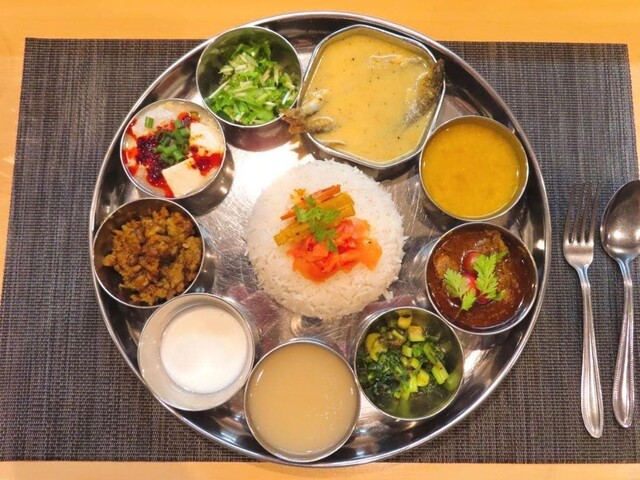
In central Osaka, the approach to a small spice restaurant says much about the dining room. Around Sakaisuji Hommachi and Kitahama, office blocks, side-street lunch queues, and low-key ground-floor rooms set a rhythm far from Dotonbori’s performative eating. Spice Ryori Nallamanam fits that quieter register: compact, counter-led, and built for diners who read a menu as structure, not spectacle.
Osaka’s curry culture has long exceeded standard Japanese curry-rice. The city absorbs South Asian, Sri Lankan, and Kansai preferences, then filters them through lunch formats for office workers, solo diners, and small groups. Here, the menu points to spice cuisine rather than one nationality: South Asian, Indian curry, and Sri Lankan categories sit together, with fish and health-conscious cooking explicit in the identity. The point is not authenticity theatre, but several spice traditions gathered into a format Osaka understands.
A spice plate built for Osaka's lunch grammar
The strongest way to read this restaurant is through the plate format. Osaka lunch counters reward clarity: a defined main idea, quick turnover, and enough variation for repeat visits. Spice Ryori Nallamanam uses that grammar while moving from heavy roux toward spice layering, seasonal ingredients, and broader South Asian vocabulary. In a city where curry can mean late-night comfort or specialist tasting menus, this sits in the serious middle: affordable enough for repeat eating, focused enough to matter beyond the neighbourhood.
The public menu language signals controlled rotation more than a fixed canon. Weekly changing spice cuisine and seasonal ingredients are part of the stated format, while the preserved banana-wrapped bento gives the operation a second life outside the dining room. In Japan, bento culture clarifies what a restaurant believes can travel: rice, spice, texture, and temperature must stay coherent after leaving the counter. For a spice specialist, that constraint reveals discipline.
Recognition has followed the format rather than a chef narrative. The restaurant was selected for Tabelog Curry 100 in 2018, 2019, and 2020, then for Tabelog Asian cuisine / Ethnic cuisine WEST 100 in 2022, 2023, and 2024. That sequence tracks a broader reclassification in Japanese dining: what once sat mainly under curry now belongs to a wider Asian and ethnic-cuisine frame, and Spice Ryori Nallamanam’s repeated inclusion places it within that shift.
For readers mapping Osaka by category, the distinction helps. A nearby European-leaning lunch at a canto (Italian), a bread run to 52CHO-ME BAKERY, or a casual stop at 551 Horai (551蓬莱) all express Osaka efficiency. This restaurant belongs to the same city logic, but asks diners to follow spice sequencing rather than portion size or nostalgia.
The room rewards counter diners and small-group planning
The physical scale shapes the experience. With 14 seats split between counter and tatami seating, the restaurant works more like a small specialist counter than a broad curry hall. Solo dining fits, family dining is possible within the tatami setup, and private use belongs to a separate rhythm rather than ordinary service. In Osaka, small rooms often carry stronger culinary identities because the menu need not satisfy every diner at once.
The price tier matters without turning this into a booking manual. Lunch around JPY 1,000 to JPY 1,999 and dinner around JPY 3,000 to JPY 3,999 place it below many tasting-menu counters but above casual chain curry. That middle band matters in Osaka: repeat local demand and specialist ambition can meet without fine-dining ceremony.
Compared with in-city peers in similar spending territory, the distinction is category discipline. Yoshoku Bistro Awano occupies a comparable broad price band but belongs to a Western-influenced comfort lane. Mashino Ken points toward Chinese cooking, while Sumibi Yakitori Nakao sits in a higher dinner bracket driven by grilled chicken and counter ritual. Spice Ryori Nallamanam’s case is narrower: spice construction, South Asian and Sri Lankan references, and a small-room service model that makes the menu feel edited rather than expansive.
Osaka visitors building a food day should not treat spice cuisine as filler between sushi, okonomiyaki, and bars. The city’s better casual meals often sit in modest-format specialists. The planning logic that might send a diner to .cafe for a tight café stop or 99 Pizza Napoletana Gourmet for focused pizza applies here: choose the venue for the format, not a generic neighbourhood box to tick.
How it fits a wider Japanese spice map
Japan’s specialist curry and spice-cooking scene is increasingly regional rather than Tokyo-dominated. Sapporo, Kyoto, Kawasaki, Kumamoto, and Kansai have micro-scenes shaped by immigrant cooking, Japanese curry evolution, and small independent operators. Comparing this Osaka address with [Curry Senmon Ten] Maruyama Kyoju. in Sapporo, [ki:] in Kyoto, (Shoku) Vietnam in Kawasaki, or.know in Kumamoto is not comparing identical cuisines. The useful comparison is how each city supports small-format specialists with strong menu identities.
That frame explains why the awards matter more than a single headline rating. Tabelog’s Hyakumeiten lists are category-based and city-sensitive; repeated selection suggests consistency in a crowded field rather than a one-season spike. In 2026, that is more useful for a traveller than vague popularity. The restaurant has not built its reputation on luxury cues, chef mythology, or imported fine-dining language, but on a compact spice format Japanese diners have repeatedly recognized across both curry and Asian-ethnic categories.
For a broader Osaka itinerary, place this meal alongside the city’s other low-friction pleasures, not against formal restaurants. Use Our full Osaka restaurants guide to map the food day, then separate after-dinner drinking through Our full Osaka bars guide. Travellers making the city a longer base can cross-check stays in Our full Osaka hotels guide, while category completists can scan Our full Osaka wineries guide and Our full Osaka experiences guide for trip elements outside restaurants.
The appeal is not that this room tries to represent all South Asian or Sri Lankan cooking in Osaka. It is that the menu makes a precise argument: spice can be seasonal, compact, fish-aware, lunch-friendly, and serious without fine-dining signals. That is an Osaka kind of intelligence.
For cross-city context, EP Club readers can compare how compact Japanese and Japanese-adjacent formats travel outside Kansai, from. 鮪と炭火焼き うお炭 秋葉原店 in Tokyo and -Grilled beef Sukiyaki- KAMAKURA TANUKIAN 鎌倉 たぬき庵 in Kamakura to Jōdo Saké Bar in Los Angeles and Onigiri Time in Pasadena. The common thread is not cuisine type, but how small formats communicate priorities quickly, then let repetition do the serious work.
Comparison Snapshot
Comparable venues side-by-side for orientation.
| Venue | Cuisine | Price | Notes |
|---|---|---|---|
| Spice Ryori NallamanamThis venue — the venue you are viewing | Modern South Asian–inspired spice curry & banana-leaf bento | $$ | Not listed |
| STUN.S | Innovative Japanese | $$ | Miyakojima |
| Meganeya | Creative Yoshoku & Wine Bar | $$ | Yodogawa |
| Pres | Modern standing wine bar & bistro | $$$ | Kita |
| MAKE ONE TWO | Asian Stand Bar / Izakaya | $$ | Chūō |
| Chaos Spice Diner Yotsubashi amerikamura ten | Spice curry & Asian fusion dining bar | $$ | Nishi |
Recognition history
Dated appearances from independent guides and award organizations, with the underlying list record or original source where available.
Tabelog 100 #93 · No. 93
Tabelog · Tabelog 100 - Asian cuisine / Ethnic cuisine - WEST - 2024
Continue exploring
More in Osaka
Restaurants in Osaka
Browse all →




Bars in Osaka
Browse all →


Hotels in Osaka
Browse all →



Wineries in Osaka
Browse all →
At a Glance
- Solo
- Casual Hangout
- After Work
- Standalone
Originally a small South Asian curry and Sri Lankan-inspired spice restaurant near Sakaisuji Hommachi/Kitahama, it now focuses on takeaway and frozen delivery, shifting the core experience from an on-site casual eatery to an at-home, aroma-driven spice meal opened from banana leaves.