
Spice Curry Te belongs to Osaka’s compact, spice-driven curry circuit rather than the city’s formal dining tier. Its Minamisenba setting, 10-seat format and Tabelog Curry WEST 100 selections in 2023 and 2024 put it in the small-shop category where consistency, queue discipline and neighbourhood rhythm matter as much as culinary ambition.
Pearl is the En Primeur Club membership app — saves, bookings, and concierge access live there. Same editors, same standards.
- Address
- Japan, 〒542-0081 Osaka, Chuo Ward, Minamisenba, 3 Chome−1−16 2階
- Website
- twitter.com
 Saves & bookings on Pearl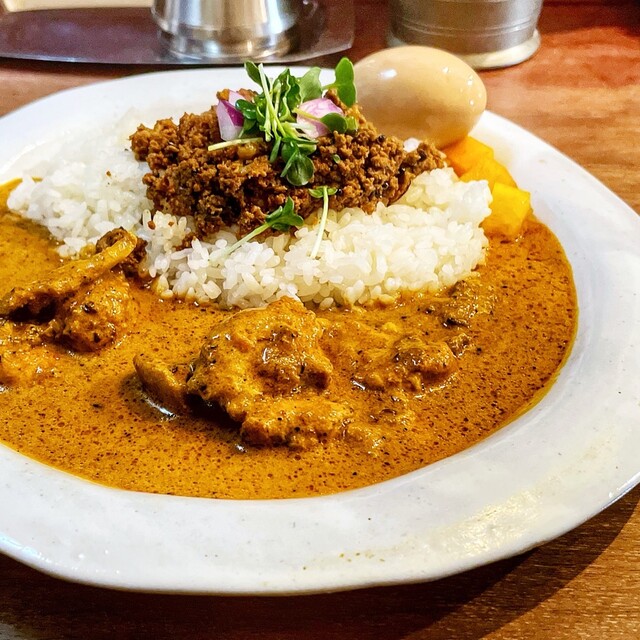
Minamisenba moves at a different tempo from the neon shorthand attached to Osaka dining. North of Shinsaibashi, offices, small fashion addresses and second-floor food rooms create a district where lunch can reveal more than dinner. Spice Curry Te sits in that register: upstairs, compact, and built for curry as a focused urban meal rather than a long restaurant performance.
Osaka’s curry culture rewards small rooms with narrow intent. The city has long treated curry as everyday food, but the specialist shops that draw attention now tend to work through spice layering, limited seating and a strong lunch identity. That places this address closer to Curry Ya Dekkao in price tier than to higher-spend rooms such as Restaurant Tsujikawa, and much closer to the casual Osaka grammar of quick, deliberate eating than to the ceremonial side of Japanese dining represented by places like Oimatsu Hisano.
Minamisenba curry with a small-room Osaka rhythm
The useful way to read this restaurant is through place. Shinsaibashi pulls visitors toward shopping streets and department-store dining; Minamisenba offers a thinner, more local layer of offices, independent storefronts and upstairs rooms dependent on repeat customers as much as destination traffic. A 10-seat curry counter and table arrangement sets the pace. This is not for sprawling groups or open-ended grazing; it is built for a short, intent stop where turnover and timing shape the experience.
That scale also explains why the restaurant belongs in Osaka’s curry conversation rather than a generic “cheap eats” category. A low price band can hide serious specialization in Japan, especially in curry, ramen, udon and bakery formats. The same city that supports heritage noodle houses such as Usami Tei Matsubaya and casual crowd magnets like 551 Horai (551蓬莱) also makes room for precise independents with narrow formats and audiences who know what they came for. Spice Curry Te fits that Osaka pattern: accessible on cost, not anonymous in intent.
The award signal matters because curry is crowded across western Japan. Selection for Tabelog Curry WEST 100 in both 2023 and 2024 places the shop inside a regional specialist list, not a broad restaurant ranking. That distinction matters. It is not a claim about luxury or tasting-menu theatrics, but recognition within a category where repeatability, flavour construction and public demand are the measures.
Why the Tabelog Curry WEST 100 signal carries weight
Tabelog’s genre lists help travellers by separating everyday formats into competitive categories. Curry shops can be hard to judge from outside: many are small, trade at lunch, and do not use the visual language of premium dining. A Curry WEST 100 selection gives a practical cue that the room has been noticed within a dense regional field. For visitors using Our full Osaka restaurants guide, that helps distinguish a specialist curry stop from a convenient meal near the station.
There is also a broader Osaka lesson in the pricing. Serious eating in the city does not always mean high spend. The same itinerary can move from a curry counter to a bakery such as 52CHO-ME BAKERY, coffee at .cafe, Neapolitan cooking at 99 Pizza Napoletana Gourmet, or Italian dining at a canto (Italian) without treating any price tier as the marker of seriousness. Osaka is unusually good at this range: its food identity is built as much on counter formats and single-purpose shops as on formal reservations.
For travellers comparing Japanese curry across regions, Osaka’s spice-curry culture differs from the heavier, roux-led image many visitors bring to Japanese curry. The category often prizes sharper seasoning, layered aromatics and personal shop identity, though specific orders vary by room and day. That makes the genre closer to a local dining subculture than a single dish. A traveller will learn more from a compact Minamisenba counter than from a generic station-building curry plate.
How to place it in an Osaka itinerary
The practical decision is simple: treat this as a focused curry stop within a Shinsaibashi or Minamisenba day, not the anchor for an elaborate evening. Its small capacity favours solo diners and pairs, and the no-reservation format suits travellers who can stay flexible. The non-smoking policy and children-welcome note make it less forbidding than some tiny counters, but the scale still argues for keeping the party small.
Payment is another cue to the kind of shop this is. Cash-only policies remain common in smaller Japanese restaurants, and here they reinforce the everyday, local mechanics of the meal. Travellers planning a wider Osaka day should think in clusters: curry in Minamisenba, drinks later via Our full Osaka bars guide, hotels through Our full Osaka hotels guide, or daytime cultural planning through Our full Osaka experiences guide. Wine-focused travellers can also scan Our full Osaka wineries guide, though the curry counter itself belongs firmly to the city’s casual dining map.
Japan’s appeal is often in these contrasts. A traveller can move from Osaka curry to regional Japanese cooking such as -Grilled beef Sukiyaki- KAMAKURA TANUKIAN 鎌倉 たぬき庵 in Kamakura, Tokyo izakaya-style eating at. 鮪と炭火焼き うお炭 秋葉原店 in Tokyo, Kumamoto’s.know in Kumamoto, Kawasaki’s (Shoku) Vietnam in Kawasaki, Sapporo curry at [Curry Senmon Ten] Maruyama Kyoju. in Sapporo, or Kyoto’s [ki:] in Kyoto, and see how sharply format changes from city to city. Even outside Japan, the same logic of narrow specialization appears at Jōdo Saké Bar in Los Angeles and Onigiri Time in Pasadena: small formats can carry serious cultural information when the menu is disciplined.
The verdict is not that Spice Curry Te is a grand Osaka dining statement. It is more useful than that. It shows how Minamisenba’s everyday restaurant layer works: compact, category-specific, price-accessible and respected within a competitive curry field. For a traveller who wants Osaka beyond the obvious food headlines, that is the point.
At a Glance
Comparable venues at the same tier.
| Venue | Cuisine | Price | Notes |
|---|---|---|---|
| Spice Curry TeThis venue — the venue you are viewing | Chūō, Japanese Curry | $ | Not listed |
| Yotsubashi Cafe | Not listed | $ | Nishi, Japanese yoshoku-style cafe specializing in hamburg steak |
| Men no Youji | Chūō, Japanese Ramen | $ | Not listed |
| Niji no Hotoke | Not listed | $ | Tennōji, Osaka spice curry & Japanese-style Western curry |
| Curry Shop MASARA | Kita, Japanese European-style curry shop | $ | Not listed |
| Osaka Naniwaya | Not listed | $ | Kita, Japanese taiyaki & kakigori sweets shop |
Recognition history
Dated appearances from independent guides and award organizations, with the underlying list record or original source where available.
Tabelog 100 #59 · No. 59
Tabelog · Tabelog 100 - Curry - WEST - 2024
Continue exploring
More in Osaka
Restaurants in Osaka
Browse all →




Bars in Osaka
Browse all →

Hotels in Osaka
Browse all →



Wineries in Osaka
Browse all →
At a Glance
- Cozy
- Casual
- Minimalist
- Solo
- Casual Hangout
- Standalone
Current opening hours
- Monday
- Closed
- Tuesday
- 11:30 AM–3:30 PM
- Wednesday
- 11:30 AM–3:30 PM
- Thursday
- 11:30 AM–3:30 PM
- Friday
- 11:30 AM–3:30 PM, 6–9 PM
- Saturday
- 11:30 AM–3:30 PM
- Sunday
- 11:30 AM–3:30 PM
Hours can change for holidays and private events. Last verified .
Compact, low-key, and informal, with a small-seating setup that feels more like a neighborhood specialty counter than a full-service dining room.