Our verdict
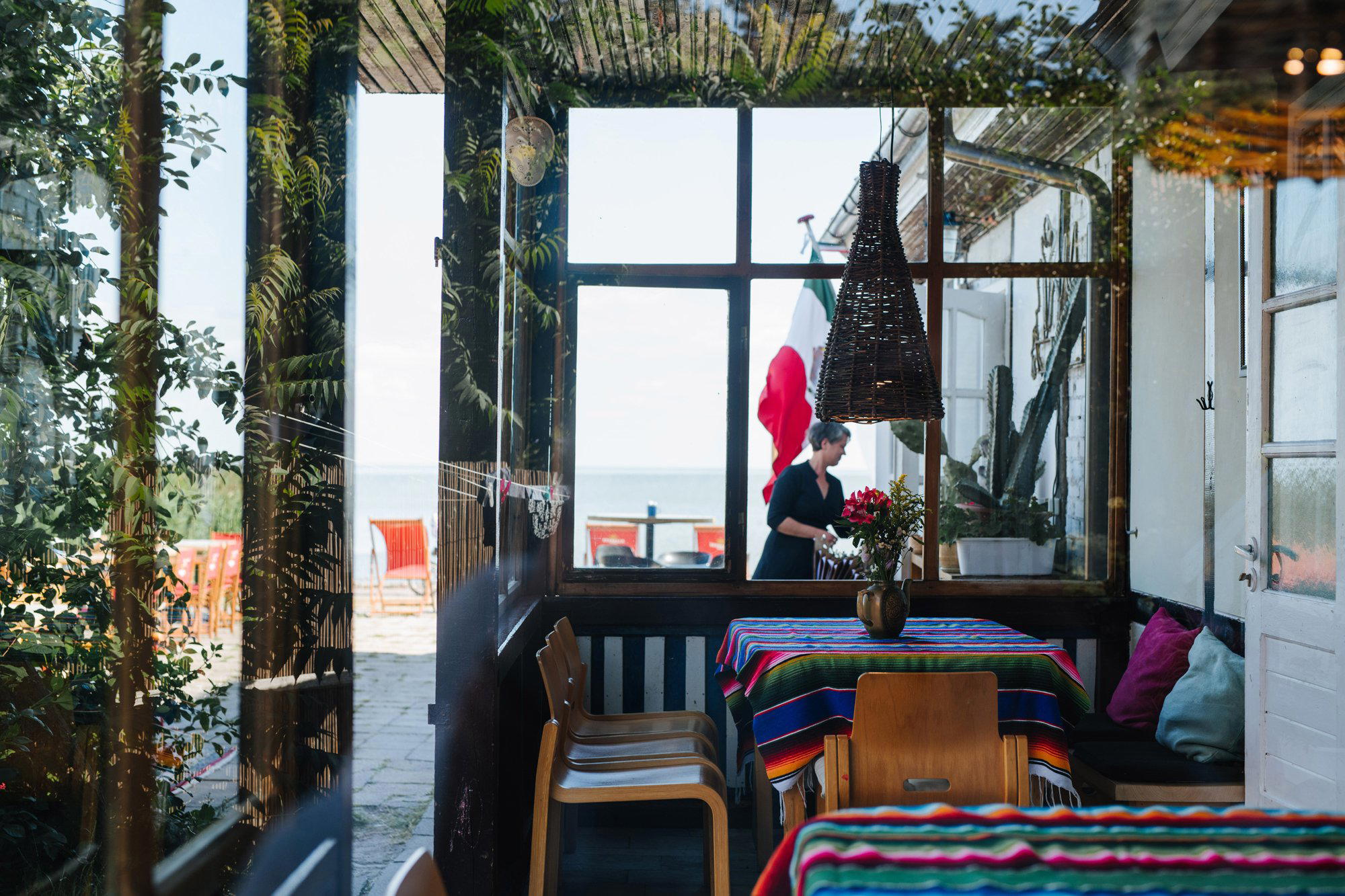
On the Curonian Spit, where Lithuanian fishing tradition meets protected-forest solitude, Sofa de Pancho Nida occupies a quietly singular position on Pamario Street. The address alone, beside the lagoon-facing edge of Nida, signals a kitchen that draws from one of Europe's most geographically specific larders. For visitors crossing to Neringa by ferry, it is a natural first stop when orienting around where local ingredients actually come from.

Pearl is the En Primeur Club membership app, where members save venues, book tables and use the concierge.
The Curonian Spit as a Larder
Neringa is not a conventional dining destination. The municipality occupies a narrow strip of sand dune and pine forest between the Curonian Lagoon and the Baltic Sea, a UNESCO World Heritage landscape where the growing season is compressed, the fishing grounds are immediate, and the supply chain from water to plate is shorter than almost anywhere else in Lithuania. Restaurants operating here either engage seriously with that geography or they don't. The ones that do occupy a specific and defensible position in the broader Lithuanian dining conversation, separate from the urban ambition of Demo in Vilnius or the coastal leisure register of Vila Komoda in Palanga City.
Sofa de Pancho Nida, at Pamario g. 24B in Nida, sits on the lagoon-facing side of the spit, the quieter, more sheltered edge that faces east toward the Nemunas delta rather than west toward open Baltic water. That orientation matters for sourcing: the Curonian Lagoon supports one of the most productive freshwater-brackish fisheries in the eastern Baltic, with eel, pike-perch, bream, and smelt as its signature species. Kitchens on this edge of Neringa have a direct relationship with that resource in a way that inland Lithuanian restaurants, regardless of ambition, simply cannot replicate.
What the Lagoon Produces
The Curonian Lagoon fishery operates under strict seasonal and quota controls tied to its status within the Curonian Spit National Park and the broader UNESCO designation. That regulatory framework shapes what any kitchen in Nida can reliably put on a menu: supply is local by necessity, not by marketing choice. Smoked eel remains the most recognisable product of this tradition, the smoking houses of Nida have been operating in recognisable form since at least the nineteenth century, when the village functioned primarily as a fishing settlement rather than the artist-colony-turned-resort it later became.
This context matters when assessing any Nida restaurant's ingredient claims. Unlike kitchens in Klaipėda, see, for comparison, ALBA Bistro in Klaipėda, which draws from a broader port-city supply network, kitchens in Nida are geographically constrained in ways that produce genuine locality. There is no credible alternative to sourcing from the lagoon and the surrounding forest when you are operating at the end of a road that terminates at the Russian exclave of Kaliningrad. The supply chain enforces honesty.
The pine forest that covers most of the spit's land surface also contributes to seasonal foraging, mushrooms in autumn, berries through summer, in a pattern shared by rural Lithuanian cooking traditions further inland, such as those found at Paliesius manor in Paliesius or Apvalaus Stalo Klubo in Trakai. But the forest here is dune-stabilising Scots pine, fragrant and protected, which places foraging within strict park boundaries and makes any kitchen's relationship with it genuinely seasonal rather than decorative.
The Address and the Approach
Pamario Street runs along the lagoon edge of Nida, and the 24B address places Sofa de Pancho Nida within the residential-scale grain of that shoreline. Nida is a small town, fewer than a thousand permanent residents, and its restaurant scene is correspondingly intimate. There are no large-format dining operations here in the way that coastal resorts elsewhere support. The scale of any Nida kitchen is necessarily modest, which tends to sharpen focus rather than dilute it.
The name itself, Sofa de Pancho, sits at an angle to the strict Lithuanian folk-restaurant tradition. That registers as a deliberate positioning choice rather than an accident: a kitchen that references the lagoon and forest larder without constraining itself to a single ethnographic register. Across the wider Lithuanian coast, that tension between local ingredient specificity and looser culinary framing is increasingly common, visible also at Surr in Druskininkai and at waterfront operations like Šturmų Švyturys in Kintai and Šturmų švyturys in Sturmai.
Neringa in the Lithuanian Dining Context
Lithuania's restaurant conversation has shifted considerably since the mid-2010s, driven primarily by Vilnius but increasingly reflected in regional towns and coastal destinations. The gap between what is available in the capital and what a serious traveller can find on the Curonian Spit has narrowed. Places like Arrivée in Kaunas and Red Brick in Radiškis demonstrate that ingredient-led cooking with considered technique is no longer exclusively an urban phenomenon in this country.
For the international traveller arriving in Neringa, most commonly by ferry from Klaipėda, a crossing that takes roughly thirty minutes, the dining options are geographically concentrated between Nida in the south and Juodkrantė further north. The spit functions as a single extended destination, and our full Neringa restaurants guide maps the full range. Within Nida specifically, Fisheria represents the most direct engagement with the lagoon-fish tradition, offering a useful point of comparison for understanding where different kitchens place themselves on the spectrum from tradition to interpretation.
For those calibrating expectations against international reference points, the ingredient-sourcing rigour of a kitchen like Le Bernardin in New York City, which has made seafood provenance a defining editorial stance for decades, or the produce-led ambition of Lazy Bear in San Francisco, the Nida context produces its own version of that logic. The constraint here is not self-imposed but geographic, which arguably makes it more consequential.
Planning a Visit
Neringa operates on a strict seasonal rhythm: the summer months between June and August concentrate the majority of visitors, and the island-like isolation of the spit means that accommodation and restaurant capacity fill quickly during peak periods. Visiting outside those months produces a materially different experience, quieter, with a higher proportion of Lithuanian rather than international visitors, and with a kitchen operating to a more compressed seasonal menu driven by what the late-autumn lagoon and forest actually provide. Ferry services from Klaipėda run year-round, though frequency drops outside the tourist season. Given the limited number of dining options within Nida itself, having a fallback plan when visiting in shoulder or low season is practical rather than overcautious.
Frequently asked questions
Does Sofa de Pancho Nida work for a family meal?
The Pamario Street setting in Nida runs at a residential scale, and most venues along that lagoon-edge strip operate informally rather than in a formal dining-room mode. Restaurant prices in Neringa generally sit below the Vilnius or Klaipėda averages, which eases the calculation for larger groups. The location at 24B Pamario places it within easy walking distance of the lagoon waterfront, a practical consideration with children in tow.
Is Sofa de Pancho Nida better for a quiet night or a lively one?
Nida has a year-round population of under a thousand residents, and the Curonian Spit has no nightlife infrastructure comparable to Klaipėda or Vilnius. Evenings on Pamario Street are defined by the lagoon rather than a bar scene, so the honest answer is: this is a quiet-night address. Visitors seeking a lively atmosphere should adjust expectations before arriving on the Spit.
What is the significance of the Curonian Spit UNESCO status for dining at Sofa de Pancho Nida?
Neringa sits entirely within a UNESCO World Heritage Site, which places supply-chain and land-use restrictions on the territory that shape what local restaurants can source and how. Unlike Palanga or Klaipėda, kitchens on the Spit work within the constraints of the Curonian Spit National Park regulations, meaning locally caught lagoon fish rather than industrial supply lines tends to define what reaches the plate. For a venue at a Pamario Street address in Nida, that UNESCO boundary is less a marketing point than an operational fact.
What do regulars order at Sofa de Pancho Nida?
What is documented is that the Curonian Lagoon fishery, operating under quota controls tied to the Curonian Spit National Park, supplies eel, pike-perch, and bream to serious cooking in the area. Those species form the backbone of meaningful Neringa meals, and any kitchen at a Pamario Street address in Nida works within that same supply reality. Check the venue's official channels for the latest details.
What's the address for Sofa de Pancho Nida?
Sofa de Pancho Nida is located at Pamario g. 24B, Neringa, 93121 Neringos sav. Lithuania, Neringa.
Should I book Sofa de Pancho Nida in advance?
Between June and August, Neringa's dining and accommodation capacity is small relative to visitor numbers, and the Curonian Spit's road access via the single ferry crossing creates a natural ceiling on how many people can arrive each day. Booking ahead during summer is the straightforward move. Outside that window, the island's seasonal rhythm means a number of venues operate reduced hours or close entirely, so confirming availability before travel is advisable regardless of the month.
At-a-Glance Comparison
| Venue | Cuisine | Price | Awards | Notes |
|---|---|---|---|---|
| Sofa de Pancho NidaThis venue (the venue you are viewing) | Authentic Mexican Taqueria | Not listed | Not listed | Not listed |
| Demo | Modern Lithuanian Farm-to-Table | $50–100 | 1 Michelin Star · La Liste Top Restaurants | Modern European, Innovative, Wine Bar & Small Plates |
| Somm | Modern European Wine Bar | $50–100 | Michelin Plate · Star Wine List | Fusion, Modern Cuisine |
| Džiaugsmas | Modern Lithuanian | $30–50 | 1 Michelin Star · La Liste Top Restaurants | Modern Cuisine |
| Gaspar's | Modern Indian Fusion | $30–50 | Michelin Bib Gourmand · La Liste Top Restaurants | Indian |
| Le Travi | Authentic Italian Osteria | $20–30 | Michelin Bib Gourmand · Star Wine List | Italian |
Continue exploring
More in Neringa
Restaurants in Neringa
All restaurants in Neringa →
Hotels in Neringa
Browse all →
Details
- Cozy
- Lively
- Casual Hangout
- Group Dining
- Waterfront
- Terrace
- Craft Cocktails
- Waterfront
- A La Carte
- Tequila
- Mezcal
Cozy and lively atmosphere with waterfront views.