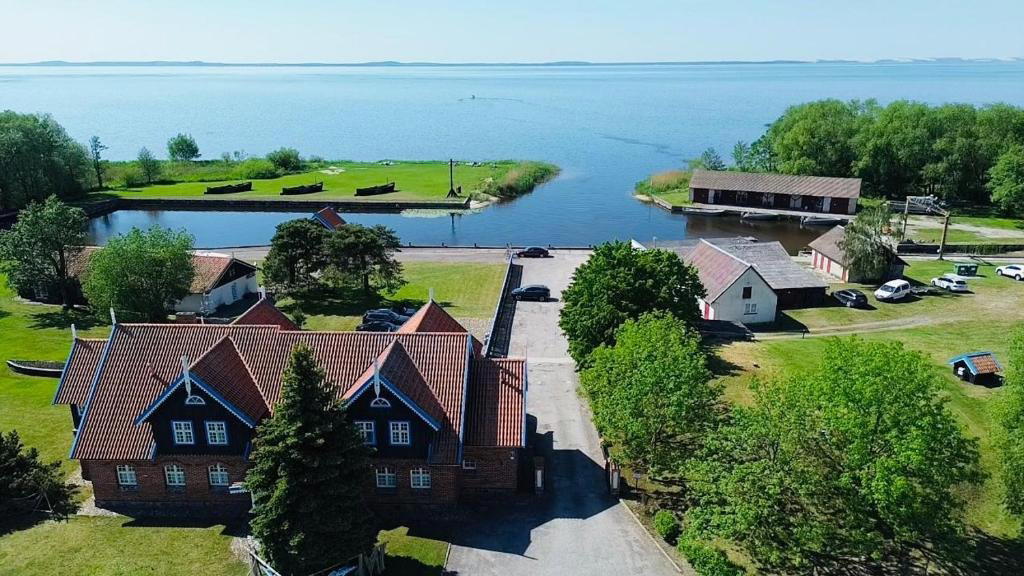
Where the Lagoon Dictates the Menu
Arriving in Šturmai, the Curonian Lagoon is not backdrop, it is the operating condition. The flat, reed-lined horizon, the smell of brackish water, the particular quality of light bouncing off still water in the early morning: these are not incidental details. They are the reason a place like Šturmų švyturys exists where it does, and they are the direct explanation for what arrives on the plate. In coastal Lithuanian settlements along the lagoon's eastern edge, the shortest distance between the water and the kitchen is not a marketing concept, it is simply the structural reality of how food moves in a region without major distribution infrastructure.
Lithuania's relationship with the Curonian Lagoon spans centuries of freshwater and brackish-water fishing, smoking traditions, and a foraging culture tied to the surrounding Nemunas Delta wetlands. The region sits within one of Europe's more significant migratory bird corridors and wetland systems, which has historically shaped both the ecology and the diet of communities along its banks. For visitors more familiar with the farm-to-table framing of urban European restaurants, what operates here is an older and less self-conscious version of the same principle: proximity to a specific landscape produces a specific set of ingredients, and those ingredients define what a kitchen can credibly offer. See also how Fisheria in Neringa works within the same lagoon geography, or how Vila Komoda in Palanga City addresses the Baltic coast's seasonal produce from a different angle.
The Logic of Sourcing in a Lagoon Settlement
The Curonian Lagoon remains one of Lithuania's primary freshwater fishing zones, with bream, pike-perch, eel, and perch forming the backbone of local catches. Smoking, particularly cold-smoking over alder, is the preservation method that defines the region's food identity, a technique with deep roots across the Baltic littoral and one that distinguishes the flavour profile of lagoon fish from anything reaching a kitchen via a mainland supply chain. In settlements like Sturmai, the sourcing conversation that urban restaurants perform as positioning is simply the default mode of operation.
This matters for a reader trying to understand what distinguishes dining in this part of Lithuania from the more visible restaurant culture of Vilnius or Kaunas. The capital's leading end, places like Demo in Vilnius or Arrivée in Kaunas, operates on a different register entirely, with modern European technique, curated wine programs, and price points that reflect urban operating costs. The lagoon settlements offer something structurally opposite: lower overhead, narrower ingredient range, and a specificity of place that no amount of technique can replicate in a city kitchen. Neither position is superior; they are simply different arguments about what a meal should do. For comparison across Lithuania's broader rural dining spectrum, Paliesius manor in Paliesius and Apvalaus Stalo Klubo in Trakai illustrate how historic estates and lakeside settings shape menus in inland Lithuania.
Sturmai in Regional Context
Šturmai is not a destination in the way that Nida or Klaipėda draw visitors. It sits within the Nemunas Delta Regional Park, a protected wetland area that limits development and keeps the settlement small. That constraint is also the reason the food culture here retains a character that more visited coastal spots have partially diluted through tourism pressure. The delta region as a whole, including the network of channels, islands, and lagoon-adjacent villages, represents one of Lithuania's less-trafficked areas for international visitors, which means the hospitality that exists here is oriented toward Lithuanians who know the area, not toward the expectations of international touring circuits.
For context on how the western Lithuanian coast handles a broader tourist volume while maintaining food identity, ALBA Bistro in Klaipėda offers a useful reference point, a port city kitchen navigating between local sourcing and wider regional ambition. And for the resort end of the Lithuanian coast, Surr in Druskininkai shows how a spa-town setting produces a different set of dining priorities altogether.
Internationally, the dynamic at play in places like Sturmai, small, ecologically constrained settlements where sourcing specificity is structural rather than aspirational, has analogues in places like the marshland villages of the Camargue, the fishing communities of coastal Brittany, or the lagoon-edge settlements of the Venetian hinterland. The ingredient logic is recognisable to anyone familiar with those contexts. Where kitchens like Le Bernardin in New York City or 8 1/2 Otto e Mezzo Bombana in Hong Kong apply high technique to premium sourced product, lagoon-settlement kitchens in Lithuania work from a narrower palette with less technical ambition but often sharper territorial identity.
Visiting Šturmų švyturys: Planning Considerations
Sturmai is accessible by road through the Nemunas Delta, though the network of minor roads through the delta requires a car, public transport connections to settlements in this zone are limited, and the distances from Klaipėda or Šilutė make a day trip feasible but require planning. The delta region's seasonal character means that visiting in summer, when water levels, birdlife, and general accessibility are at their peak, gives a materially different experience from an off-season visit.
Travellers interested in the broader texture of Lithuanian rural dining alongside this region might also consider Red Brick in Radiškis as part of a wider itinerary through the country's less-visited interior.