Tabelog 100 #70
Our verdict
A seven-seat counter in Awaza gives Osaka ramen a neighbourhood-scale reading: compact, practical, and serious without drifting into tasting-menu theatre. Ramen Kasumi Awaza honten carries Tabelog Ramen OSAKA 100 recognition for 2025, with a format built around ramen, abura-soba, and maze-soba rather than a broad izakaya spread.

Pearl is the En Primeur Club membership app, where members save venues, book tables and use the concierge.
The menu
What to order
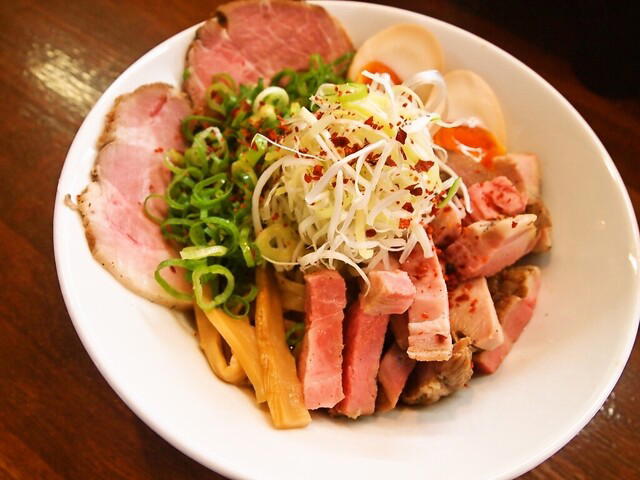
- Niboshi ramen
- Niboshi mazemen
- Abura soba / maze soba
Osaka is not only neon overload. Beyond the broad clichés, the city also moves at a lower register: office workers, apartment blocks, everyday meals, and the kind of lunch decisions that become routine before they become reputation. In that setting, a ramen address carries different weight from a destination dining room or a late-night spectacle. The format is direct, and the value of the experience sits in the discipline of a short, noodle-led menu rather than in ceremony.
Osaka’s ramen culture is often discussed less loudly than Tokyo’s, but the city is a strong test market because diners move quickly, compare aggressively, and do not reward softness for long. Ramen Kasumi Awaza honten belongs to the category of shops that make sense when viewed through daily use: a straightforward rhythm and a menu anchored in ramen, abura-soba, and maze-soba. That combination places it between soup-focused ramen houses and the drier, sauce-driven bowls that have become a serious subculture across urban Japan.
Osaka's counter culture, compressed into a focused format
The city context matters here. This is not only the theatre of sightseeing shorthand, and that restraint changes the meal. Ramen places are often built around speed and focus, but not necessarily anonymity. The experience can feel close and practical by default: not in the luxury sense, but in the Japanese everyday sense that the meal is quick, direct, and attentive to the bowl in front of you. For travellers used to larger casual restaurants, this is the difference between eating ramen as a dish and reading ramen as an operating system.
The shop’s recognition through Tabelog Hyakumeiten in 2025 gives it a useful external marker, especially in a city where ramen rankings can be noisy and local loyalty runs deep. Its listed Tabelog score of 3.71 also gives diners a public reference point without turning the visit into a trophy hunt. That matters because Osaka’s noodle scene can absorb clear broths, richer styles, sauce-led bowls, and soupless formats without settling into a single dominant shorthand.
Within that broader field, abura-soba and maze-soba are not side notes. They shift the emphasis away from soup volume toward tare, oil, noodle texture, and mixing technique. A shop that lists those categories alongside ramen is speaking to a diner who understands that a bowl can be judged without the usual broth-first hierarchy. That is where the Osaka setting feels apt: less tourist-facing shorthand, more repetition, value, and specificity.
Why this shop fits Osaka's everyday serious-food logic
Osaka is often reduced to takoyaki, okonomiyaki, and street-food ease, but its sharper dining identity lies in how often casual formats carry specialist expectations. The city can support polished dining rooms alongside everyday counters and budget-minded specialists, because price point and seriousness are not treated as opposites. Ramen sits comfortably in that logic: a modest spend can still demand focus, queue discipline, and a clear point of view.
That also explains why a ramen stop in Osaka can be more revealing than another luxury reservation. Compared with higher-spend Osaka rooms such as Bistro des Chenapans or Yiwanshui, the appeal is not substitution; it is contrast. The city’s dining range is strongest when a visitor understands both ends: the polished meal and the fast noodle stop, the wine list and the quick bowl, the composed plate and the dish that has to justify itself in minutes.
For a broader Osaka eating map, editorial threads matter more than a single itinerary. Casual bakeries, coffee stops, curry counters, and specialist budget addresses such as Spice curry 43 or Louloutte show how much of the city’s appeal sits below fine-dining price bands. The same pattern appears across Japan: a focused casual counter or compact dining room can carry as much editorial interest as a formal restaurant when the format is specific.
Read it as part of the city, not as a checklist stop
The practical read is simple: this is a ramen-focused Osaka address with a listed budget of Dinner: - JPY 999; Lunch: - JPY 999, and categories that cover ramen, abura-soba, and maze-soba. Those details make it accessible, but they do not change the core experience: the value is in a focused bowl, quick decision-making, and respect for a specialist format.
For visitors building a fuller Osaka trip, the ramen stop works better as part of a city day than as a standalone trophy. Use Our full Osaka restaurants guide for the dining spread, then cross-check sleep, drinks, and side trips through Our full Osaka hotels guide, Our full Osaka bars guide, Our full Osaka wineries guide, and Our full Osaka experiences guide. The stronger itinerary is not a chain of famous names; it is a sequence that makes sense by city, appetite, and pace.
That approach also keeps comparisons honest. A ramen address in Osaka is not trying to answer the same question as fine-dining rooms, bars, hotel restaurants, or destination counters elsewhere. Its point is narrower and more useful: Osaka still rewards specialist places where recognition follows repetition rather than spectacle. Ramen Kasumi Awaza honten is strongest when read in that register.
Frequently asked questions
What part of town is Ramen Kasumi Awaza honten in?
Ramen Kasumi Awaza honten is located in Osaka.
What's the price range at Ramen Kasumi Awaza honten?
Pricing at Ramen Kasumi Awaza honten is listed as - JPY 999 - JPY 999.
When can I go to Ramen Kasumi Awaza honten?
Check current opening times directly before visiting Ramen Kasumi Awaza honten.
What do critics highlight about Ramen Kasumi Awaza honten?
Critics can point to its Tabelog Hyakumeiten recognition for Osaka in 2025 and its listed Tabelog score of 3.71. The menu focus on ramen, abura-soba, and maze-soba gives it a clear, noodle-led brief.
Where the Accolades Land
Comparable venues to anchor price and recognition.
| Venue | Cuisine | Price | Awards | Notes |
|---|---|---|---|---|
| Ramen Kasumi Awaza hontenThis venue (the venue you are viewing) | Niboshi-focused ramen shop | $10–20 | Tabelog 100 #70 | Not listed |
| Kokoro ni Amai Anpanya Umeda ten | Japanese Anpan Bakery | $1–10 | Tabelog 100 #67 | Kita |
| Rika Shokudo Tenma honten | Japanese Curry House | $1–10 | Tabelog 100 #68 | Kita |
| Gunjo | Tsukemen and ramen noodle bar | $10–20 | Tabelog 100 #87 | Kita |
| Niji no Hotoke | Osaka spice curry & Japanese-style Western curry | $10–20 | Tabelog 100 #48 | Tennōji |
| Ramen Tetsushi | Ramen shop | $10–20 | Tabelog 100 #38 | Toyonaka |
Recognition history
Dated appearances from independent guides and award organizations, with the underlying list record or original source where available.
Tabelog 100 #70 · No. 70
Tabelog · Tabelog 100 - Ramen - OSAKA - 2025