
Osaka Mentetsu is a compact ramen counter in Sonezaki, close to Higashi Umeda, where the appeal lies in disciplined service rather than spectacle. Its repeat selection for Tabelog’s Ramen Hyakumeiten, including the Osaka 2025 list, places it inside the city’s serious noodle conversation while keeping the experience firmly in the everyday ramen bracket.
Pearl is the En Primeur Club membership app — saves, bookings, and concierge access live there. Same editors, same standards.
- Address
- 2 Chome-10-27 Sonezaki, Kita Ward, Osaka, 530-0057, Japan
- Phone
- +81 6-6232-8459
- Website
- mentetsu.co.jp
 Saves & bookings on Pearl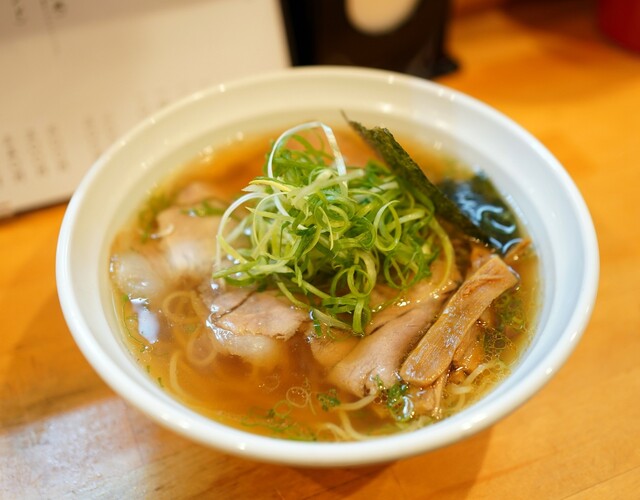
Approach the Sonezaki side of Umeda and the city changes register: office towers, underground station flow, late-night drinking streets and narrow restaurant fronts all press into the same few blocks. Ramen works well in this part of Osaka because it suits the rhythm of the district. Meals are short, seats turn quickly, and the counter becomes a small production line where timing matters as much as recipe. Osaka Mentetsu belongs to that grammar: an 11-seat, counter-only room where the meal is shaped by coordination between kitchen, counter service and the pace of customers waiting for their turn.
That format says more about Osaka ramen than a long origin story would. The city’s noodle culture does not need the temple-like silence associated with some Tokyo counters, nor the tourist theatre that has attached itself to certain Dotonbori addresses. Around Umeda, ramen competes with yakitori, standing bars, department-store dining floors and late trains. A serious bowl has to earn attention without asking for an evening. The proof point here is sustained recognition: Osaka Mentetsu has appeared in Tabelog’s Ramen Hyakumeiten selections across multiple years, including the Ramen OSAKA 2025 list, with a listed Tabelog score of 3.71. In a category with heavy local participation and fast customer turnover, repeat selection is a stronger signal than a single spike of publicity.
A counter format built on timing, not theatre
Small ramen rooms expose weak systems quickly. With only counter seating, there is little space to hide confusion between boiling, plating, clearing and seating. The better Osaka counters operate less like restaurants with a front room and more like compact teams working in one sightline. The kitchen controls the bowl; the counter controls the tempo; the service handoff keeps the room from clogging. That dynamic is the experience at Osaka Mentetsu: not a chef’s-table performance, but a precise urban meal where the guest reads the room and moves with it.
The 11-seat count matters. It keeps the experience close to the cooking, but it also makes the meal a poor fit for sprawling groups or lingering conversation. Reservations are not part of the format, which aligns it with a wider ramen tradition in Japan: demand is managed by queue, turnover and timing rather than advance planning. This is why a ramen counter can feel more democratic than many acclaimed dining rooms. Recognition does not necessarily convert into ceremony; it often sharpens the discipline around speed, consistency and seat management.
Payment practice also reflects the category’s older habits. Cash remains the working assumption at many ramen shops, and this address lists no credit card, electronic money or QR payment acceptance. For international travellers used to hotel concierges and card-forward restaurants, that detail is not a footnote. It is part of how the ramen economy keeps friction low for the operator and prices anchored in an everyday bracket.
Where it sits in Umeda's eating map
Umeda is not one dining district. It is a stack of them: commuter food around stations, department-store restaurants, after-work izakaya routes, polished beef counters and side-street specialists. In that mix, ramen plays a particular role. It can be a lunch decision between meetings, a pre-train meal, or the final stop after drinks near Ohatsu Tenjin. The local comparison set is wide. sumibi yaki tori kamo jin Ohatsu tenjin ten sits in a higher dinner bracket, Wagyu Kaiseki Tajimaya Umeda belongs to a much more expensive beef-led occasion, and Osaka Teppanyaki Kobe Beef TATARA pushes into a polished teppanyaki register. At the other end, Tachinomi Izakaya LIBERTY and Stand Tiger Lily share the low-commitment spirit of the area, but with bar energy rather than noodle-counter focus.
That spread explains the appeal of ramen in Kita Ward. It gives the city an acclaimed meal that does not require the cost structure of kaiseki, wagyu or hotel dining. The restaurant’s price band sits in the low thousands of yen, which keeps it closer to everyday eating than destination tasting menus. The recognition adds editorial weight; the format keeps the meal fast and practical. For readers building a wider Osaka food itinerary, the contrast is useful: pair a compact ramen stop with broader city references such as Our full Osaka restaurants guide, then use Our full Osaka bars guide, Our full Osaka hotels guide, Our full Osaka wineries guide and Our full Osaka experiences guide to avoid treating Umeda as a single-purpose stop.
Osaka’s casual eating culture is broad enough that ramen should not carry the whole trip. Nearby and citywide references such as.cafe, 52CHO-ME BAKERY, 551 Horai (551蓬莱), 99 Pizza Napoletana Gourmet and a canto (Italian) show how quickly the city moves between snacks, bakeries, regional chains and serious independent rooms. For a wider Japan-and-beyond map of casual specialists, compare the category logic with -Grilled beef Sukiyaki- KAMAKURA TANUKIAN 鎌倉 たぬき庵 in Kamakura. 鮪と炭火焼き うお炭 秋葉原店 in Tokyo.know in Kumamoto, (Shoku) Vietnam in Kawasaki, [Curry Senmon Ten] Maruyama Kyoju. in Sapporo, [ki:] in Kyoto, Jōdo Saké Bar in Los Angeles and Onigiri Time in Pasadena.
How to read the recognition
Tabelog’s Hyakumeiten lists carry particular weight for ramen because the category is dense, local and price-sensitive. A listed counter is not automatically formal, luxurious or comfortable in the Western fine-dining sense. It is being judged inside a different tradition, where repeatability, broth-and-noodle balance, customer volume and local enthusiasm matter. The 2025 Osaka ramen selection places the restaurant in a competitive field within the city rather than on a national tasting-menu pedestal.
The practical read is simple: treat it as a focused ramen stop in Umeda, not as a long meal. Lunch and dinner both fit the local rhythm, but peak commuter and after-work windows can tighten the room quickly. The smarter expectation is a concise, disciplined bowl in a small team environment, backed by repeated local recognition and stripped of ceremony.
Awards and Standing
Comparable venues by cuisine and category.
| Venue | Cuisine | Price | Notes |
|---|---|---|---|
| Osaka MentetsuThis venue — the venue you are viewing | Osaka-style ramen counter | $ | Not listed |
| Chitose Udon | Osaka Nikusui Udon | $ | Namba |
| Deiribashi Kintsuba Ya | Traditional Japanese Wagashi & Kintsuba Café | $ | Kita |
| Aimai | Spicy Japanese curry house | $ | Kita |
| Motsuyaki Doppo Tenma ten | Japanese motsuyaki standing bar | $ | Kita |
| Kikujudo Yoshinobu | Traditional Japanese wagashi & tea cafe | $ | Chūō |
Recognition history
Dated appearances from independent guides and award organizations, with the underlying list record or original source where available.
Tabelog 100 #91 · No. 91
Tabelog · Tabelog 100 - Ramen - OSAKA - 2025
Continue exploring
More in Osaka
Restaurants in Osaka
Browse all →




Bars in Osaka
Browse all →




Hotels in Osaka
Browse all →




Wineries in Osaka
Browse all →
At a Glance
- Cozy
- Lively
- Solo
- Casual Hangout
- After Work
- Chefs Counter
- Standalone
Current opening hours
- Monday
- 11:30 AM–2:30 PM, 5:30–10 PM
- Tuesday
- 11:30 AM–2:30 PM, 5:30–10 PM
- Wednesday
- 11:30 AM–2:30 PM, 5:30–10 PM
- Thursday
- 11:30 AM–2:30 PM, 5:30–10 PM
- Friday
- 11:30 AM–2:30 PM, 5:30–11:30 PM
- Saturday
- 11:30 AM–2:30 PM, 5:30–11:30 PM
- Sunday
- 11:30 AM–2:30 PM, 5:30–9 PM
Hours can change for holidays and private events. Last verified .
A compact, counter-only ramen shop with an informal, bustling feel; guests sit close to the open preparation area, creating an energetic yet cozy atmosphere typical of urban Osaka ramen counters.