
Tabelog 100 #99
Our verdict
Okonomiyaki Murakami places Onomichi’s griddle culture in a small-counter format rather than a destination-dining frame. Its Tabelog Okonomiyaki 100 selection in 2025, nine-seat counter, take-out option, and focus on okonomiyaki, stir-fried noodles, and teppanyaki make it a useful read on how Hiroshima-area comfort food travels beyond the city’s larger dining circuits.

Pearl is the En Primeur Club membership app — saves, bookings, and concierge access live there. Same editors, same standards.
- Address
- 2 Chome-1-14 Kubo, Onomichi, Hiroshima 722-0045, Japan
- Phone
- +81 848-37-3100
- Hours
- Mon–Fri ClosedSat–Sun 11 AM–3 PM, 4:30–7 PM
- Website
- instagram.com
- Directions
- Get directions
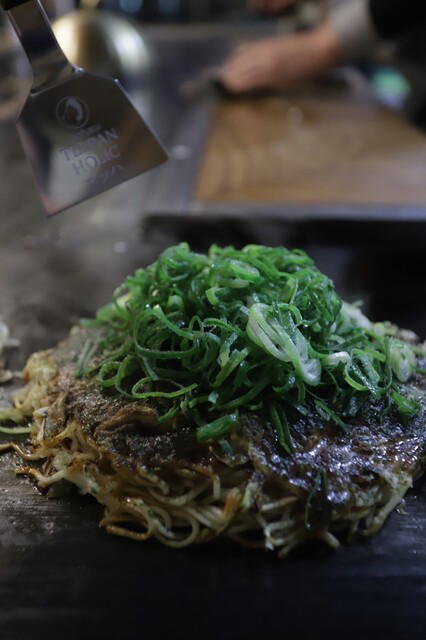
Onomichi’s food rhythm is set by slope, sea air, shopping arcades, and small rooms where the cooking surface can define the meal. Okonomiyaki belongs naturally to that scale: not an imported spectacle, but part of the area’s everyday grammar of griddle cooking, noodles, sauce, and hot-plate discipline. Okonomiyaki Murakami fits it as a focused local address where the griddle is the center of gravity.
Okonomiyaki is often framed through larger-city food culture, but Onomichi gives it another register: a port town used to feeding walkers, cyclists, temple-route visitors, and regulars without making every meal an occasion. The value is direct: a casual price tier, a narrow menu universe, and minimal distance between cooking and eating. Recognition matters because it separates a local staple from a tourist fallback. Selection for Tabelog 100 - Okonomiyaki - 2025 places the shop in a national category conversation, not just a local recommendation.
A griddle tradition shaped by noodles, sauce, and Setouchi practicality
Okonomiyaki’s sourcing story is not rare luxury ingredients, but how ordinary components behave when worked on iron. The appeal is a fuller casual meal built through heat, timing, and texture rather than luxury presentation. In Onomichi, the experience is less theatrical abundance than griddle control and a practical sense of appetite.
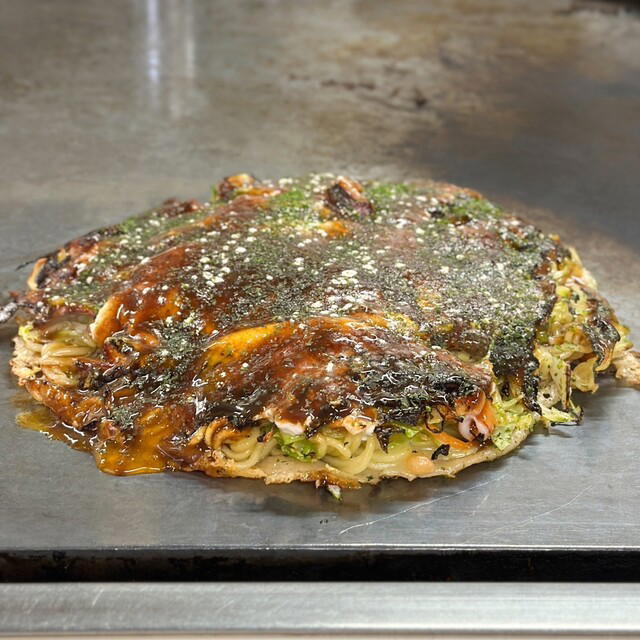
The listed categories, okonomiyaki, stir-fried noodles, and teppanyaki, signal a kitchen built around the hot plate rather than a broad izakaya menu. A griddle specialist has fewer places to hide: noodle handling, sauce balance, and browning carry the meal. The format also suits direct, low-ceremony dining, one reason Japanese specialist restaurants remain efficient for serious eating. Guests need no luxury framing or multicourse commitment to access the core craft.
The restaurant’s value is better read through durability of format than through a romantic origin story. The useful point is not nostalgia, but repeatability: a modest price tier and a style of cooking that feeds people well without luxury framing. Onomichi’s dining scene includes dessert stops such as Dolce Honten, casual local addresses such as Karasawa, and more formal Japanese cooking represented by 割烹 東山; the griddle specialist occupies another lane, closer to daily appetite than ceremony.
The compact format keeps the meal close to the heat
A focused griddle format changes how okonomiyaki is read. In broader casual rooms, the dish can become background fuel; here, the cooking method itself sets the pace. The point is concentration rather than breadth: a local specialist, not a themed dining room engineered to cover every possible craving.
That focus has conditions. A hot-plate meal better suits diners who are comfortable with a direct, casual format and a narrow food brief. The central appeal remains the relationship between griddle cooking and guest. The restaurant is best approached as a place for okonomiyaki, stir-fried noodles, and teppanyaki rather than as a broad evening program.
For Onomichi, the broader pattern is useful. The city’s better eating is not concentrated in one polished district; it runs through Onomichi’s small specialty rooms and everyday dining addresses. Restaurant YOSORO shows another side of the dining map, while the full local spread is better read through Our full Onomichi restaurants guide. Visitors building a wider trip can pair meals with Our full Onomichi hotels guide, Our full Onomichi bars guide, Our full Onomichi wineries guide, and Our full Onomichi experiences guide, but the logic here is direct: arrive for the griddle, not a long evening program.
How to read it against Japan's casual-specialist tier
Japan’s casual-specialist restaurants can be harder to judge than luxury counters because the signals are quieter. Awards help, but format tells as much as recognition. A Tabelog score of 3.67 and a 2025 Tabelog Okonomiyaki 100 selection point to category credibility, while the budget remains casual. Together, they matter more than either signal alone: a modestly priced specialist with national recognition is not just a convenient stop.
Okonomiyaki Murakami is best understood as a narrow-purpose address. It is not covering every major Japanese comfort-food category under one roof. Its vocabulary is griddle food, noodles, and teppan cooking, and that focus is the reason to pay attention. Compared with out-of-metro okonomiyaki peers such as Okonomiyaki Tecchan Honten, the price tier sits in familiar casual territory; compared with Onomichi’s broader dining range, the draw is category clarity rather than variety.
For readers planning across Japan, the useful comparison is format, not a checklist of dishes. Specialist comfort food can be as revealing as a formal counter when the rules are clear. That logic explains why tightly focused casual rooms can sit beside more formal restaurants in a serious dining itinerary. The lesson is the same: category discipline often matters more than breadth.
Onomichi rewards this kind of eating. A traveler can move from gelato at Dolce Honten to local casual cooking at Karasawa, then to okonomiyaki without pretending the city is a fine-dining circuit. For broader reference points across EP Club’s Japan and diaspora coverage, the common thread is not prestige for its own sake; it is whether the format teaches something specific about how people eat.
Frequently asked questions
Is Okonomiyaki Murakami a family-friendly restaurant?
It can suit diners who are comfortable with a griddle-focused casual meal. Because the appeal is direct and specialist rather than slow or sprawling, it is best for guests who want a straightforward okonomiyaki stop in Onomichi.
What's the overall feel of Okonomiyaki Murakami?
It feels direct and workmanlike: a focused okonomiyaki address in Onomichi. The 2025 Tabelog 100 selection gives it clear editorial weight, while the listed budget of Dinner: JPY 1,000 - JPY 1,999; Lunch: JPY 1,000 - JPY 1,999 keeps it firmly in the casual category.
Is Okonomiyaki Murakami expensive?
Pricing at Okonomiyaki Murakami is listed as JPY 1,000 - JPY 1,999 JPY 1,000 - JPY 1,999.
What is Okonomiyaki Murakami known for?
Okonomiyaki Murakami is known for okonomiyaki, stir-fried noodles, and teppanyaki in Onomichi, with recognition from Tabelog 100 - Okonomiyaki - 2025.
In Context: Similar Options
Comparable venues by cuisine and price in the same metro.
| Venue | Cuisine | Price | Awards | Notes |
|---|---|---|---|---|
| Okonomiyaki MurakamiThis venue — the venue you are viewing | Hiroshima-Style Okonomiyaki | $10–20 | Tabelog 100 #99 | Not listed |
| 割烹 東山 | Traditional Japanese Robatayaki | Not listed | Not listed | Onomichi |
| Karasawa | Handmade Japanese ice cream & monaka shop | $1–10 | Tabelog 100 #45 | Tsuchido |
| Dolce Honten | Gelato Cafe | $1–10 | Tabelog 100 #90 | Setoda-cho Hayashi |
| 楽々 | Handmade Udon | $10–20 | Tabelog 100 #32 | 幾野 |
| Gyoza Kogetsu | Traditional Japanese Gyoza | $10–20 | Tabelog 100 #48 | Kitahama |
Recognition history
Dated appearances from independent guides and award organizations, with the underlying list record or original source where available.
Tabelog 100 #99 · No. 99
Tabelog · Tabelog 100 - Okonomiyaki - 2025
Details
- Cozy
- Classic
- Rustic
- Casual Hangout
- Solo
- Family
- Group Dining
- Standalone
- Open Kitchen
- Beer Program
- Street Scene
- A La Carte
- Counter Dining
- Beer
- Vegetarian Friendly
Current opening hours
- Monday
- Closed
- Tuesday
- Closed
- Wednesday
- Closed
- Thursday
- Closed
- Friday
- Closed
- Saturday
- 11 AM–3 PM, 4:30–7 PM
- Sunday
- 11 AM–3 PM, 4:30–7 PM
Hours can change for holidays and private events. Last verified .
Small, informal, and warmly local, with a simple neighborhood-shop atmosphere rather than a polished dining room.