Okamoto

Tabelog 100 #71
Our verdict
Okamoto places Nishinomiya’s Koshienguchi area into the Kansai yakitori conversation, with a 2025 Tabelog 100 Yakitori WEST selection and a dinner spend in the JPY 10,000–14,999 bracket. The appeal is less about spectacle than location and category discipline: a serious grilled-chicken counter in a residential rail-side district better known to visitors as a stop between Osaka and Kobe.

Pearl is the En Primeur Club membership app, where members save venues, book tables and use the concierge.
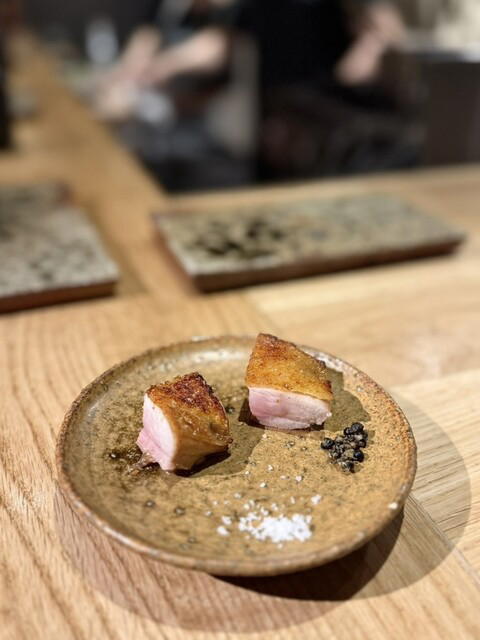
The menu
What to order
- Yakitori (grilled chicken skewers)
- Grilled chicken parts assortment
Approaching Nishinomiya, the mood shifts from big-station Kansai to a smaller city rhythm: apartment blocks, local shopping streets, and the practical calm of a commuter area rather than a dining quarter built for tourists. That setting matters. Yakitori in Japan has always lived comfortably between everyday drinking culture and exacting craft, and in Nishinomiya the genre reads differently from the high-gloss counters of central Osaka or Kobe. Okamoto belongs to that quieter register, where the point is not theatrical luxury but a focused evening around grilled chicken skewers, smoke, pacing, and restraint.
The restaurant’s 2025 Tabelog Hyakumeiten recognition for yakitori gives it a clear signal within western Japan’s crowded yakitori field. This is a category where recognition tends to reward consistency as much as novelty: careful sourcing, controlled heat, and a kitchen able to turn a familiar format into a measured sequence. In a city whose visitors often pass through for local activities and residential life, that accolade places Nishinomiya into a broader Kansai dining map rather than leaving it as a satellite between larger centres.
Nishinomiya gives the yakitori format a local frame
Kansai dining often rewards proximity and planning, but not every local restaurant plays the same role. Around major terminals, yakitori can become a quick pre-train meal or a late drinking stop. In Nishinomiya, the tempo is more local. A restaurant here has to serve guests who know the city and diners willing to leave the more obvious restaurant corridors. That changes the expectation: the room does not need to announce itself as a destination, but the cooking has to justify the detour.
Okamoto’s position in Nishinomiya is useful for travellers who already understand the Hyogo-Osaka corridor. It suits an evening that is built around the Hanshin-Kobe side of Kansai rather than a checklist meal in Umeda or Sannomiya. The city’s dining identity is mixed: bakeries, patisseries, everyday Japanese restaurants, and small specialist rooms sit close to residential streets. For a wider read on that spread, see Our full Nishinomiya restaurants guide, with nearby food stops such as Patissier Eiji Nitta, Maruyasu, Yoshoku Musha Musha, Ramen Senmon Nagomi Mukonosou ten, and Yoshoku to Wine no Omise Tsukushien showing how varied the city’s table can be.
The category is narrow, which is exactly the point
Yakitori is often misunderstood by travellers as casual skewers first and craft second. At the stronger end of the genre, the hierarchy reverses. The interest lies in heat management, sequencing, chicken part selection, salt and tare decisions, and the way the meal moves from leaner cuts to richer textures without turning heavy. No single detail needs to be ornamental. A serious yakitori room earns attention by making repetition feel precise rather than monotonous.
Okamoto sits in a dinner price tier of JPY 10,000 - JPY 14,999, separating it from casual station drinking spots and putting it closer to specialist Kansai yakitori counters. That bracket matters because it changes what a diner should expect: not a broad izakaya menu built around volume, but a tighter grilled-chicken experience where the value is in control and progression. Compared with lower-priced regional alternatives such as Yoshoku Musha Musha or Ramen Senmon Nagomi Mukonosou ten, this is a different dining decision entirely. Compared with a mid-priced western-style room such as Yoshoku to Wine no Omise Tsukushien, the spend reflects specialization rather than breadth.
The 2025 recognition also gives the restaurant useful context. A Nishinomiya yakitori room appearing in a major selection suggests meaningful traction in a category that does not usually reward flash alone. That does not make it a trophy meal by default; it makes it a useful marker of where Kansai’s serious yakitori conversation is extending beyond the central urban zones.
How to read Okamoto within a Nishinomiya evening
This is not the address for diners seeking maximal choice across cuisines in one room. It is for those who want a narrow Japanese format handled with enough confidence to anchor the night. Nishinomiya rewards that kind of planning. The city is not short on polished sweets, bakeries, and everyday restaurants, but its stronger specialist rooms ask visitors to think at city scale. Pairing dinner here with a broader day in the area makes more sense than treating it as a last-minute add-on after central Osaka.
For visitors building a larger stay, the restaurant works as one piece of a Nishinomiya itinerary rather than the whole argument for the city. Hotels, drinking rooms, wineries, and cultural activities are covered separately in Our full Nishinomiya hotels guide, Our full Nishinomiya bars guide, Our full Nishinomiya wineries guide, and Our full Nishinomiya experiences guide. Readers comparing Japanese dining formats beyond Hyogo can also look more broadly at other specialist rooms in Japan and abroad, while keeping Okamoto in mind as a focused Nishinomiya example rather than a catch-all dining room.
The editorial case is clean: Okamoto is valuable because it proves that serious yakitori in Kansai is not confined to the obvious restaurant districts. Its recognition, narrow category focus, and Nishinomiya setting make it a strong choice for diners who read local dining scenes carefully and prefer specialist formats over broad menus. In Nishinomiya, that combination carries more weight than decorative luxury.
Frequently asked questions
What are the operating hours at Okamoto?
Current operating hours for Okamoto should be confirmed directly with the restaurant before visiting.
What does dinner at Okamoto typically cost?
Pricing at Okamoto is listed as JPY 10,000 - JPY 14,999 View spending breakdown.
Where exactly is Okamoto?
Nishinomiya.
What is Okamoto known for?
Okamoto is a yakitori restaurant in Nishinomiya, with Tabelog Hyakumeiten recognition in 2025. Its listed dinner price range is JPY 10,000 - JPY 14,999.
Can Okamoto handle vegetarian requests?
Okamoto is built around yakitori, so the menu focus is grilled chicken skewers rather than vegetarian cooking. Diners seeking meat-free plates should contact the restaurant directly before booking.
A Lean Comparison
Side-by-side context: comparable cuisine and price.
| Venue | Cuisine | Price | Awards | Notes |
|---|---|---|---|---|
| OkamotoThis venue (the venue you are viewing) | Yakitori | $50–100 | Tabelog 100 #71 | Not listed |
| Maruyasu | Fugu (Pufferfish) Fine Dining | $500+ | Tabelog Bronze #256 | Not listed |
| Yoshoku Musha Musha | Not listed | Not listed | Not listed | JPY 1,000 - JPY 1,999 JPY 1,000 - JPY 1,999 |
| Yoshoku to Wine no Omise Tsukushien | Not listed | Not listed | Not listed | JPY 5,000 - JPY 5,999 JPY 2,000 - JPY 2,999 |
| Ramen Senmon Nagomi Mukonosou ten | Not listed | Not listed | Not listed | JPY 1,000 - JPY 1,999 JPY 1,000 - JPY 1,999 |
| Patissier Eiji Nitta | Not listed | $10–20 | Tabelog 100 #69 | JPY 1,000 - JPY 1,999 JPY 1,000 - JPY 1,999 |
Recognition history
Dated appearances from independent guides and award organizations, with the underlying list record or original source where available.
Tabelog 100 #71 · No. 71
Tabelog · Tabelog 100 - Yakitori - WEST - 2025
Continue exploring
More in Nishinomiya
Restaurants in Nishinomiya
All restaurants in Nishinomiya →




Bars in Nishinomiya
Browse all →




Hotels in Nishinomiya
Browse all →



Wineries in Nishinomiya
Browse all →
Details
- Date Night
- Group Dining
- Casual Hangout
- After Work
- Late Night
- Chefs Counter
- Standalone
- Sake Program
- Beer Program
- A La Carte
- Counter Dining
- Sake
- Beer
Current opening hours
- Monday
- 5–11:30 PM
- Tuesday
- Closed
- Wednesday
- 5–11:30 PM
- Thursday
- 5–11:30 PM
- Friday
- 5–11:30 PM
- Saturday
- 5–11:30 PM
- Sunday
- 5–11:30 PM
Hours can change for holidays and private events. Hours as of .