Tabelog 100 #3
Our verdict
NUWARA KADE places Sri Lankan curry inside Osaka’s wider appetite for specialist, low-friction dining rather than formal tasting-menu theatre. Its Tabelog 100 selections for Asian and ethnic cuisine in 2022, 2023, and 2024, plus earlier curry-category recognition, make it a useful marker for how Kansai diners treat spice, rice, and counter-style meals with serious attention.

Pearl is the En Primeur Club membership app, where members save venues, book tables and use the concierge.
The menu
What to order
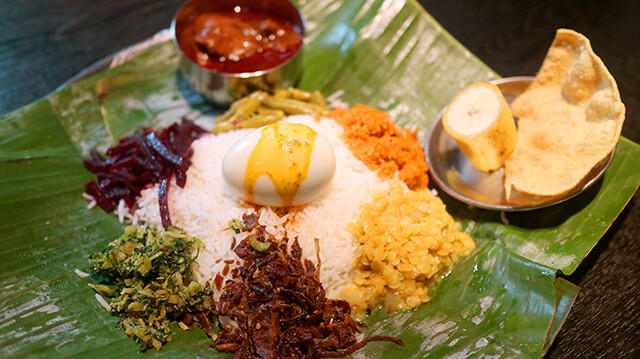
- All 18 Types Customizable Sri Lankan Curry Plate
- Biryani
- Sri Lankan Curry Ramen
- Nuwara Plate
Osaka is not only its loudest dining districts, and that is part of the point. Away from the city’s most theatrical restaurant zones, the rhythm often shifts toward offices, apartment blocks, and workday restaurants, where curry houses and small specialist kitchens build repeat custom without relying on spectacle. NUWARA KADE fits that practical Osaka tradition: a compact-feeling, category-led address with Sri Lankan curry as an anchor and izakaya-adjacent flexibility that makes the meal feel less like a fixed-format restaurant than a local habit.
Osaka’s curry culture has never stayed in one lane. Japanese curry shops, spice-curry specialists, South Asian kitchens, and drinking-friendly small restaurants overlap across the city. The useful distinction is format, not simply nationality: some rooms behave like quick lunch counters, others like evening drinking spots with curry at the centre. This restaurant sits in the latter-middle ground, where Sri Lankan, curry, and izakaya categories meet rather than cancel one another out.
Sri Lankan curry in Osaka's specialist middle tier
The evidence is not vague popularity. NUWARA KADE is listed in Tabelog’s Hyakumeiten context for 2024, with a published score of 3.54 and categories that place it under Sri Lankan, curry, and izakaya-style dining. That matters because it frames the restaurant through use rather than ceremony: this is not a luxury room trying to look important, but a specialist casual venue whose identity is legible through the way diners and listings classify it.
Sri Lankan curry also occupies a different register from the heavier, roux-based Japanese curry many travellers first associate with Japan. The meal can turn on rice, multiple curry components, sharp contrasts, and spice structure rather than one sauce poured over a plate. Without relying on a named signature dish, the editorial signal is clear: the draw is the curry format itself, not a chef biography or luxury room.
That makes the restaurant useful for travellers who already understand Osaka as a city of small-format eating. A day might move through bakeries, snack counters, station-area staples, and compact restaurants before landing in a more specialist curry lane. The same city can hold many kinds of dining rooms, counters, bistros, and stripped-back cafe stops without those genres feeling like imported decoration. Osaka absorbs formats through use, and NUWARA KADE belongs to that practical, repeatable side of the map.
A room built for rotation, not ceremony
The setup is best understood through pace rather than grandeur. This is the kind of casual Osaka restaurant where solo diners, friends, and small groups can all make sense of the format, depending on the hour and the purpose of the meal. That flexibility is common in the city’s stronger everyday rooms: service needs to be direct enough for a focused curry visit, elastic enough for dinner, and relaxed enough that food and drinks can share the same frame.
The team dynamic is not expressed through named personalities, because the public identity is format-led. It shows through category overlap. Sri Lankan curry supplies the centre of gravity; izakaya framing gives the room evening elasticity; the wider impression is of a restaurant built around practical appetite rather than performance. In Osaka, serious casual dining often depends on whether a room can stay fluid across uses: solo lunch, group dinner, curry-focused visit, or a drink-led evening with food carrying equal weight.
Compared with nearby and citywide peers, the positioning is specific. Ramen Kasumi Awaza honten, Yiwanshui, and Bistro des Chenapans sit in different dining lanes, while NUWARA KADE competes less on polish than category authority. Its 2024 Tabelog recognition places it among noted Sri Lankan, curry, and izakaya-style specialists rather than formal dining rooms. That is the correct lens. Expect a specialist casual restaurant, not choreographed fine dining.
The same lens helps within a wider Japan itinerary. Travellers comparing regional curry and compact specialist dining will find that the most memorable rooms are often the ones with the clearest purpose, not the longest explanations. Across Japan and beyond, narrow formats can carry a full identity when the restaurant knows what it is for. NUWARA KADE’s strength is exactly that kind of clarity: curry-led, casual, practical, and grounded in Osaka’s appetite for specialist everyday dining.
How to read it within an Osaka trip
This address works when the day already includes Osaka’s denser central districts and the meal needs a sharper point of view than another station-area default. The city setting changes the expectation: the reward is not spectacle, but a curry-focused restaurant with enough recognition to justify attention from diners who care about Osaka’s spice scene.
The practical reading is simple without turning the meal into logistics. NUWARA KADE’s listed budget is dinner at JPY 2,000 - JPY 2,999 and lunch at JPY 1,000 - JPY 1,999, which puts it in a useful range for travellers building a day around casual but specific eating. For current opening hours, payment rules, reservations, and access details, check the restaurant’s latest official or listing information before going, since small restaurants can change operations without much ceremony.
For planning the rest of the city, use Our full Osaka restaurants guide for dining context, Our full Osaka hotels guide for where to base, Our full Osaka bars guide for later drinking, Our full Osaka wineries guide for wine-focused leads, and Our full Osaka experiences guide for cultural pacing around meals. NUWARA KADE is not a grand statement restaurant. It is more useful than that: a compact, recognised Sri Lankan curry address showing how Osaka’s casual dining intelligence works when spice, rice, drinks, and repeat local use share one room.
Frequently asked questions
What days is NUWARA KADE closed?
Current closing days are not confirmed in the available ground-truth listing for NUWARA KADE. Check the venue’s latest official channels or current restaurant listing before visiting.
What should I budget for a meal at NUWARA KADE?
Pricing at NUWARA KADE is listed as dinner: JPY 2,000 - JPY 2,999; lunch: JPY 1,000 - JPY 1,999.
How do I find NUWARA KADE?
Osaka.
What's the signature at NUWARA KADE?
There isn’t a single named signature dish in the provided record. The clearest signal is its Sri Lankan and curry focus, with izakaya-style flexibility, plus 2024 Tabelog Hyakumeiten recognition and a listed score of 3.54. Check the venue's official channels for the latest details.
A Credentials Check
Comparable venues to calibrate price, style, and recognition.
| Venue | Cuisine | Price | Awards | Notes |
|---|---|---|---|---|
| NUWARA KADEThis venue (the venue you are viewing) | Authentic Sri Lankan Curry & Biryani | $20–30 | Tabelog 100 #3 | Not listed |
| Ren | Cocktail bar with light bar food | $20–30 | Tabelog 100 #13 | Kita |
| Poussin | Pudding & Cake Shop | $10–20 | Tabelog 100 #56 | Nishi |
| MONDIAL KAFFEE 328 | Specialty Coffee & Café with House-Roasted Beans and Sweets | $10–20 | Tabelog 100 #62 | Nishi |
| Dojima Samboa | Classic Japanese cocktail bar | $20–30 | Tabelog 100 #77 | Kita |
| GUFO | Ice Cream Café | $10–20 | Tabelog 100 #6 | Nishi |
Recognition history
Dated appearances from independent guides and award organizations, with the underlying list record or original source where available.
Tabelog 100 #3 · No. 3
Tabelog · Tabelog 100 - Asian cuisine / Ethnic cuisine - WEST - 2024