Noor




1 Michelin Star · Star Wine List · We're Smart World 4 Radishes
Our verdict
Housed in a converted Theresia Chapel on Groningen's southern edge, Noor operates at the top of the city's creative dining tier. The prestige menu, priced at €210, is built around vegetable-forward cooking with precise technical execution, earning the kitchen a White Star recognition from Star Wine List. Thursday through Saturday evenings are the primary service window, with Saturday lunch adding a rare daytime option.

Pearl is the En Primeur Club membership app, where members save venues, book tables and use the concierge.
The menu
What to order
- Celeriac with yoghurt and salted lemon
- Dry-aged sea bass with verjus beurre blanc
- Filet Américain with piccalilli
A Chapel Setting That Frames the Cooking
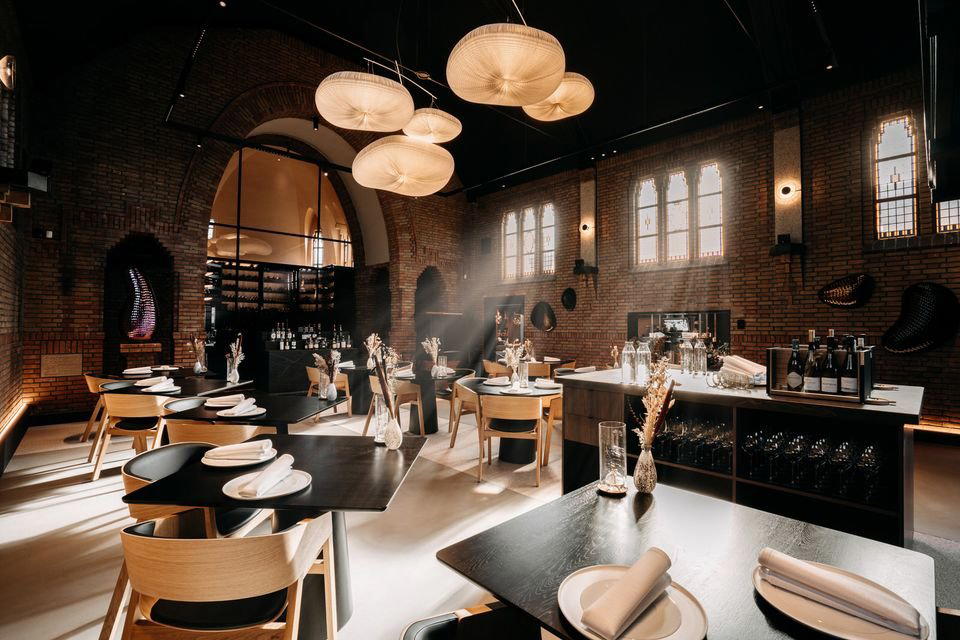
Groningen's fine dining scene is compact but increasingly ambitious, with a cluster of creative kitchens pulling the city into conversations previously reserved for Amsterdam, Rotterdam, and Maastricht. At the top of that bracket, Noor occupies a former Theresia Chapel on Zuiderweg, a setting that does something most purpose-built restaurant spaces cannot: it imposes its own architectural logic on the experience. The stained-glass windows and chapel proportions have been preserved, and a contemporary interior has been drawn around them rather than imposed over them. The entrance route through the kitchen is not theatrics for its own sake, it signals immediately that what happens in that room is the foundation of everything else on the premises.
Converted ecclesiastical spaces appear across northern European fine dining, and they tend to produce two outcomes: spaces where the architecture overwhelms the food, and spaces where the tension between the sacred and the culinary becomes genuinely productive. Noor belongs to the second category. The setting heightens attention without competing with the plate.
The Prestige Menu and What It Signals
The price point tells you where Noor sits in the Dutch fine dining tier. At €210 for the prestige menu, it prices against a cohort that includes De Librije in Zwolle, Aan de Poel in Amstelveen, and De Bokkedoorns in Overveen, kitchens operating in the upper bracket of Netherlands creative cuisine. For Groningen specifically, that €210 figure represents a meaningful step above the city's mid-range creative tier, which includes Bisque and De Haan at the €€€ level, and separates it further from accessible options like Dokjard and De Grote Frederik Bistro.
The White Star recognition from Star Wine List, published in August 2022, adds a specific credential: the wine program is being taken seriously at the level the prestige menu demands. In the broader Dutch context, prestige-menu kitchens that earn wine-list recognition alongside culinary awards are relatively few, and that pairing matters when assessing value at the €210 tier. Internationally, the creative format at this price level draws comparison with properties like Platán Gourmet in Tata and Brut172 in Reijmerstok, where the tasting-menu structure carries similar price signals and similar expectations around kitchen coherence.
The Kitchen as Collaboration
Dutch fine dining has undergone a gradual shift over the past decade, with single-chef auteur kitchens giving way to more overtly collaborative models. The logic is partly practical: the creative and physical demands of a prestige tasting menu are difficult to sustain under one person, and kitchens that distribute authorship across two or more principals tend to show more consistent execution across service. Noor follows this model explicitly, with two chefs working in tandem rather than a conventional head chef and brigade hierarchy.
That collaboration is visible in the menu's character. The cooking at this level in the Netherlands tends to resolve into one of two modes: a technically driven style anchored in classical French architecture, or a more ingredient-led approach that treats the produce as the organizing principle. Noor sits in the second camp. Vegetables are treated as primary material rather than accompaniment, and the kitchen's approach to fermentation, curing, and acid introduces complexity that does not depend on protein-led richness. The celeriac cooked in a salt crust, a preparation that requires patience and precise timing, and the dry-aged sea bass with verjus beurre blanc and codium oil both illustrate how the team uses technique to deepen rather than disguise the ingredient. These are dishes that ask the kitchen to trust the produce and trust the diner to follow.
The vegetarian set menu, which requires advance ordering, extends this logic further. Offering a dedicated vegetable menu at the prestige-menu level, rather than simply accommodating dietary requirements, is a positioning choice that aligns Noor with a small cohort of Dutch kitchens willing to argue that vegetables can carry the full weight of a formal tasting experience. De Groene Lantaarn in Staphorst and De Lindehof in Nuenen occupy adjacent territory in their treatment of local and garden produce at the high end of the Dutch scene.
Service Structure and the Front-of-House Dimension
The team dynamic at Noor extends to the front of house, and in a chapel conversion with a kitchen-entry sequence, the spatial choreography of service matters as much as the food program. The passage through the kitchen on arrival is an act of orientation, guests understand the kitchen's scale, its organization, and its pace before they sit down. That kind of transparency is a front-of-house decision as much as a design one, and it changes the register of the subsequent service. Sommelier engagement in this context is not supplementary; the White Star recognition implies a wine program that is being presented with a distinct point of view, likely with a focus on European producers whose approach to viticulture aligns with the kitchen's vegetable-forward sensibility.
Comparable team-led formats in the Netherlands, including De Lindenhof in Giethoorn, demonstrate that the most coherent prestige menus are those where kitchen, sommelier, and floor operate around a shared editorial position rather than in functional silos. At Noor, the collaborative kitchen structure suggests that the front-of-house presentation is likely designed to reflect the same philosophy: ingredient-focused, deliberate, and built for a guest who wants to understand what they are eating and why.
Planning a Visit
Noor operates Thursday through Saturday evenings from 6:30 PM, with service running until midnight. Saturday adds a lunch sitting from noon to 4:30 PM, the only daytime window in the schedule, and for visitors combining the restaurant with a wider Groningen stay, the logical entry point. The kitchen is closed Sunday through Wednesday. Given the prestige-menu format and the chapel's finite capacity, booking well in advance is advisable, particularly for Friday and Saturday evenings. Noor is located at Zuiderweg 38 in the southern part of Groningen, a short distance from the city centre. For those exploring the wider Groningen dining and hospitality offer, EP Club's guides cover restaurants, hotels, bars, wineries, and experiences across the city. The Blumé listing is worth cross-referencing for visitors assessing the broader shape of Groningen's modern French and creative fine dining tier.
Frequently asked questions
What should I eat at Noor?
The prestige menu at €210 is the primary format, built around vegetable-forward creative cooking with a clear technical foundation. Confirmed dishes from the kitchen include celeriac cooked in a salt crust with yoghurt and salted lemon, and dry-aged sea bass with baked potato, verjus beurre blanc, and codium oil. Both illustrate the kitchen's approach: fermentation and acid used to build depth, and produce treated as the main event rather than supporting material. If you are visiting as a non-meat-eater, the dedicated vegetarian set menu covers the same creative ambition as the prestige menu but requires advance notice at the time of booking. The White Star wine recognition from Star Wine List (2022) signals that the wine program is worth engaging with seriously rather than treating as optional.
Cuisine and Credentials
| Venue | Cuisine | Price | Awards |
|---|---|---|---|
| NoorThis venue (the venue you are viewing) | Contemporary French with Global Influences | $150–200 | 1 Michelin Star · Star Wine List |
| De Grote Frederik Bistro | Contemporary French Bistro | $50–100 | Michelin Bib Gourmand |
| Dokjard | International Brew-Bistro with Creative Fusion | $30–50 | Michelin Bib Gourmand |
| Bisque | Modern French-Dutch Fine Dining | Not listed | Michelin Plate · Star Wine List |
| De Haan | Modern French-Dutch Fine Dining | $50–100 | Michelin Plate |
| Hanasato | Authentic Washoku Japanese | $100–150 | Michelin Plate |
Recognition history
Dated appearances from independent guides and award organizations, with the underlying list record or original source where available.
Michelin 1 Star
Michelin
Star Wine List
Star Wine List
Opinionated About Dining Top Restaurants in Europe Recommended
Opinionated About Dining
We're Smart World 4 Radishes
We're Smart World
Noor
Featured Guides

Continue exploring
More in Groningen
Restaurants in Groningen
All restaurants in Groningen →
Bars in Groningen
All bars in Groningen →
Noor
The wine
- Wine program
- Deep wine list
- Extensive wine list
- Sommelier-led
- Natural wine
- Zero-proof drinks
Details
- Elegant
- Intimate
- Sophisticated
- Quiet
- Scenic
- Special Occasion
- Date Night
- Celebration
- Open Kitchen
- Chefs Counter
- Historic Building
- Design Destination
- Wine Cellar
- Extensive Wine List
- Sommelier Led
- Natural Wine
- Zero Proof
- Local Sourcing
- Farm To Table
- Sustainable Seafood
- Set Menu
- Tasting Menu
- Wine Pairing
- Juice Pairing
- Natural Wine
- Vegetarian Friendly
- Pescatarian Friendly
- Allergy Accommodating
Current opening hours
- Monday
- Closed
- Tuesday
- Closed
- Wednesday
- 6:30 PM–12 AM
- Thursday
- 6:30 PM–12 AM
- Friday
- 12–4:30 PM, 6:30 PM–12 AM
- Saturday
- 12–4:30 PM, 6:30 PM–12 AM
- Sunday
- Closed
Hours can change for holidays and private events. Hours as of .
Serene and contemplative atmosphere with preserved stained-glass windows, contemporary luxury design, and soft lighting that honors the chapel's sacred heritage while creating an intimate dining sanctuary.