No.9 Park
No.9 Park occupies a Beacon Hill townhouse steps from the State House, where Boston's political and professional class has long converged over French and Italian-inflected cooking and a wine program that earns consistent editorial recognition. The room rewards those who return: regulars report a coherence of service and menu that deepens with familiarity, placing the restaurant firmly in Boston's upper tier of long-form dining rooms.
 Discover on Pearl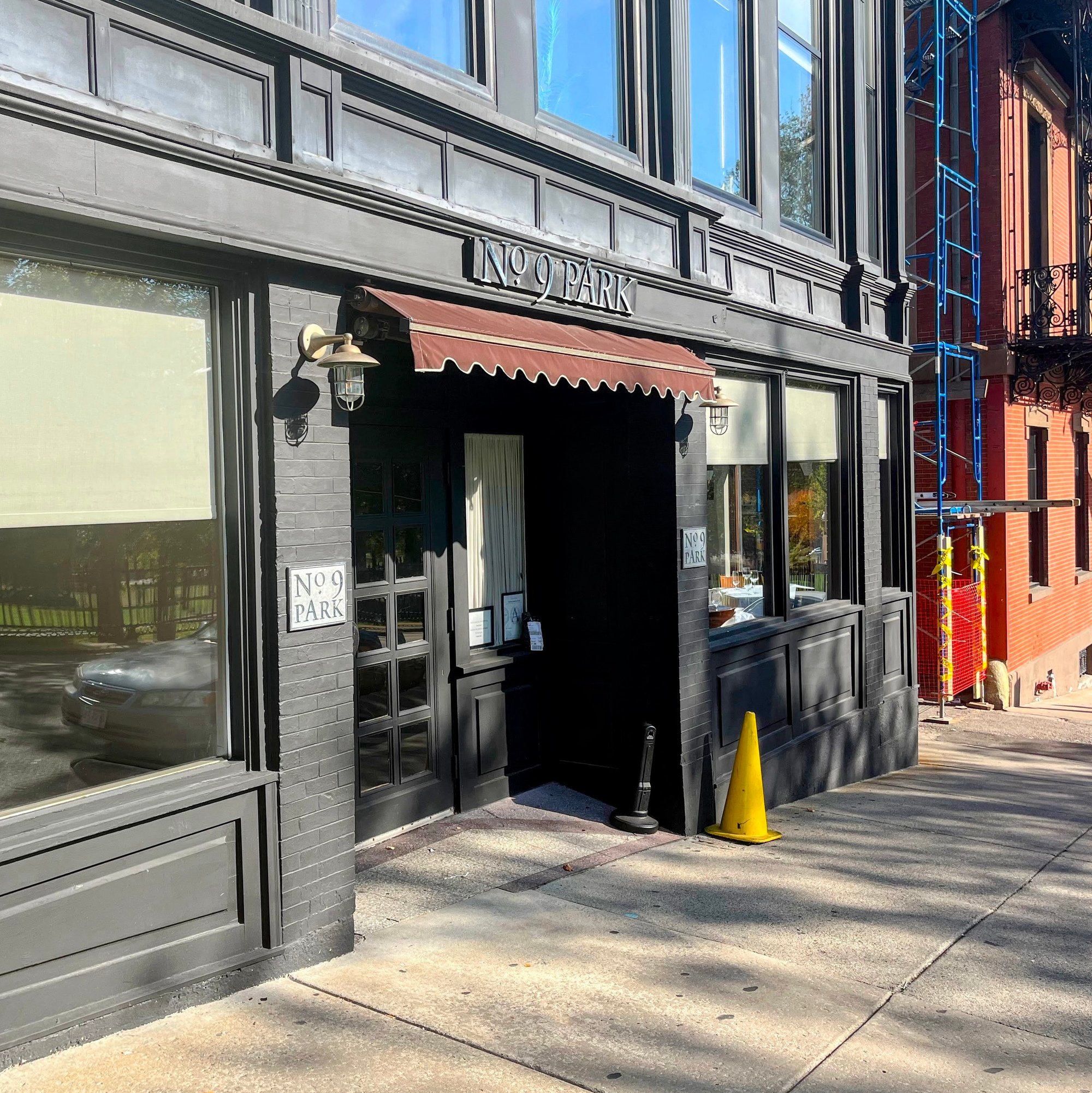
Where Beacon Hill Comes to Settle In
The approach along Park Street Place says something before you've crossed the threshold. Beacon Hill's Federal-era architecture — brick rowfronts, gas-style lanterns, the gold dome of the State House visible from the corner — sets a register that No.9 Park holds once you're inside. This is not a room built for spectacle. It is built for duration: long meals, considered wine choices, conversation that doesn't have to compete with a DJ set or an open kitchen's theatre. In a city where dining rooms increasingly court the first-visit experience, No.9 Park has always been oriented toward the return visit.
That orientation is visible in how the space is used. Regulars gravitate toward particular tables, and the floor staff knows it. The professional and political class that has made this corner of Boston a crossroads for decades keeps showing up here for the same reason certain restaurants in Washington or Paris become default rooms for a particular stratum of city life: the formula is consistent, the room is quiet enough for negotiation or intimacy, and the cooking doesn't try to surprise at the cost of reliability.
The Case Boston's Long-Running Rooms Make
Boston's fine dining tier has contracted and reshuffled since the early 2000s. Some of the city's most ambitious rooms from that era have closed, simplified, or pivoted to casualness. The survivors tend to fall into two camps: places that have reinvented themselves around trend cycles, and places that have held a defined position long enough that the position itself becomes the value. No.9 Park belongs to the second camp. Its French and Italian culinary reference points , the kind of European classical grounding that shaped American fine dining through the 1990s and 2000s , feel less dated now than they did during the farm-to-table wave that briefly made them seem unfashionable. Context restores them.
In peer terms, No.9 Park sits alongside a small set of Boston rooms where the wine list and service floor are as much the reason for the reservation as the kitchen. That's a different value proposition than the city's newer chef-driven tasting menu format, and it appeals to a different kind of returning guest: one who wants the meal calibrated to the evening's tempo rather than the kitchen's preferred sequence. For those guests, the wine program is often the anchor. Long-standing lists built with genuine cellar depth offer something a newly opened room simply cannot manufacture.
What Regulars Come Back For
The regulars' perspective on a room like this diverges sharply from the first-timer's. For someone visiting once, the question is whether the food justifies the category. For someone who has been coming for years, the question is different: does the room still hold its quality across a season, does the floor team retain enough institutional knowledge to recall preferences, does the kitchen maintain enough consistency that a dish ordered again three months later is recognisably the same dish?
By the accounts that circulate in Boston's dining conversation, No.9 Park answers those questions affirmatively. The French and Italian framework means the cooking doesn't lurch between experimental phases. Dishes evolve with the season but the vocabulary stays stable, which is exactly what a certain kind of regular needs. They're not coming for discovery; they're coming for confirmed pleasure in a room that makes them feel known.
The bar program is part of this retention calculus. In a city where cocktail culture has matured considerably, with rooms like Equal Measure and Asta raising the technical bar, No.9 Park's bar functions as a pre-dinner gathering point for regulars who treat the full evening as a single arc. The cocktail list isn't trying to compete with dedicated cocktail programs; it's calibrated to transition guests into a long meal. That is its own form of expertise.
Boston's Upper-Tier Dining and Where No.9 Park Sits
Positioning No.9 Park accurately within Boston's current fine dining tier requires acknowledging what the city's upper bracket now contains. Newer openings like Baleia have introduced different culinary vernaculars. The steakhouse tradition, represented by rooms like Abe & Louie's, occupies an adjacent but distinct category. No.9 Park's differentiation comes from the coherence of its register: European classical framework, serious wine program, Beacon Hill address, and a service model built around recognizing faces rather than processing covers.
That coherence is harder to engineer than it looks. Restaurants that try to acquire this quality through investment in décor or imported talent rarely achieve it. It accrues through years of consistent operation, staff retention, and the accumulation of a loyal clientele whose own return visits reinforce the room's culture. In that sense, longevity is the product, not a byproduct.
For context on how this kind of venue compares to long-standing cocktail-led destinations in other American cities, the peer set includes places like Kumiko in Chicago and Jewel of the South in New Orleans , rooms where program depth and institutional knowledge are the primary draws, and where a first visit is often the beginning of a longer relationship. Internationally, the same pattern appears at venues like The Parlour in Frankfurt, where the room's value compounds across visits. In the American West, ABV in San Francisco and Bar Leather Apron in Honolulu operate on similar logic. Julep in Houston and Superbueno in New York City represent the more progressive end of this spectrum, where program identity drives loyalty rather than room familiarity alone.
Planning a Visit
No.9 Park's Beacon Hill address means parking is not a practical option; the venue is leading reached on foot from downtown or via the Red and Green Line stop at Park Street, which is a short walk. For a room of this standing in Boston's upper tier, reservations are advisable well ahead for weekend evenings, and the booking window is leading treated as a planning matter rather than a same-week decision. The room suits a full evening: those who come for a drink at the bar before moving to a table tend to get more out of the experience than those who arrive simply to eat and leave. Dress expectation runs toward smart; this is Beacon Hill rather than the Seaport, and the clientele reflects it. For a broader orientation to the city's dining options across price tiers and neighbourhoods, the full Boston restaurants guide maps the competitive set in detail.
Frequently Asked Questions
- What's the must-try cocktail at No.9 Park?
- The bar at No.9 Park operates as a preamble to the dining room rather than a destination in its own right, which shapes what to order. The cocktail list follows the restaurant's French and Italian framework, so spirit-forward drinks that complement food rather than compete with it tend to be the more considered choices. If you're seated at the bar before dinner, asking the bartender what's working that evening is a reasonable approach; the staff have the contextual knowledge that comes with a long-running program.
- What is No.9 Park leading at?
- In Boston's fine dining tier, No.9 Park's strongest claim is the coherence of the full evening rather than any single element. The French and Italian culinary framework, the wine program, and a service model built around returning guests combine into a room that rewards familiarity over time. For those who've navigated Boston's dining scene long enough to value consistency over novelty, it occupies a position that few newer openings have replicated.
- How far ahead should I plan for No.9 Park?
- For weekend evenings, treating the booking as a two-to-three-week decision is prudent; for peak periods or special occasions, extending that window is sensible. The room's established clientele means demand is steady rather than trend-driven, so last-minute availability exists but shouldn't be relied upon for a specific date. Weekday evenings offer more flexibility, and the room's character is arguably better expressed on a quieter night when the service can move at a slower register.
- Is No.9 Park a good option for a business dinner in Boston?
- For professional occasions requiring a room with low ambient noise, a serious wine list, and a service team experienced with pacing long meals, No.9 Park has served that function for Boston's professional class for years. The Beacon Hill address , close to the financial district and Government Center , is logistically convenient, and the room's formality sits at a level that signals occasion without theatrical excess. It belongs to a specific tier of Boston dining rooms where the setting does part of the work.
A Pricing-First Comparison
A small comparison set for context, based on the venues we track.
| Venue | Price | Awards | Notes |
|---|---|---|---|
| No.9 Park | This venue | ||
| Equal Measure | World's 50 Best | ||
| Blossom Bar | Cocktail bar (referenced as alum) | ||
| NAMU Distilling Company | Korean-American distillery and snacks (soju, gin, makgeolli-based spirits, anju) | ||
| Swingers | Activity-bar with Detroit-style pizza | ||
| Hecate |
Need a table?
Our members enjoy priority alerts and concierge-led booking support for the world's most difficult tables.
Get Exclusive Access