
Tabelog 100 #92
Our verdict
Niboshi Raamen Neko Tora Tei is a Yamato ramen counter built around niboshi, the dried-sardine stock that gives this style its saline depth and clipped finish. Its inclusion in Tabelog 100 - Ramen - Kanagawa for 2024 and 2025 places it in a selective local ramen conversation rather than the broader tourist circuit.

Pearl is the En Primeur Club membership app, where members save venues, book tables and use the concierge.
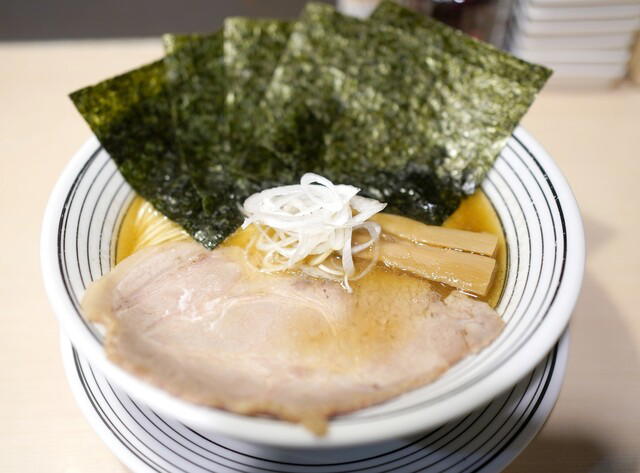
The menu
What to order
- Niboshi ramen
- Super boiled dried shiramen
- Niboshi ramen with chashu, menma, and negi
Approaching a serious ramen shop in Yamato rarely needs the theatre of major-station queues. The signal is usually plainer: a focused meal, a short service rhythm, and a bowl whose character is judged quickly. At Niboshi Raamen Neko Tora Tei, the available category is ramen, and the name points diners toward a niboshi-style identity. That makes the restaurant easier to read as a specialist address rather than a broad casual stop, while still keeping the experience in the everyday price range listed for both lunch and dinner.
Yamato sits in the practical belt of local dining, close enough to larger urban routines to feel their pull, yet distinct in its everyday habits. Ramen here competes on repeatability as much as destination value. A shop recognised by Tabelog Hyakumeiten in 2025 is not being rewarded for novelty alone. It has to make sense to diners who understand price, pace, and category identity, and who have alternatives within the same city. In Yamato’s ramen field, Umai Yo Yuchan Ramen, Ramen Go, Men Tei Tsumugi and Ethan Shokudo help frame a broader everyday scene. That puts this shop in a demanding middle: accessible enough for routine dining, scrutinised enough to need a clear point of view.
Niboshi stock gives Yamato ramen its sharper register
Niboshi ramen belongs to a different emotional register from richer bowls that often travel better on social media. Dried sardines can bring iodine, savour, and a faintly austere edge; the style is not designed simply to blanket the palate. For diners comparing ramen in Yamato, that matters because it changes how the bowl is approached: balance, aroma, and pace become central, and the pleasure comes from definition rather than weight.
That is why recognition in a ramen-focused list carries useful meaning here. Tabelog’s Hyakumeiten selections are not fine-dining awards; they are often more revealing for casual Japanese genres, where depth can be hidden inside inexpensive formats. A ramen shop selected by Tabelog Hyakumeiten is being placed among venues judged by diners who compare bowls carefully, not by travellers chasing a single tasting menu. Niboshi Raamen Neko Tora Tei’s Tabelog score of 3.72 adds another signal: strong enough to matter in a category where small differences are debated intensely, but not inflated into luxury language.
The sourcing angle is not about a romantic backstory. It is about how a dried-fish-led idea behaves as a foundation. Niboshi is preserved, portable, and historically practical, which helps explain why the term has such reach in ramen culture. Yet the style is unforgiving. Unlike heavier broths that can absorb variation through density, a sharper ramen profile exposes balance and extraction decisions. A shop associated with this name is making a technical wager: clarity will be enough.
A focused ramen shop belongs to the serious everyday tier
The format is part of the argument. A focused ramen meal is linear: order, wait, eat, leave. There is no need for tableside ceremony or menu sprawl to distract from broth, noodles, and pacing. In Japan, this is not austerity for its own sake; it is a service model built for food that changes quickly in the bowl. Ramen cools, noodles soften, aroma fades. The best casual shops keep the kitchen and diner in the same rhythm.
This is also where Yamato’s broader dining scene becomes useful context. The city is not framed by a single restaurant district, so credible addresses tend to be evaluated through purpose: ramen, curry, sweets, casual cooking, and small specialist rooms. Nearby Yamato listings such as other local noodle counters, Men Tei Tsumugi, Ethan Shokudo, and other category-specific addresses show how the city’s appeal is distributed across modest, focused places rather than a single dining strip. For a wider scan, use Our full Yamato restaurants guide; the broader city pages for Yamato hotels, Yamato bars, Yamato wineries, and Yamato experiences help place a meal within a full day rather than treating the bowl as an isolated errand.
Against that local backdrop, a ramen shop with a clear name and category has a precise role. It is not competing with celebratory dining in other Japanese cities or overseas Japanese concepts. Its value is narrower and more exacting: a low-friction bowl in which ramen itself is the main decision.
How to read the bowl before ordering
For diners used to richer ramen styles, niboshi requires a recalibration. The pleasure is in tension: mineral depth against aromatic lift, savour against bitterness, speed against concentration. A good niboshi bowl does not need to be heavy to feel complete. It should make the next sip feel logical, not compulsory.
The editorial case for Niboshi Raamen Neko Tora Tei is strongest for travellers already interested in Japan’s ramen grammar, or for Yamato diners choosing between comparable casual shops. Its 2025 Tabelog Hyakumeiten recognition gives the shop a verifiable place in the ramen conversation, while the focused format keeps the experience disciplined. This is not a broad-menu crowd-pleaser in disguise. It is a focused ramen address associated with a demanding style, and that focus is exactly the reason to pay attention.
Frequently asked questions
What does dinner at Niboshi Raamen Neko Tora Tei typically cost?
Pricing at Niboshi Raamen Neko Tora Tei is listed as JPY 1,000 - JPY 1,999 JPY 1,000 - JPY 1,999 View spending breakdown.
What time does Niboshi Raamen Neko Tora Tei open and close?
Specific opening hours are not provided here. Check the venue's official channels for the latest details.
Where is Niboshi Raamen Neko Tora Tei in Yamato?
Yamato.
What's the signature at Niboshi Raamen Neko Tora Tei?
The name points to niboshi ramen, and the shop’s 2025 Tabelog Hyakumeiten recognition confirms its place in the ramen conversation. In Yamato, the focus is on a concise ramen experience rather than a sprawling menu.
Do they accommodate allergies at Niboshi Raamen Neko Tora Tei?
Those details are not provided here. Check the venue's official channels for the latest details.
Is Niboshi Raamen Neko Tora Tei a family-friendly restaurant?
Specific family-friendly details are not provided here. The venue is in Yamato and is best understood as a focused ramen address; check the venue's official channels for the latest details.
Comparison Snapshot
Nearby venues at a similar price tier for orientation.
| Venue | Cuisine | Price | Awards | Notes |
|---|---|---|---|---|
| Niboshi Raamen Neko Tora TeiThis venue (the venue you are viewing) | Niboshi-focused ramen shop | $10–20 | Tabelog 100 #92 | Not listed |
| Umai Yo Yuchan Ramen | Rich Tonkotsu Ramen Shop | $10–20 | Tabelog 100 #45 | Yamato |
| China Soba Suzuki | Japanese Ramen | $1–10 | Tabelog 100 #70 | Sakuragaoka |
| Maison Givree | French Patisserie | $10–20 | Tabelog 100 #10 | Chuo-Rinkan |
| CINNAMON GARDEN | Sri Lankan Curry House | $10–20 | Tabelog 100 #73 | Minami Rinkan |
| Pentai | Casual Thai restaurant | $10–20 | Tabelog 100 #46 | Minamirinkan |
Recognition history
Dated appearances from independent guides and award organizations, with the underlying list record or original source where available.
Tabelog 100 #92 · No. 92
Tabelog · Tabelog 100 - Ramen - KANAGAWA - 2025
Continue exploring
More in Yamato
Restaurants in Yamato
All restaurants in Yamato →



Bars in Yamato
Browse all →







Details
- Cozy
- Lively
- Classic
- Intimate
- Solo
- Casual Hangout
- After Work
- Chefs Counter
- Standalone
- A La Carte
- Counter Dining
- Soft Drinks
Current opening hours
- Monday
- 11 AM–5 PM
- Tuesday
- 11 AM–5 PM
- Wednesday
- 11 AM–5 PM
- Thursday
- 11 AM–5 PM
- Friday
- 11 AM–5 PM
- Saturday
- 11 AM–5 PM
- Sunday
- Closed
Hours can change for holidays and private events. Hours as of .
A small, non-smoking counter-only ramen bar with a distinctly Japanese neighborhood feel; it’s often busy and energetic but still feels cozy and intimate, with guests seated close together at the counter and a focus on the steaming bowls of ramen being prepared right in front of them.