New Delhi Restaurant
On Ellis Street in the Tenderloin, New Delhi Restaurant occupies a stretch of San Francisco where Indian cooking has fed the neighborhood for decades. The address sits at the intersection of price accessibility and subcontinental depth that the city's regulars know well. For those tracking where loyal, returning crowds anchor their midweek dinners, this is a reliable coordinate.
Pearl is the En Primeur Club membership app — saves, bookings, and concierge access live there. Same editors, same standards.
- Address
- 160 Ellis St, San Francisco, CA 94102
- Phone
- +14153978470
- Website
- newdelhirestaurant.com
- Directions
- Get directions
 Saves & bookings on Pearl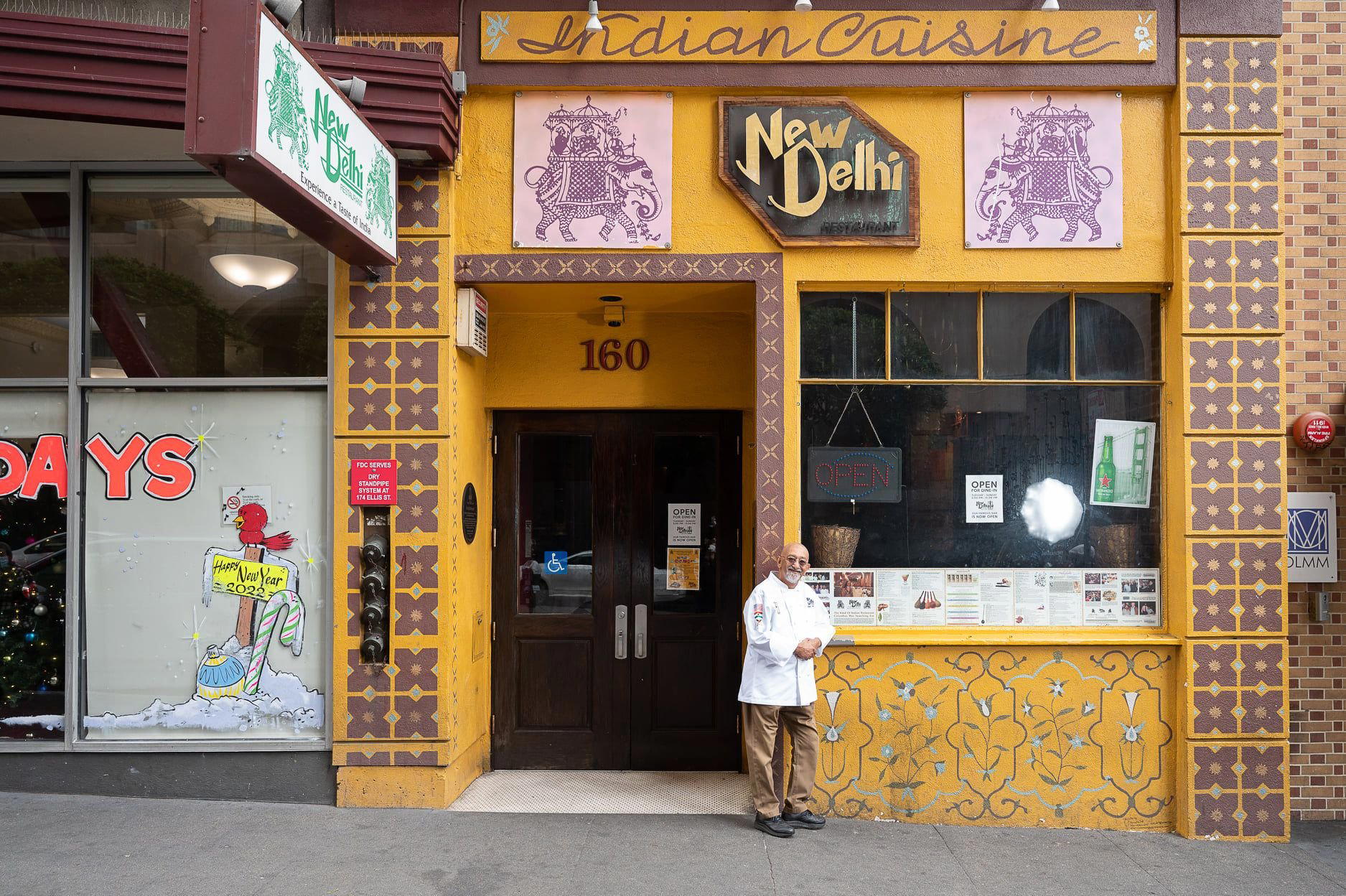
The Tenderloin Table That Keeps Its Regulars
Ellis Street in the Tenderloin does not court the kind of diner who arrives clutching a reservation confirmation from a tasting-menu counter. The neighborhood has its own logic: a dense, working population, a long-established South Asian corridor, and a dining culture built on repetition rather than occasion. New Delhi Restaurant at 160 Ellis St, San Francisco, is an Authentic Regional Indian restaurant with a recommended reservation policy and a price tier around $35 per person. It sits inside that logic. The room draws people who already know what they want before the menu arrives, which is the clearest signal a restaurant can send about the trust it has accumulated over time.
San Francisco's Indian restaurant segment has never occupied the same critical spotlight as the city's celebrated tasting-menu circuit, where places like Lazy Bear, Atelier Crenn, Benu, Quince, and Saison define the upper register. But the city's appetite for subcontinental cooking is genuine and long-running, and it tends to express itself through neighborhood loyalty rather than award cycles. That dynamic is exactly what the regulars at a place like New Delhi understand implicitly: the kitchen's value proposition is consistency and depth, not spectacle.
What Keeps the Regulars Coming Back
The regulars' perspective on any long-standing neighborhood restaurant is a more useful lens than the first-timer's. For the returning crowd, the question is never whether the food is interesting, it is whether it is correct. Indian cooking at this level of the market succeeds or fails on the calibration of spice, the precision of dal, the texture of bread. A kitchen that gets those fundamentals right across years earns a kind of loyalty that press attention rarely builds.
In the Tenderloin's South Asian dining corridor, that loyalty is also shaped by the street-level economics of the neighborhood. The regulars who anchor midweek dinner service at establishments on and around Ellis Street are typically not cross-referencing Michelin guides. They are measuring against the last visit. That self-referential standard is demanding in its own way: the bar is the kitchen's own history, and slippage is noticed immediately by the people who eat there three times a month.
This pattern appears in Indian restaurant clusters across American cities, in Chicago's Devon Avenue corridor, in Jackson Heights in New York, in sections of Los Angeles, and it is not distinctive to any single establishment. But the regulars-first dynamic matters as a frame because it explains why these restaurants rarely show up in the editorial coverage that attaches to places like Atomix in New York City or Alinea in Chicago, while simultaneously outlasting many of the restaurants that do. Longevity in a neighborhood like the Tenderloin is its own credential.
The Broader San Francisco Indian Dining Context
San Francisco's relationship with Indian cuisine is older and deeper than its reputation suggests. The Bay Area's South Asian population is one of the largest in the country, concentrated in both the city proper and in the South Bay technology corridor. That population supports a wide range of establishments, from weekend-only regional specialists in Fremont to fast-casual lunch counters serving the Civic Center office crowd. The Tenderloin sits in the middle of that spectrum, close enough to downtown to catch the lunch trade and grounded enough in the neighborhood to hold a dinner regular base.
The comparison set for a restaurant at this address is not the tasting-menu tier that occupies food media's attention. It is the cluster of subcontinental kitchens within walking distance, the takeaway operations, the lunch buffet formats that still define the category for many diners. Within that comparable set, the question is execution: consistency of spice balance, freshness of the bread program, the depth of the curry base. These are the standards the regulars apply, and they apply them without ceremony.
For context on how the American fine dining axis frames Indian-influenced cooking at the highest level, it is worth noting where the critical conversation has landed in recent years: Korean-influenced tasting menus like Atomix and Asian-French hybrids like Benu have absorbed much of the critical oxygen in the subcontinental-adjacent space, while the everyday neighborhood operators remain largely outside that frame. That is not a judgment on quality; it is an observation about how critical attention is distributed.
Placing the Address
160 Ellis St puts the restaurant squarely between Union Square's hotel cluster and the Civic Center, in a part of the city that receives foot traffic from multiple directions but belongs to none of them cleanly. It is not a destination neighborhood in the sense that the Mission or Hayes Valley are destination neighborhoods. It is a working part of the city, and the restaurants that survive there do so by being useful to the people who live and work within a few blocks.
The same geography that keeps this address off the tourist circuit is what makes it legible to the regulars. The low ambient noise of the Tenderloin dining scene means that a kitchen earning repeat visits is doing so on merit rather than on the momentum of a press cycle. Compare that to the performance required to fill a room at The French Laundry in Napa or Single Thread Farm in Healdsburg, where the reservation itself is a signal of intent, and the contrast becomes clear. Different pressures, different accountability, different definition of success.
Across American cities, neighborhood Indian restaurants of this type carry a reference function in the dining ecosystem that destination restaurants cannot fill. The regulars at this address are not comparing the experience to Le Bernardin in New York City or Blue Hill at Stone Barns. They are comparing it to last Tuesday, which is the more demanding standard for a kitchen in this position.
Cuisine and Credentials
Comparable venues nearby, for context on price, style, and recognition.
| Venue | Cuisine | Price | Notes |
|---|---|---|---|
| New Delhi RestaurantThis venue — the venue you are viewing | Authentic Regional Indian | $$ | Not listed |
| Curry Up Now | Modern Indian Street Food | $$ | Mission |
| India Clay Oven | Authentic Northern Indian Tandoori | $$ | Outer Richmond |
| Pakwan | Authentic Pakistani-Indian | $$ | Mission |
| Noe Valley Books | Dining | Not listed | San Francisco |
| Saigonese Café | Vietnamese café & bánh mì shop | $$ | Embarcadero |
Continue exploring
More in San Francisco
Restaurants in San Francisco
Browse all →
Bars in San Francisco
Browse all →
Hotels in San Francisco
Browse all →
At a Glance
- Romantic
- Classic
- Elegant
- Historic
- Cozy
- Date Night
- Group Dining
- Special Occasion
- Business Dinner
- Historic Building
- Open Kitchen
- Craft Cocktails
- Local Sourcing
Current opening hours
- Monday
- 5–11 PM
- Tuesday
- 5–11 PM
- Wednesday
- 5–11 PM
- Thursday
- 5–11 PM
- Friday
- 5–11 PM
- Saturday
- 5–11 PM
- Sunday
- 5–11 PM
Hours can change for holidays and private events. Last verified .
Romantic dining reminiscent of a Maharajah’s private banquet room with ornate pillars, exposed brick walls, and handmade Italian tiled floors.