Myranel

Michelin Plate
Our verdict
A Michelin Plate recipient on the historic Chemin du Roy corridor west of Québec City, Myranel brings modern cuisine to a village setting where sourcing from the surrounding St. Lawrence lowlands is less a marketing choice than a practical reality.

Pearl is the En Primeur Club membership app, where members save venues, book tables and use the concierge.
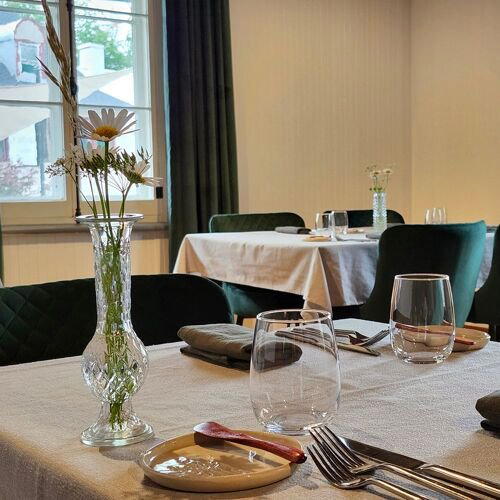
Where the Chemin du Roy Meets the Table
Drive west out of Québec City along the Chemin du Roy, the oldest road in Canada, tracing the north shore of the St. Lawrence, and the landscape shifts within forty minutes from urban density to fieldstone farmhouses, tidal flats, and villages that have changed in outline more than in character since the eighteenth century. Deschambault sits in this corridor, and arriving at 241 Chemin du Roy, the address of Myranel, places you firmly inside that older rhythm. The region's pantry has always been extraordinary: the St. Lawrence lowlands produce some of Québec's most distinct vegetables, herbs, and river fish, and the farms between Portneuf and Lotbinière counties have supplied urban restaurant kitchens for decades. What Myranel does is situate the kitchen inside that supply chain rather than at the end of it.
Rural Fine Dining and the Sourcing Argument
A pattern has emerged across Canada's smaller communities over the past decade: restaurants in proximity to primary producers are beginning to outperform their urban counterparts on the ingredient question, if not always on infrastructure. Restaurant Pearl Morissette in Lincoln in Ontario's Niagara Peninsula made this case forcefully by placing itself inside a working farm. Eigensinn Farm in Singhampton took it further, collapsing the distance between cultivation and service to near zero. In Québec, Narval in Rimouski has staked a similar position on the lower St. Lawrence. Myranel fits within this cohort: a modern cuisine operation working in a rural setting where the relationship to local supply is structural, not decorative.
The Michelin Plate awarded in 2025 is a meaningful signal in this context. Michelin's expansion into Québec has been attentive to exactly this category of restaurant, kitchens that cook with precision and intention outside the metropolitan tier. A Plate designation indicates cooking worth a stop, and for a village address on the Chemin du Roy, it positions Myranel in the same conversation as the province's destination dining addresses, including Tanière³ in Québec City, the benchmark for Québec's modern cuisine ambition. The peer comparison is instructive: where Tanière³ operates at the outer edge of tasting menu complexity in an urban cellar setting, Myranel's context is the open agricultural corridor outside the city, with different constraints and different raw material advantages.
What Modern Cuisine Means Along the St. Lawrence
Modern cuisine, as a category, covers a wide range of approaches, from technique-driven tasting menus to more relaxed formats that apply contemporary precision to regional produce without the full ceremony of a multi-course progression. In rural Québec, the tendency has been toward the latter: menus that reference the seasons and the immediate geography with specificity, without requiring the dining ritual that urban fine dining often demands. The St. Lawrence corridor supplies wild herbs, eel, freshwater fish, heritage grain, and dairy from farms that have been operating in the same counties for generations. A kitchen that takes this geography seriously has access to ingredients that urban addresses must import, often in degraded condition. That proximity advantage shows in the quality ceiling available to a kitchen like Myranel's.
For context on how modern cuisine is evolving across Canada, Alo in Toronto and AnnaLena in Vancouver define the urban end of the spectrum, with considerable investment in technique and format. ARLO in Ottawa and ÄNKÔR in Canmore work within regional settings where local character is more explicitly part of the editorial proposition. Myranel belongs to the Québec expression of this broader Canadian tendency, in a village where sourcing proximity is less a philosophy than a geographic fact. Internationally, the model is not unlike what Frantzén in Stockholm established as a template for produce-led precision cooking at the highest level, though operating in a very different scale and context.
The Deschambault Context
Deschambault is not a dining destination in the way that Charlevoix has been positioned, with its coordinated regional branding and tourist infrastructure. It is a heritage village with a functioning community, and the dining options here are few. That scarcity is part of Myranel's positioning: it is not competing in a crowded field but operating in a space where the restaurant becomes the reason to make the drive. Restaurants at this address and price point ($$$, placing it in the mid-to-upper tier rather than the full luxury bracket occupied by Montreal's Jérôme Ferrer - Europea or the full tasting menu operations) tend to attract a local and regional audience before drawing visitors, which keeps the feedback grounded.
The Chemin du Roy corridor is worth treating as a day trip or overnight from Québec City rather than a standalone destination. Our full Deschambault hotels guide lists accommodation options in and around the village for those making an evening of the drive. The road itself is heritage-designated and the village has a concentration of eighteenth-century architecture that makes the approach feel deliberate. For those building a broader itinerary, Auberge Saint-Mathieu in Saint-Mathieu-du-Parc represents another rural Québec dining address worth pairing on a longer circuit through the Mauricie region.
Planning Your Visit
Myranel sits at the $$$ price point, which in Québec's current dining market means a meaningful meal without the full tasting menu commitment. For a village address with a Michelin Plate, booking ahead is advisable, restaurants of this type with limited covers fill quickly once recognition circulates. Deschambault is roughly forty-five minutes west of Québec City by car along Route 138, the Chemin du Roy. There is no public transit connection to the village, so a car is the practical requirement. The surrounding area warrants exploration beyond the meal itself: our full Deschambault experiences guide covers the heritage sites and river access points that make the drive worthwhile in both directions. For those whose Québec itinerary extends to bars and wine, our full Deschambault bars guide and our full Deschambault wineries guide round out the picture. A full directory of the village's dining options appears in our full Deschambault restaurants guide.
Frequently asked questions
What does dinner at Myranel typically cost?
Pricing at Myranel is listed as $$$.
Where is Myranel in Deschambault?
Myranel is located at 241 Chem. du Roy, Deschambault, QC G0A 1S0, Canada, Deschambault.
Quick Comparison
Comparable venues nearby, for context on price, style, and recognition.
| Venue | Cuisine | Price | Awards | Notes |
|---|---|---|---|---|
| MyranelThis venue (the venue you are viewing) | Modern French Farm-to-Table | Not listed | Michelin Plate | Not listed |
| Coteau | French-Canadian Fine Dining | Not listed | Michelin Plate | Old Québec |
| Place Carmin | Modern French Brasserie | $100–150 | Michelin Plate | Vieux Montréal |
| Saint-Amour | Haute French Quebecois Fine Dining | $100–150 | Michelin Plate · Star Wine List | Vieux-Québec, Cap-Blanc, Colline parlementaire |
| Restaurant Limousine | Contemporary French Bistro | $50–100 | Not listed | Saint-Lambert Village |
| PLACE DUFFERIN | French Breakfast & Afternoon Tea | $30–50 | Not listed | Vieux-Québec, Cap-Blanc, Colline parlementaire |
Recognition history
Dated appearances from independent guides and award organizations, with the underlying list record or original source where available.
Michelin Plate
Michelin
Full recognition history (2 entries)
Michelin Plate
Michelin
Details
- Cozy
- Elegant
- Intimate
- Rustic
- Date Night
- Special Occasion
- Historic Building
- Farm To Table
- Local Sourcing
- Set Menu
- Vegetarian Friendly
Current opening hours
- Monday
- Closed
- Tuesday
- Closed
- Wednesday
- 5–9 PM
- Thursday
- 5–9 PM
- Friday
- 5–9 PM
- Saturday
- 5–9 PM
- Sunday
- Closed
Hours can change for holidays and private events. Hours as of .
Warm and welcoming historic house with original ceiling beams, creating an authentic and cozy atmosphere praised for its synergy with the culinary experience.