Moh Teng Pheow Nyonya Koay

Michelin Bib Gourmand
Our verdict
Operating from the same Lebuh Chulia address since a kueh factory was established here in 1933, Moh Teng Pheow Nyonya Koay holds a 2025 Michelin Bib Gourmand for its traditional Nyonya kueh, steamed, fried, and baked preparations made to decades-old recipes. The converted patio with exposed brick walls and a vine-covered pergola makes it one of George Town's most atmospheric spots for a low-cost, high-craft feed.

Pearl is the En Primeur Club membership app, where members save venues, book tables and use the concierge.
The menu
What to order
- Kueh Lapis
- Kueh Talam
- Ang Koo Kuih
- Nasi Ulam
- Laksa
- Nasi Lemak
Where the Price of Entry Is Almost Nothing
George Town's hawker and heritage-food tier operates at a price point that most cities can only approximate. At the lower end of that tier sits a category where the outlay is minimal and the craft behind the food is anything but: the traditional kueh shop. These are not casual snack counters. Many are multigenerational operations, working from recipes that predate Malaysia's independence, producing items that require real skill to execute, the right ratio of pandan to rice flour, the correct steaming time for a kuih talam that holds its two-tone set without collapsing. Moh Teng Pheow Nyonya Koay, on Lebuh Chulia, sits at the sharper end of this category.
Ninety Years of the Same Recipe
The Nyonya kueh tradition belongs to the Peranakan community, whose culinary identity formed over centuries from the intermarriage of Chinese settlers with local Malay populations, concentrated heavily in Penang, Malacca, and Singapore. Kueh, the broad umbrella term for cakes, dumplings, puddings, and pastries, became one of the most technically demanding expressions of that merged cuisine. The colours are vivid (pandan green, coconut-milk white, palm-sugar brown), the textures precise (glutinous, silky, crisp at the edges), and the methods time-consuming. Many of the preparations that appear easy to reproduce turn out, in practice, to require the kind of institutional memory that only comes from doing the same thing across decades.
The timeline at Moh Teng Pheow is specific. In 1933, the current owner's father opened a kueh factory on this site. In 2016, the family converted a space behind the factory into a sit-down restaurant, allowing visitors to eat freshly made kueh on the premises rather than buying to take away. The factory and the restaurant now operate as a single unit: production happens out back, and the product lands on your table minutes after it has been made. That proximity between kitchen and table is one of the factors the Michelin inspectors tend to reward at the Bib Gourmand level, where value and consistency across multiple visits carry more weight than fine-dining theatre.
The Kueh Itself
Range on offer covers several of the canonical Nyonya preparations. Kuih lapis, the layered steamed cake, requires each stratum to be set individually before the next is poured, a process that can take several hours for a single tray. Kuih talam uses a pandan-flavoured green layer below and a salted coconut cream layer above, the contrast between sweet and savoury being a recurring structural principle in Nyonya cooking. Ang koo, the red tortoise cake filled with mung bean paste, is a steamed preparation with a glutinous rice exterior that sits closer to dim sum than to Western pastry. Nyonya chang, the Peranakan interpretation of the Chinese rice dumpling, wraps spiced pork filling inside glutinous rice, the whole thing folded into bamboo leaves and boiled. These preparations span steamed, deep-fried, and baked methods, which means the kitchen is running multiple techniques simultaneously.
A selection of Nyonya dishes accompanies the kueh program, though the kueh is the primary draw. The combination gives the meal a structure: savoury Nyonya food as context, kueh as the main event and the historical through-line. For a price bracket that sits at the bottom of George Town's dining spectrum, this is a considerable amount of culinary heritage per ringgit spent.
The Setting on Lebuh Chulia
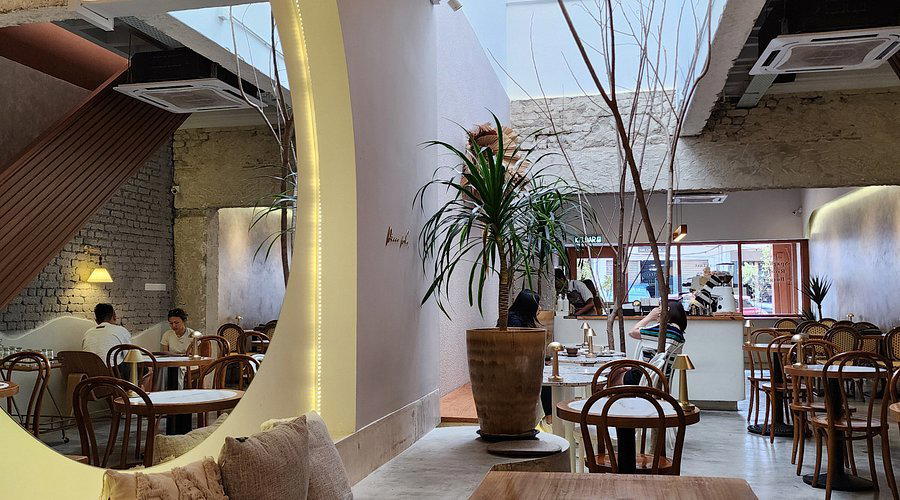
The converted patio does significant atmospheric work. Exposed brick walls, a vine-covered pergola overhead, and a glass roof that diffuses the Penang light without blocking it entirely create an environment that reads as genuinely old rather than fabricated-rustic. Lebuh Chulia is one of the core streets of George Town's Unesco-listed heritage zone, and the address places Moh Teng Pheow within easy reach of the inner city's main concentration of shophouse architecture, temples, and clan jetties. The neighbourhood has seen rising visitor numbers since the Unesco listing in 2008 brought international attention to George Town's built heritage, and the street-food and heritage-cuisine tier has benefited from that footfall without pricing itself out of local reach, a balance that remains more intact here than in comparable heritage cities elsewhere in the region.
The open-air format under the pergola is consistent with how George Town's food culture has always operated: the boundary between inside and outside is porous, the setting is functional rather than designed-for-Instagram, and the focus stays on what is being eaten.
Placing It Against the Broader George Town Table
George Town's dining range in 2025 stretches from the Bib Gourmand tier, shared by Moh Teng Pheow and a cluster of other hawker and heritage operations, up through mid-price Peranakan sit-down restaurants to a small group of higher-spend contemporary venues. Auntie Gaik Lean's Old School Eatery occupies the next price tier up, offering a fuller Peranakan meal in a shophouse setting at prices that still read as accessible against regional comparators. Richard Rivalee takes the Peranakan base in a more contemporary direction. At the upper end, Au Jardin operates in European Contemporary territory at $$$ pricing, and The Pinn occupies its own niche in the heritage-adjacent fine-dining space.
Moh Teng Pheow sits at the base of that price range, in the same single-dollar bracket as street-food operations like 888 Hokkien Mee. What distinguishes it from a standard hawker stop is the sit-down format, the breadth of the kueh program, and the Michelin recognition, which positions it as a heritage destination rather than simply a cheap eat. For visitors with limited time in George Town, it functions as a single-stop introduction to Nyonya kueh culture that requires no navigation beyond finding the address on Lebuh Chulia.
The value proposition compares favourably with Peranakan kueh experiences in Singapore, where equivalent preparations at heritage shops in Katong or along Joo Chiat Road carry prices that have tracked upward with the city-state's cost base. George Town's lower cost of living keeps the entry point accessible in a way that Singapore's equivalent tier can no longer match. That gap is part of what draws food-focused visitors to Penang specifically, and Moh Teng Pheow is among the clearest expressions of why the city's heritage food culture retains its currency.
For broader planning across George Town, see our full George Town restaurants guide, our full George Town hotels guide, our full George Town bars guide, and our full George Town experiences guide. Elsewhere in Malaysia, Dewakan in Kuala Lumpur and Bee See Heong in Seberang Perai represent contrasting points on the country's culinary range, while The Planters at The Danna in Langkawi serves visitors travelling further up the peninsula. For comparative small-eats culture at a similar price point in a different heritage city, the Tainan entries worth tracking include A Cun Beef Soup, A Hai Taiwanese Oden, A Ming Zhu Xing, A Wen Rice Cake, and A Xing Shi Mu Yu, a cluster of Bib Gourmand-level small-eats operations that share the same value-to-craft ratio as Moh Teng Pheow.
Planning Your Visit
The address is Lebuh Chulia, Jalan Masjid, in the heart of George Town's heritage zone, walkable from the majority of the area's boutique hotels and guesthouses. No website or phone number is listed in the public record, which is consistent with how many of George Town's long-established food operations handle bookings, walk-in is the standard approach. The price range sits at the lowest tier of George Town's dining scale, making it a reasonable addition to any itinerary regardless of overall budget. The Michelin Bib Gourmand, awarded in 2025, is the clearest trust signal the kitchen has: that distinction is given for good food at a price that represents genuine value, which is precisely what a ninety-year-old kueh factory turned restaurant is positioned to deliver. See also our full George Town wineries guide for completeness across the city's food and drink categories.
Frequently asked questions
at Moh Teng Pheow Nyonya Koay?
The kitchen's focus is Nyonya kueh, the broad category of Peranakan cakes, dumplings, puddings, and pastries that encompasses both sweet and savoury preparations. Confirmed items from the production line include kuih lapis (layered steamed cake), kuih talam (pandan and salted coconut cream layers), ang koo (red glutinous rice cake with mung bean filling), and Nyonya chang (spiced pork rice dumplings in bamboo leaf). These are the preparations the operation has been making since the factory opened in 1933, and they represent the strongest case for the Michelin Bib Gourmand awarded in 2025. A selection of Nyonya dishes is also available, but the kueh is the primary reason to visit.
Do I need a reservation at Moh Teng Pheow Nyonya Koay?
No booking infrastructure, phone number or website, appears in the public record, which suggests walk-in is the operative model. This is consistent with the $ price tier and the Bib Gourmand category, where the format is typically informal and high-turnover. George Town's Bib Gourmand venues do attract visitor queues, particularly at peak tourist periods and on weekends, so arriving early in the day reduces wait time. The open patio format adds some capacity flexibility that a narrow shophouse counter would not.
The Short List
| Venue | Cuisine | Price | Awards | Notes |
|---|---|---|---|---|
| Moh Teng Pheow Nyonya KoayThis venue (the venue you are viewing) | Traditional Nyonya Kuih & Delicacies | $1–10 | Michelin Bib Gourmand | Not listed |
| Au Jardin | Modern European with Local Accents | $200–300 | 1 Michelin Star · World's 50 Best #39 | European Contemporary |
| Auntie Gaik Lean's Old School Eatery | Peranakan (Nyonya) | $10–20 | 1 Michelin Star | Peranakan |
| Ah Boy Koay Teow Th'ng | Teochew Koay Teow Th'ng | $1–10 | Michelin Bib Gourmand | Street Food |
| Aria | Modern American | Not listed | Not listed | Not listed |
| Communal Table by Gēn | Modern Malaysian Fusion | $30–50 | Michelin Bib Gourmand · Star Wine List | Malaysian |
Recognition history
Dated appearances from independent guides and award organizations, with the underlying list record or original source where available.
Michelin Bib Gourmand
Michelin
Full recognition history (3 entries)
Michelin Bib Gourmand
Michelin
Michelin Bib Gourmand
Michelin
Continue exploring
More in George Town
Restaurants in George Town
All restaurants in George Town →
Bars in George Town
All bars in George Town →
Details
- Classic
- Cozy
- Rustic
- Historic
- Casual Hangout
- Brunch
- Historic Building
- A La Carte
- Vegetarian Friendly
Current opening hours
- Monday
- 10 AM–5 PM
- Tuesday
- 10 AM–5 PM
- Wednesday
- 10 AM–5 PM
- Thursday
- 10 AM–5 PM
- Friday
- 10 AM–5 PM
- Saturday
- 10 AM–5 PM
- Sunday
- 10 AM–5 PM
Hours can change for holidays and private events. Hours as of .
Nostalgic antique interior with simple cafe-style seating in a converted patio under glass roof and Penang umbrellas, evoking old-school Nyonya house vibes.