Tabelog 100 #3
Our verdict
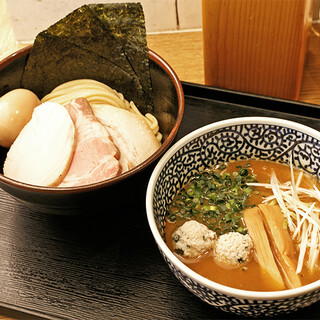
Menya Ittou places Tokyo’s ramen culture in its precise, low-friction form: counter seating, ramen and tsukemen, and a budget that remains in the JPY 1,000–1,999 band for lunch and dinner. Its Tabelog Ramen TOKYO 100 selection in 2025, plus earlier Tabelog Award Bronze recognition, puts it in the city’s serious ramen conversation without moving into fine-dining theater.

Pearl is the En Primeur Club membership app, where members save venues, book tables and use the concierge.
The menu
What to order
- Noukou gyokai tsukemen (rich chicken & seafood dipping noodles)
- Seafood tsukemen
- Thick chicken paitan-gyokai ramen
- Low-temperature pork chashu
Tokyo is not only the version most visitors use as shorthand for dining: it has more than neon mythology, hotel lobbies, and destination tasting menus, with a daily rhythm shaped by commuters as much as by reservations. That matters for ramen. The form rewards focus, repetition, and queue discipline more than ceremony, and Menya Ittou sits inside that tradition with a ramen and tsukemen format and a price band that keeps the decision refreshingly direct.
Tokyo ramen culture has a split personality. Lunch can be brisk, solo, and transactional in the better sense of the word: a bowl, a counter seat, a tight turnover, no performance. Dinner changes the mood. The same format becomes a deliberate stop after work, when the meal has more breathing room but not necessarily more luxury. Menya Ittou’s lunch and dinner budgets both sit at JPY 1,000–1,999, which is part of the point. The value proposition does not depend on a cheaper noon set or a dressed-up evening menu; it depends on the confidence of a narrow format executed at a recognized level.
Ramen and tsukemen as Tokyo's serious counter culture
Ramen in Tokyo is often misread by travelers as casual food first and craft food second. The better reading reverses that order. The city’s serious ramen shops operate like compact laboratories: ticketing or waiting systems replace reservations, counter seats replace dining rooms, and the menu tends to narrow rather than sprawl. Menya Ittou belongs to that school. Its categories are ramen and tsukemen, the dipping-noodle form that asks a diner to think about broth and noodles as separate components before they come together.
The recognition tells a clearer story than adjectives would. The shop is listed in the Tabelog Hyakumeiten selection for 2025, with a Tabelog score of 3.79. For a ramen counter, those signals carry a different weight than a white-tablecloth award. They point to consistency in a field where tiny variations in broth, noodle texture, temperature, and turnover can change the meal more than a new room or service script.
That consistency also explains why the lunch-versus-dinner divide here is less about price and more about intent. At lunch, the counter format suits a compact detour: eat, reset, move on. At dinner, the same bowl reads differently, especially for travelers who have spent the day in Tokyo and want a meal that does not require the choreography of a tasting menu. The fixed price band across both services keeps the evening from becoming a premium occasion. It remains ramen on ramen’s own terms.
Why Tokyo changes the calculation
Location is part of the editorial argument. Tokyo’s dining map often funnels visitors toward the most familiar areas, but ramen excellence has long been distributed across rail lines and everyday parts of the city. Menya Ittou asks for a more local reading of Tokyo: the reward is not a skyline view or a hotel-adjacent address, but the kind of specialized counter that survives by repeat demand and tight execution. In that sense, the setting is not incidental. It filters out the diner looking for spectacle and favors the diner willing to travel for a specific bowl.
Compared with other Tokyo options in a broad casual-to-specialist field, the positioning is sharp. Shozan, One More, Sansar Koiwa ten, and SPICE Cafe all give visitors different ways to read the city’s everyday dining culture, while Yakiniku Kosen sits in a different category altogether. Menya Ittou’s argument is narrower: spend modestly, accept the counter format, and judge the meal by ramen standards rather than by the signals attached to broader restaurant luxury.
That is also why the absence of a long chef narrative is not a weakness. Ramen shops are often better understood through systems than biography: format, turnover, category focus, and public recognition. Here, the ramen and tsukemen focus avoids the menu drift that can soften specialist shops. The result is a place where the reader’s decision is practical but not shallow: this is for a diner who wants Tokyo ramen treated as a serious meal, not as a late-night afterthought.
How to fold it into a Tokyo dining itinerary
Menya Ittou works particularly well as a counterpoint to Tokyo’s reservation-heavy dining culture. A trip built only around polished counters, intimate rooms, and tasting menus can start to flatten into appointment dining. A ramen stop in Tokyo restores another side of the city: low price, short format, high scrutiny. It also pairs naturally with a wider look at the city’s casual and specialist restaurants, from other curry counters and yakitori rooms to casual cafes and compact neighborhood dining rooms.
For broader planning, keep the ramen stop in conversation with Our full Tokyo restaurants guide, then widen the trip through Our full Tokyo hotels guide, Our full Tokyo bars guide, Our full Tokyo wineries guide, and Our full Tokyo experiences guide. Travelers extending the food itinerary beyond Tokyo can compare regional casual formats through unnamed dining in other Japanese cities and beyond. For an international contrast in Japanese-influenced casual dining, other overseas examples show how far the vocabulary travels once it leaves Japan.
The sharper recommendation is to treat this as a purposeful ramen meal rather than a filler between larger bookings. Lunch gives the cleanest read of the shop’s everyday function; dinner gives it more gravity without changing the economic frame. Either way, the appeal is disciplined: a specialized category, public recognition, and a Tokyo setting that reminds diners how much of the city’s serious eating happens outside the obvious zones.
Frequently asked questions
What's the address for Menya Ittou?
Tokyo.
Is Menya Ittou expensive?
Pricing at Menya Ittou is listed as JPY 1,000 - JPY 1,999 JPY 1,000 - JPY 1,999.
When can I go to Menya Ittou?
Check current opening details before visiting Menya Ittou, as hours are not provided here.
What is Menya Ittou known for?
Menya Ittou is known for ramen and tsukemen in Tokyo. It also carries Tabelog Hyakumeiten 2025 recognition, with a listed score of 3.79.
Comparable Options
Comparable venues to anchor price and recognition.
| Venue | Cuisine | Price | Awards | Notes |
|---|---|---|---|---|
| Menya IttouThis venue (the venue you are viewing) | Modern Tokyo tsukemen & ramen | $10–20 | Tabelog 100 #3 | Not listed |
| Shozan | Sanuki Udon & Japanese Noodles | $10–20 | Tabelog 100 #19 | JPY 999 |
| One More | Traditional Japanese kissaten café | $10–20 | Tabelog 100 | JPY 1,000 - JPY 1,999 JPY 1,000 - JPY 1,999 View spending breakdown |
| Yakiniku Kosen | Japanese Yakiniku | $30–50 | Tabelog Silver #63 | Yakiniku (Japanese BBQ), JPY 6,000 - JPY 7,999 |
| Sansar Koiwa ten | Traditional Nepalese Home-Style Cuisine | $10–20 | Tabelog 100 #86 | JPY 1,000 - JPY 1,999 JPY 1,000 - JPY 1,999 View spending breakdown |
| SPICE Cafe | Creative spice-focused curry cafe | $20–30 | Tabelog 100 #21 | JPY 6,000 - JPY 7,999 JPY 1,000 - JPY 1,999 |
Recognition history
Dated appearances from independent guides and award organizations, with the underlying list record or original source where available.
Tabelog 100 #3 · No. 3
Tabelog · Tabelog 100 - Ramen - TOKYO - 2025