Markthalle
Markthalle occupies a converted market hall on Limmatstrasse in Zurich's District 5, a neighbourhood that has reshaped itself around creative food culture over the past decade. The address places it inside a broader cluster of producers, traders, and kitchens where local sourcing and imported technique intersect. For visitors mapping Zurich's less formal dining tier, it is a reference point worth knowing.
Pearl is the En Primeur Club membership app — saves, bookings, and concierge access live there. Same editors, same standards.
- Address
- Limmatstrasse 231, 8005 Zürich, Switzerland
- Phone
- +41 44 201 00 60
- Website
- restaurant-markthalle.ch
- Directions
- Get directions
 Saves & bookings on Pearl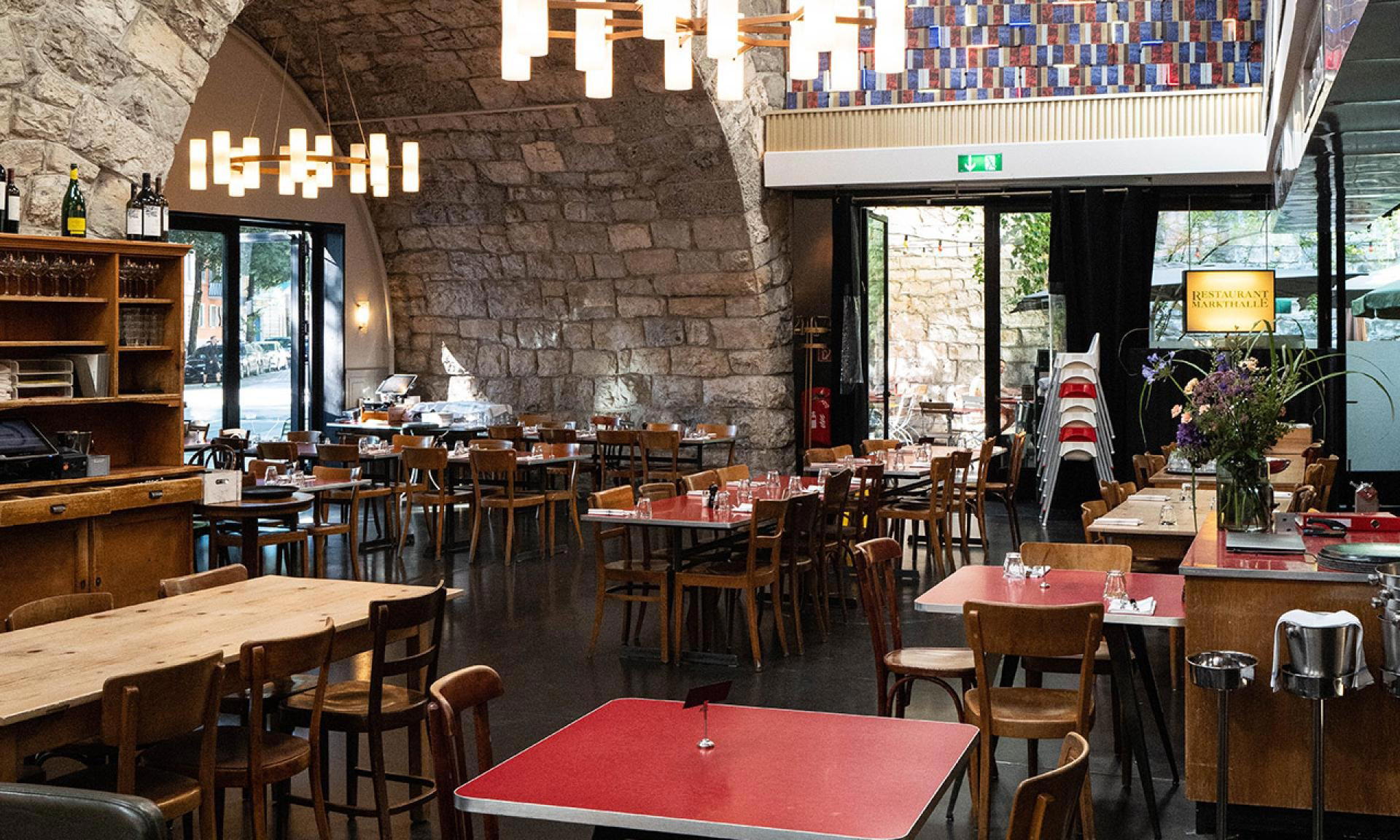
District 5 and the Market Hall Tradition
Zurich's fifth district, Zürich West, spent most of the twentieth century as an industrial corridor. The tanneries and machine works have been replaced, steadily and without much ceremony, by a food culture that now reads as one of the city's more serious. Limmatstrasse is near the centre of that shift. The buildings here were built to move goods, and several have found second lives as covered markets, food halls, and production kitchens. Markthalle, at number 231, sits inside this pattern: a space shaped by the logic of a trading floor, repurposed for the more considered exchange of producer and diner.
This format, the covered market adapted for sit-down and counter eating, has grown significantly across European cities over the past fifteen years. In Zurich, it occupies a distinct position in the dining hierarchy: less formal than the Michelin-tracked rooms of the city centre, but considerably more curated than a conventional food court. The tension between those two registers is where places like Markthalle tend to do their most interesting work.
Local Ingredients, Imported Method
The editorial logic of Swiss dining in this price tier increasingly runs through a single axis: how much of what arrives on the plate was produced within a day's drive, and what tradition shaped the hands that prepared it. Switzerland's geography makes this question more charged than it would be in, say, a coastal country with a single dominant culinary identity. The country sits at the intersection of German, French, and Italian food cultures, and its professional kitchens have absorbed training from all three. A cook who completed a stage in Lyon or worked a season in northern Italy brings back not just technique but a set of assumptions about ingredient hierarchy, sauce weight, and plating discipline that then meets Swiss dairy, Swiss charcuterie, Swiss grain.
This intersection is what makes the market hall format particularly well-suited to Zurich. A covered trading space with multiple vendors or kitchen stations can hold that plurality without forcing it into a single menu logic. Diners move between registers: a stall sourcing Graubünden air-dried meat alongside a counter applying French-derived reduction work to the same regional product. The result is not fusion in the lazy sense, but something closer to applied translation, technique serving ingredient rather than overriding it.
For visitors building a picture of how Zurich eats in its less ceremonial mode, this approach provides a useful reference. The city's higher end rooms, places like IGNIV Zürich by Andreas Caminada with its sharing format, or The Counter and The Restaurant in the creative tier, operate with full brigade infrastructure and long tasting sequences. A market hall operates with a different resource profile and, consequently, a different relationship to the diner: shorter transactions, more immediate sourcing decisions, less mediated by a single chef's vision.
The Zürich West Dining Cluster
Limmatstrasse and the streets around it form one of the more coherent dining clusters in the city. This is not accidental. The neighbourhood's post-industrial bones, large ground-floor footprints, loading bays converted to terraces, warehouse ceilings that accommodate noise, attracted exactly the operators who needed space but not polish. Over time, that concentration created its own gravity. Producers found it worth delivering here. Diners began treating the area as a destination rather than a detour.
The comparison set in this part of Zurich is not the starred rooms of Bahnhofstrasse or the hotel dining rooms that benchmark against international luxury standards. It is a different competitive tier: Widder with its Swiss identity, Eden Kitchen & Bar applying Italian logic to local produce. Markthalle operates in a register where format and sourcing do more of the critical work than kitchen pedigree alone.
Switzerland's broader fine dining geography is worth holding in mind for context. The country punches significantly above its size in Michelin coverage. Hotel de Ville Crissier in Crissier and Schloss Schauenstein in Fürstenau represent the country's highest-rated rooms; Memories in Bad Ragaz, Cheval Blanc by Peter Knogl in Basel, and Einstein Gourmet in Sankt Gallen sit in the same conversation. Zurich's own market hall scene runs in deliberate counterpoint to that formal register, drawing visitors who want proximity to Swiss produce without the investment required by a multi-course tasting menu.
Seasonality and the Market Hall Calendar
The market hall format is intrinsically seasonal in a way that a fixed-menu restaurant is not. Procurement decisions happen closer to service, and the range of what is available shifts week to week as alpine growing seasons move through their cycles. Spring brings the first Swiss asparagus from the Rhine valley lowlands and the early soft cheeses from higher pastures. Summer expands the range considerably: stone fruit, courgette blossom, lake fish. Autumn is the peak moment for game, mushroom, and the preserved goods, dried, pickled, fermented, that Swiss larder culture has refined over centuries. Winter contracts the fresh range and pushes sourcing toward root vegetables, aged cheeses, and the cured meats that make the Graubünden and Valais regions worth knowing about at any time of year.
Visiting in the shoulder seasons, particularly October and November, aligns with the period when Swiss larder produce is at its most varied and kitchen teams have had time to develop the season's approach. This is also when tourist pressure drops below the summer peak, which affects table availability and, in some venues, the willingness of kitchen staff to engage with diners about what they are eating and where it originated.
Planning a Visit
Markthalle sits at Limmatstrasse 231 in District 5, reachable by tram from the main station in under ten minutes. For visitors using Zurich as a base to explore the country's wider dining offer, the city's transport infrastructure makes day trips to some of Switzerland's most significant rooms entirely practical: focus ATELIER in Vitznau is accessible by lake boat and rail, and Mammertsberg in Freidorf is within an hour by train. Further afield, La Table du Valrose in Rougemont and Da Vittorio in St. Moritz reward the additional travel time. For international reference points in the same produce-led, technique-driven conversation, Le Bernardin in New York and Lazy Bear in San Francisco operate in analogous territory at different price points and scales.
For a comprehensive map of where Markthalle sits relative to the full range of Zurich's dining options, the EP Club Zurich restaurants guide covers the city's key rooms across price tiers, formats, and neighbourhoods. Maison Wenger in Le Noirmont is worth adding to any itinerary that extends into the Jura.
Continue exploring
More in Zürich
Restaurants in Zürich
Browse all →
Bars in Zürich
Browse all →

Hotels in Zürich
Browse all →

At a Glance
- Lively
- Industrial
- Casual
- Well Known
- Group Dining
- Casual Hangout
- Business Dinner
- Celebration
- Private Event
- Open Kitchen
- Garden
- Terrace
- Historic Building
- Standalone
- Beer Program
- Local Sourcing
- Farm To Table
Current opening hours
- Monday
- Closed
- Tuesday
- 9 AM–11:45 PM
- Wednesday
- 9 AM–11:45 PM
- Thursday
- 9 AM–11:45 PM
- Friday
- 9 AM–11:45 PM
- Saturday
- 9 AM–11:45 PM
- Sunday
- Closed
Hours can change for holidays and private events. Last verified .
Casual and lively market atmosphere with open kitchen, cheerful hustle and bustle, urban garden terrace, and wonderful aromas of fresh bread and cheeses throughout the space.