Market House Meats
Our verdict
The space itself carries the sensibility of a working butcher-counter heritage adapted for a more deliberate dining moment, positioning it alongside Seattle's broader shift toward provenance-led, ingredient-forward eating.

Pearl is the En Primeur Club membership app, where members save venues, book tables and use the concierge.
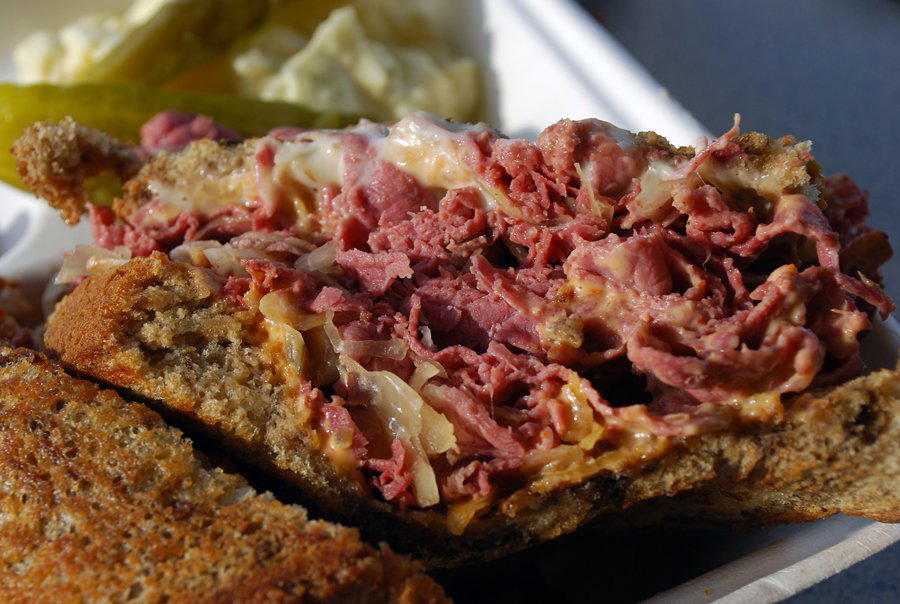
The menu
What to order
- Market House Grilled Reuben
- Corned Beef Sandwich
- Pastrami Sandwich
First Hill's Meat-Forward Proposition
Seattle's dining geography tends to reward the edges. The city's most discussed restaurants cluster in Capitol Hill, South Lake Union, and the Pike Place orbit, leaving First Hill as a corridor that passes through rather than destination in itself. That positioning creates a particular kind of venue: one that earns its clientele through product and repetition rather than neighborhood foot traffic.
The address itself functions as a kind of editorial statement. A butcher-counter or meat-focused format here reads differently than it would in Capitol Hill's more saturated dining corridor or Ballard's market-adjacent streets. The lack of surrounding noise means the venue has to create its own atmosphere rather than absorbing the street energy around it.
The Space as Argument
Meat-focused formats in American cities have occupied several architectural registers over the past decade. The first wave leaned into the theatrical: exposed timber, visible aging chambers, track lighting over slabs of beef that functioned more as display than working inventory. The second wave pulled back toward the functional, tile, stainless, the honest grammar of a working counter, as a way of signaling that the product, not the staging, was the point.
Market House Meats sits within that second current. In Seattle specifically, this kind of format carries associations with Pike Place Market's long tradition of counter-service fish and meat vendors, even when the venue itself is physically removed from that market. The city's food culture has trained diners to read a certain kind of working-counter aesthetic as a trust signal rather than a compromise.
Compare this with the design grammar of a venue like Canlis, Seattle's most formally composed dining room, where the mid-century architecture is itself part of the proposition. Or with Joule, where the New Asian format channels a different kind of spatial restraint. Market House Meats operates in neither register, it belongs to the category of spaces that communicate competence through material honesty rather than design ambition.
Provenance and the Butcher Counter Tradition
The broader American meat-focused dining scene has bifurcated sharply. On the other side, a smaller cohort of butcher-adjacent venues has built around traceability, smaller producer relationships, and a format that blurs the line between retail and restaurant. This second category commands a different kind of loyalty: regular customers who treat the counter as a provisioning relationship as much as a dining experience.
Seattle has particular reason to sustain that second model. The Pacific Northwest's livestock and ranching tradition, eastern Washington beef, regional lamb, heritage pork from smaller operations, gives a provenance-led butcher format genuine sourcing depth to draw on. The same regional food culture that supports 1415 1st Ave and shapes the sensibility at venues along 1744 NW Market St creates an informed customer base that can distinguish between genuine producer relationships and marketing language.
At a national scale, the venues that have most successfully fused butchery credibility with serious dining have tended to build their reputations slowly, through word-of-mouth and repeat custom rather than press cycles. That pattern holds across categories: Blue Hill at Stone Barns in Tarrytown built its farm-to-table authority through years of consistent sourcing discipline. Single Thread Farm in Healdsburg operates with similar producer-relationship depth. The butcher-counter format, at its finest, compresses that sourcing logic into a daily transaction.
Seattle Meat Culture in Context
The city's relationship with quality meat has always been shaped by proximity to production. Eastern Washington cattle ranching, Skagit Valley agriculture, and the regional fishing and farming economies that feed into Pike Place have historically given Seattle diners closer contact with sourcing realities than comparable cities on the coasts. That context makes First Hill's meat-focused venues legible in a way they might not be elsewhere.
It's closer to the sensibility of a place like 2963 4th Ave S, where the format serves a neighborhood logic rather than a destination-dining one.
For reference, the broader American fine-dining tier, Le Bernardin in New York, The French Laundry in Napa, Providence in Los Angeles, operates from a fundamentally different premise, one where the room, the service architecture, and the tasting format are inseparable from the food. The butcher-counter model inverts that hierarchy: the product comes first, and the room exists to support its preparation and sale.
Planning Your Visit
First Hill is accessible by foot from downtown Seattle, Capitol Hill, and the Convention Center area.
| Venue | Format | Neighborhood | Booking |
|---|---|---|---|
| Market House Meats | Butcher/counter-service | First Hill | |
| Canlis | New American fine dining | Queen Anne | Advance reservation required |
| Joule | New Asian | Wallingford | Reservation recommended |
For a broader orientation to Seattle's dining options across neighborhoods and price tiers, see our full Seattle restaurants guide. Further context on comparable American counter and provenance-led formats can be found through coverage of venues like Emeril's in New Orleans, Addison in San Diego, The Inn at Little Washington, Atomix in New York City, and 8 1/2 Otto e Mezzo Bombana in Hong Kong, each representing distinct points on the spectrum from counter-service directness to formal dining ceremony.
Frequently asked questions
Where is Market House Meats located?
Market House Meats is located at 1124 Howell St, Seattle, WA 98101, Seattle.
Is Market House Meats a good option for a quick lunch near the Seattle Convention Center?
The address at 1124 Howell St, Seattle places Market House Meats within practical walking distance of the Washington State Convention Center, making it one of the more accessible counter-service options for attendees who want something grounded in local sourcing rather than hotel dining. The butcher-counter format also suits a faster midday visit better than a sit-down restaurant would. Confirming current hours before going is advisable, as operating schedules for this format can shift.
Do they take walk-ins at Market House Meats?
Counter-service and butcher-adjacent formats at this price point in Seattle's First Hill generally operate on a walk-in or first-come basis rather than advance reservations. The Howell Street location, within easy reach of downtown and the Convention Center, means foot traffic can be steady at peak lunch and early evening hours.
What makes Market House Meats worth seeking out?
Market House Meats sits inside a Seattle tradition of counter-service, product-first food culture that the city's proximity to Eastern Washington cattle country and Skagit Valley agriculture has long supported. The First Hill address at 1124 Howell St places it away from the more crowded Capitol Hill and Pike Place circuits, which tends to mean a less tourist-driven clientele and sharper focus on the product itself. That positioning within Seattle's dining geography, rewarding those willing to move one neighborhood off the main clusters, is the core argument for the visit.
The Minimal Set
Comparable venues nearby, for context on price, style, and recognition.
| Venue | Cuisine | Price | Notes |
|---|---|---|---|
| Market House MeatsThis venue (the venue you are viewing) | Classic American Deli | $10–20 | Not listed |
| Brave Horse Tavern | American Gastropub | Not listed | South Lake Union, American Gastropub |
| The Hart and the Hunter | Elevated Americana Diner | $20–30 | Belltown, Polished Americana Diner |
| Skillet Diner @ Capitol Hill | Minor, American Diner | Not listed | Not listed |
| Homegrown | Sustainable American Sandwiches & Bowls | $10–20 | West Queen Anne, Sustainable American Sandwiches & Bowls |
| The Dish Cafe | American Breakfast & Brunch with Mexican Influences | $10–20 | Fremont, American Breakfast & Brunch with Mexican Influences |
Continue exploring
More in Seattle
Restaurants in Seattle
All restaurants in Seattle →
Bars in Seattle
All bars in Seattle →
Hotels in Seattle
All hotels in Seattle →

Details
- Classic
- Rustic
- Casual Hangout
- Historic Building
- A La Carte
Current opening hours
- Monday
- 8 AM–4 PM
- Tuesday
- 8 AM–4 PM
- Wednesday
- 8 AM–4 PM
- Thursday
- 8 AM–4 PM
- Friday
- 8 AM–4 PM
- Saturday
- 8 AM–4 PM
- Sunday
- Closed
Hours can change for holidays and private events. Hours as of .
Classic, no-frills butcher shop deli with the nostalgic aroma of cured meats and a fast-paced counter service vibe.