Makina Cafe
Our verdict
Makina Cafe brings together Ethiopian, Eritrean, and Italian-influenced cooking in New York City, occupying a niche that few restaurants in the country attempt with any seriousness. The kitchen draws on injera-centered traditions while weaving in Mediterranean threads that reflect the colonial history connecting the Horn of Africa to Italy. For New York diners looking beyond the city's dominant fine-dining register, Makina offers a culturally specific alternative.

Pearl is the En Primeur Club membership app, where members save venues, book tables and use the concierge.
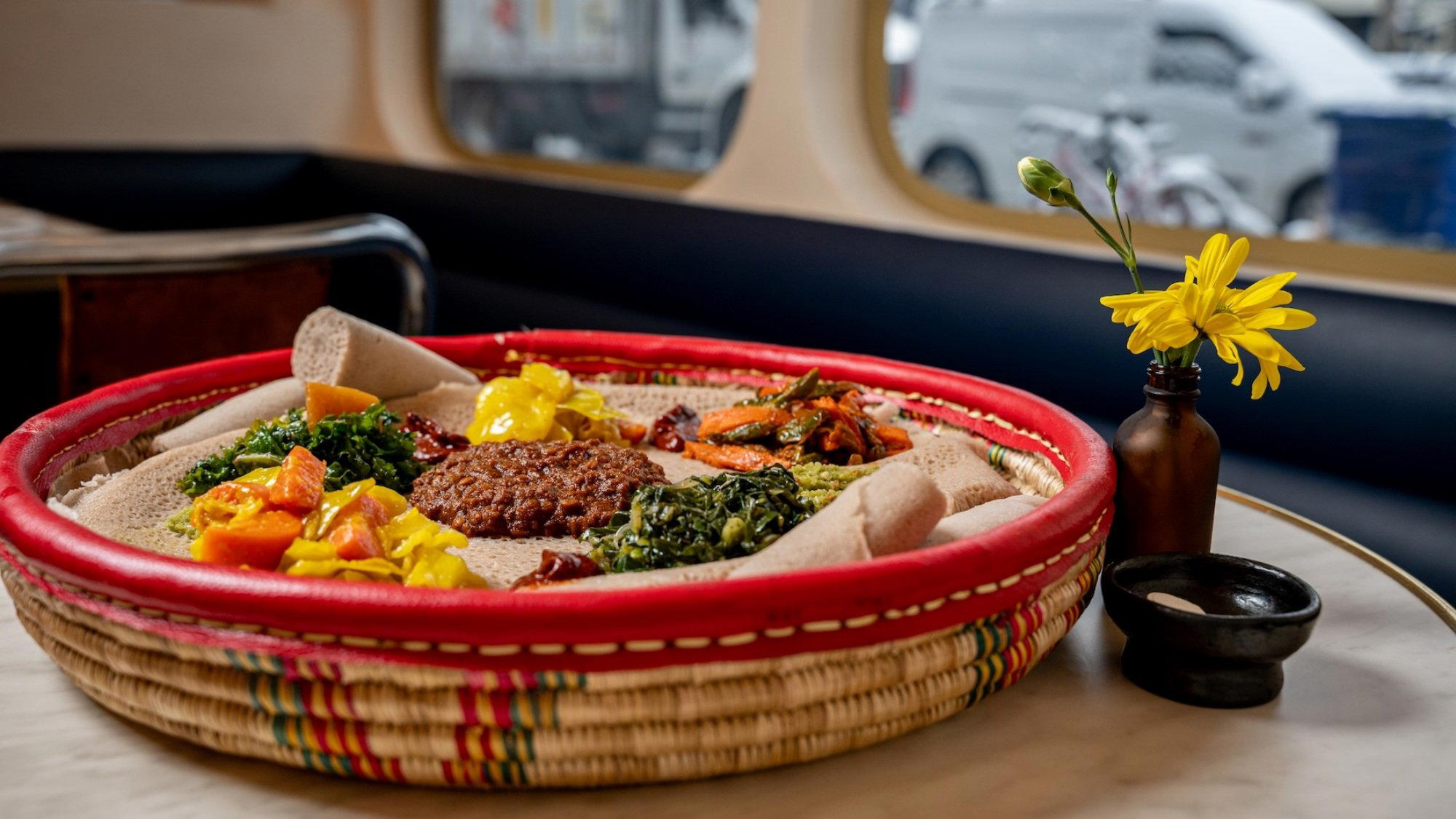
The menu
What to order
- Asmara platter
- Doro wot
- Sambusas
- Kitfo
- Berbere-spiced prawns
Where the Horn of Africa Meets the Aperitivo Hour
New York has always been a city where immigrant cooking eventually finds its fine-dining register, but the process is rarely linear. Ethiopian and Eritrean restaurants spent decades concentrated in specific neighbourhoods, the East Village, Harlem, the Bronx, serving communal platters on injera to diners who already knew the tradition. What has shifted in recent years is the emergence of a smaller cohort of restaurants that treat this cuisine with the same structural seriousness that, say, Atomix applied to Korean cooking or Eleven Madison Park applied to plant-forward fine dining. Makina Cafe belongs to that cohort, and its Italian-influenced thread sets it apart even within it.
The Italian dimension is not decorative. It is a direct inheritance from the colonial period when Eritrea and parts of Ethiopia were administered by Italy, leaving behind pasta-making traditions, espresso culture, and a culinary vocabulary that blended with local ingredients over generations. The result is a cuisine that produces dishes sitting comfortably between two traditions without belonging entirely to either. In a city where the aperitivo ritual has taken hold, from the Negroni-and-cicchetti format borrowed from Venice to the broader idea of small plates consumed at the boundary between afternoon and evening, Makina's kitchen offers a version of that rhythm rooted in a completely different geography.
The Aperitivo Logic Applied to East African Tradition
The aperitivo hour, as it functions in northern Italian cities, is built around restraint and conviviality rather than volume. A drink, a spread of small bites, a reason to linger before committing to dinner. That structure maps surprisingly well onto the Ethiopian tradition of coffee ceremony and small accompaniments, where the act of gathering carries as much weight as the food itself. Makina operates at this intersection, which makes it a genuinely different proposition from the communal-platter Ethiopian restaurants that anchor the neighbourhood tradition.
New York's dining scene has become increasingly comfortable with this kind of cross-traditional format. The city's most discussed openings over the past several years have consistently been those that place one culinary tradition in conversation with another, rather than presenting a single cuisine in isolation. Where Le Bernardin operates within a rigorously defined French seafood canon, and where Masa holds to an equally disciplined Japanese omakase format, Makina positions itself in the more porous space where culinary histories overlap. That positioning carries its own risks, fusion is easy to get wrong, but when the historical connection between the two traditions is genuine rather than invented, the results tend to be coherent.
Reading the Menu as a Cultural Document
Ethiopian and Eritrean cooking shares foundational elements: injera as the primary vehicle for eating, berbere and mitmita as spice anchors, slow-cooked stews (wot) built on legumes, lentils, and occasionally meat. The Italian influence introduces pasta formats, tomato-based preparations, and a coffee culture that in Eritrea developed its own local character distinct from both the Ethiopian coffee ceremony and the Italian espresso bar. At Makina, these threads appear together without the kitchen forcing them into artificial harmony.
For comparison, Frasca Food and Wine in Boulder built its identity around a highly specific Italian regional tradition (Friulian), and that specificity proved to be a strength rather than a limitation. The same logic applies here: a restaurant that knows exactly which culinary histories it is drawing on tends to execute more convincingly than one that draws broadly.
For readers curious about how other American restaurants have made cultural specificity their defining characteristic, the approach at Blue Hill at Stone Barns in Tarrytown offers a different but structurally parallel example, where hyperlocal sourcing functions as the unifying thread in the same way that historical culinary exchange functions at Makina.
New York Context: Where Makina Sits in the Dining Map
The city's Ethiopian and Eritrean dining scene is not small, but it is concentrated, and it skews heavily toward casual and communal formats. The restaurants that have tried to bring this tradition into a more considered dining format remain a short list.
Compared to the city's dominant fine-dining tier, Per Se, Le Bernardin, Masa, Eleven Madison Park, Makina operates in a different register entirely, one defined less by formal tasting-menu structure and more by the kind of culturally grounded cooking that has been gaining critical attention across American cities. Lazy Bear in San Francisco, Smyth in Chicago, and Providence in Los Angeles each built their reputations on a specific point of view rather than category prestige, and that is the more useful comparison set for understanding what Makina is doing.
For Italian-inflected cooking with serious sourcing credentials, the benchmark internationally sits at restaurants like Dal Pescatore in Runate or Atelier Moessmer Norbert Niederkofler in Brunico, both of which demonstrate how Italian regional traditions sustain serious culinary ambition over decades. Makina's engagement with the Italian thread operates at a different scale and with a different cultural logic, but the underlying seriousness about where ingredients and techniques come from is a point of connection.
Readers planning a broader New York itinerary will find additional context in our full New York City restaurants guide, which maps the city's dining scene across cuisines, price points, and neighbourhoods.
Planning Your Visit
Given the format and culinary approach, this is a restaurant suited to an unhurried evening rather than a quick meal, and arriving with time to engage with the coffee and small-plate dimension of the menu will yield a more complete experience of what the kitchen is doing. For comparable experiences across American cities, Emeril's in New Orleans, Addison in San Diego, Single Thread Farm in Healdsburg, The French Laundry in Napa, and The Inn at Little Washington each offer a sense of how American restaurants at different price points handle culturally grounded cooking with considered service. Quick reference: booking method, hours, and price range to be confirmed directly with the venue.
Frequently asked questions
at Makina Cafe?
Given the kitchen's Ethiopian, Eritrean, and Italian-influenced framing, the dishes that sit at the intersection of those traditions are where the concept is most fully expressed. Injera-based preparations with slow-cooked stews represent the foundation of the cuisine, while the Italian-inflected dishes reflect the specific colonial history that connects the Horn of Africa to Italian culinary practice. Specific menu details should be confirmed directly with the venue, as the offering may shift seasonally.
Is Makina Cafe reservation-only?
In New York, restaurants operating at a considered mid-to-upper price tier in a specific culinary niche typically recommend booking in advance, particularly on weekends, when demand for culturally specific dining experiences has grown alongside broader interest in non-European cuisines.
What's the signature at Makina Cafe?
The clearest signature is the culinary framing itself: Ethiopian and Eritrean tradition in active conversation with Italian-influenced technique and preparation, a combination rooted in documented colonial history rather than invented fusion. Within that frame, the coffee dimension of the experience carries particular weight, given the importance of coffee ceremony in Ethiopian and Eritrean culture and the role espresso culture plays in the Italian half of the equation.
Is Makina Cafe good value for money?
Contextually, Ethiopian and Eritrean restaurants in New York have historically occupied the accessible end of the price spectrum, and the cuisine's emphasis on legumes, lentils, and shared injera platters tends to keep per-head costs lower than European fine-dining formats at equivalent quality levels. The Italian-influenced element may shift the pricing register upward relative to neighbourhood peers, but this should be verified directly.
Does Makina Cafe represent a distinct culinary tradition within New York's African dining scene?
Yes, and the distinction matters. The Italian-Eritrean culinary connection is historically grounded: Italian colonial administration of Eritrea from the late nineteenth century through the mid-twentieth century left a documented culinary legacy, including pasta traditions and espresso culture that became embedded in local food practice. For diners tracking the emergence of African cuisines beyond West African and North African formats in American cities, this is a meaningful data point.
Budget and Context
| Venue | Cuisine | Price | Awards | Notes |
|---|---|---|---|---|
| Makina CafeThis venue (the venue you are viewing) | Eritrean-Ethiopian | Not listed | Not listed | Not listed |
| Le Bernardin | French Seafood Fine Dining | $300–500 | 3 Michelin Stars · World's 50 Best #13 | French, Seafood |
| Atomix | Modern Korean Tasting Menu | $300–500 | 2 Michelin Stars · World's 50 Best #11 | Modern Korean, Korean |
| Per Se | French Fine Dining Tasting Menu | $300–500 | 3 Michelin Stars · World's 50 Best #40 | French, Contemporary |
| Masa | Traditional Japanese Omakase | $500+ | 2 Michelin Stars · World's 50 Best #27 | Sushi, Japanese |
| Eleven Madison Park | Contemporary Plant-Based Fine Dining | $300–500 | 3 Michelin Stars · World's 50 Best #4 | French, Vegan |
Continue exploring
More in New York City
Restaurants in New York City
All restaurants in New York City →
Bars in New York City
All bars in New York City →
Hotels in New York City
All hotels in New York City →
Wineries in New York City
All wineries in New York City →
Details
- Cozy
- Warm
- Trendy
- Casual Hangout
- Special Occasion
- Date Night
- Open Kitchen
- Craft Cocktails
- Local Sourcing
- A La Carte
- Small Plates
- Craft Cocktails
- Beer Program
- Vegetarian Friendly
- Vegan Options
- Gluten Free Options
Warm and utterly lovely blush pink dining room with a welcoming neighborhood vibe.