
Michelin Bib Gourmand
Our verdict
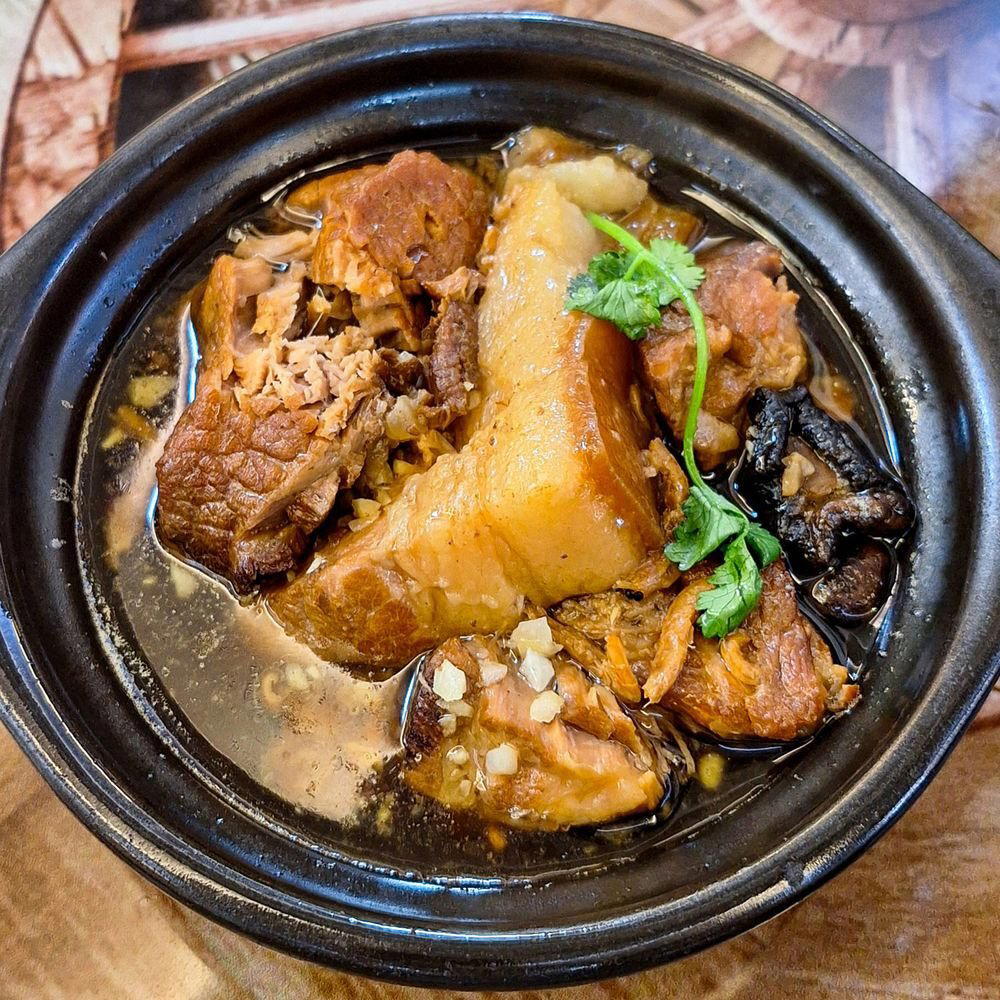
Lu Niang Zi in Xiamen's Huli district has held the Michelin Bib Gourmand in both 2024 and 2025 for its beef noodle soup, a bowl built on long-simmered bone stock, pickled cabbage, and meticulously cooked long loin. At single-digit renminbi prices, it represents the Bib Gourmand's original premise: serious cooking at everyday cost. The marinated meat platter, tripe, intestine, shin, dried tofu, hard-boiled egg, is the essential order alongside the soup.

Pearl is the En Primeur Club membership app, where members save venues, book tables and use the concierge.
The menu
What to order
- Beef noodle soup with pickled cabbage
- Red-braised beef noodle soup
- Marinated meat platter
Where Xiamen's Noodle Culture Cuts Closest to the Bone
Arrive on Shentian Road in the Huli district on any ordinary morning and the evidence of a working food culture presents itself without ceremony. Steam rises from a counter, plastic stools fill quickly, and the room smells of long-cooked bone stock and pickling brine. Lu Niang Zi is the kind of shop that has no use for atmosphere as a design decision, the environment simply is what it is: functional, unpretentious, and organised entirely around the production of beef noodle soup. That clarity of purpose is, in the context of China's increasingly performative dining scene, something worth paying attention to.
The Stock as Argument
Southern Fujian's noodle tradition differs in important ways from the wheat-forward bowls of northern China or the chilli-laden soups of Sichuan. The regional instinct runs toward layered umami built from patient extraction, long bone stocks, seasoned with restraint, and toward the sharp counterpoint of preserved vegetables. At Lu Niang Zi, the beef bone stock that forms the base of the signature soup represents this tradition in its most direct expression. The stock is flavoursome without being heavy, carrying depth from extended cooking rather than from the addition of fat or seasoning shortcuts. Against that base, pickled cabbage does structural work: its acidity cuts through the richness and resets the palate between mouthfuls, a technique embedded in Fujian home cooking long before it appeared on any restaurant menu.
The long loin, cooked to a point where it reads as tender but retains enough firmness to have texture, demonstrates a calibration that is harder to achieve than it appears. Overcook it and the soup becomes soft and monotone. Undercook it and the broth's depth gets lost against the grain of the meat. The kitchen at Lu Niang Zi hits that interval consistently enough to have earned Michelin's Bib Gourmand recognition in consecutive years, 2024 and 2025, a signal that the standard has not drifted.
The Menu in Full
The red-braised beef noodle soup and the noodles dressed in beef ragout extend the kitchen's beef focus across different preparations. Each format explores a different relationship between the noodle and its protein: the broth-based versions reward slow eating, while the ragout-dressed preparation is denser and more immediate. Together they outline what the kitchen knows how to do, and the limits of what it attempts to do, which is part of the discipline that makes a small shop like this coherent rather than scattered.
Marinated meat platter earns its place as a separate order. Dried tofu, hard-boiled eggs, beef tripe, intestine, and shin each take on the brine differently, and the platter functions as a study in how a single seasoning logic produces multiple textures. At a price point that sits firmly in the single-digit renminbi range, the ¥ designation here reflects genuine accessibility, not false modesty, the platter represents the kind of value proposition that the Bib Gourmand was designed to identify. For context, similar offal-and-braised-protein arrangements appear across Fujian noodle shops, but the consistency of execution here sets it apart from the average neighbourhood counter.
The Sustainability Case Hidden in Plain Sight
Editorial angle on sustainability is not always about sourcing certifications or farm partnerships. Sometimes it is about the cooking logic itself. A kitchen that centres beef bone stock uses a part of the animal that industrial food systems routinely discard. Bone-based cookery requires time rather than premium cuts, and the marinated meat platter's inclusion of tripe, intestine, and shin reflects a whole-animal philosophy that predates contemporary sustainability discourse by several centuries in Fujian cooking. This is not a program or a statement, it is simply how the cuisine works, and why a shop operating at this price point can produce a broth of this depth. Nose-to-tail usage in this context is structural rather than philosophical, which arguably makes it more durable than venues that wear sustainability as a marketing position.
Same logic applies to the pickled cabbage. Fermentation and pickling are preservation techniques that reduce waste and extend the useful life of seasonal produce. In Fujian kitchens, pickled vegetables are not a trend; they are a baseline. Lu Niang Zi's use of pickled cabbage in the signature soup is neither innovative nor nostalgic, it is simply the correct technique, deployed at the right moment in the bowl.
Xiamen's Noodle Tier and Where Lu Niang Zi Fits
Xiamen has a well-established noodle culture that spans multiple traditions. Sha cha mian, noodles dressed with a sauce built from dried shrimp, peanuts, and aromatics, is the city's most recognisable export in this category, with shops like Wu Lan Sha Cha Mian, Wu Tang Sha Cha Mian, and Yue Hua Sha Cha Mian representing the established end of that sub-category. Ming Yue Xia Mian (Xiahe Road) extends the conversation toward a different noodle register. Lu Niang Zi sits in a distinct position within this scene, focusing on beef-driven preparations that are less common in Xiamen's default noodle vernacular. That specialisation gives the shop a clearer identity within a crowded category.
Across China's noodle-focused Bib Gourmand tier, the pattern is consistent: a narrow menu, a single dominant protein or technique, and a stock or sauce that has been refined over years of repetition. A Bing Bao Shan Mian in Hangzhou and A Kun Mian in Taichung represent the same tier in their respective cities. Lu Niang Zi's two consecutive Bib Gourmand recognitions place it comfortably inside that national peer group. For a different register of Chinese dining in the region, Fleurs Et Festin (Chao Zhou) in Xiamen occupies a more formal tier.
Further afield, the fine-dining end of Chinese cuisine in mainland cities and across the region is covered in depth through venues like Xin Rong Ji in Beijing, 102 House in Shanghai, Ru Yuan in Hangzhou, Xin Rong Ji in Chengdu, Chef Tam's Seasons in Macau, and Imperial Treasure Fine Chinese Cuisine in Guangzhou. The contrast between those addresses and a Huli noodle shop is precisely the point: the Bib Gourmand system exists to make clear that serious cooking is not the exclusive property of white-tablecloth rooms.
Planning Your Visit
Lu Niang Zi is located at 5 Shentian Road, Siming District. The ¥ price range means a full meal, soup, noodles, and the marinated platter, lands well under ¥50 per person, which places it among Xiamen's most accessible Michelin-recognised addresses. Arriving early is practical advice rather than a rumour: morning sessions at shops of this type tend to see the leading stock, and the most popular preparations can run out before midday. No advance booking infrastructure is in place for a shop at this format and price point; the model is walk-in, counter-order, and eat quickly. The Huli district is east of the more tourist-heavy Gulangyu and Zhongshan Road areas, which means the clientele skews toward local residents and workers rather than hotel guests, a further signal of authenticity rather than performance.
For broader context on eating and staying in the city, see our full Xiamen restaurants guide, our full Xiamen hotels guide, our full Xiamen bars guide, our full Xiamen wineries guide, and our full Xiamen experiences guide.
Frequently asked questions
Is Lu Niang Zi (Huli) child-friendly?
At ¥ prices in an informal counter-style shop on Shentian Road, the format is accessible for all ages. The broth-based dishes, beef noodle soup and pickled cabbage bowls, are straightforward and unlikely to present difficulties for younger diners. No reservation formality or dress code applies.
Is Lu Niang Zi (Huli) formal or casual?
Fully casual. Two consecutive Michelin Bib Gourmand awards (2024 and 2025) designate Lu Niang Zi as an affordable, no-frills operation, the Bib Gourmand category exists precisely for this type of venue. Come as you are; the focus is the bowl, not the room.
What kind of recognition has Lu Niang Zi (Huli) received?
Lu Niang Zi (Huli) has received recognition including: This simple shop is famous for beef noodle soup and noodles dressed in beef ragout. The signature beef noodle soup with pickled cabbage is a must – the beef long loin is perfectly cooked to be tender but firm. The beef bone stock is flavour….
What do people recommend at Lu Niang Zi (Huli)?
The Michelin guide points directly to the beef noodle soup with pickled cabbage: long loin cooked tender but firm, set in beef bone stock, with pickle cutting through the richness. The red-braised beef noodle soup and the marinated platter, which includes dried tofu, hard-boiled eggs, beef tripe, intestine, and shin, are consistently cited alongside it.
What's the pricing like at Lu Niang Zi (Huli)?
Pricing at Lu Niang Zi (Huli) is listed as ¥.
Where do I go for Lu Niang Zi (Huli)?
Lu Niang Zi (Huli) is located at 5 Shentian Rd, Siming District, Xiamen, Fujian, China, 361001, Xiamen.
A Quick Peer Check
A quick peer list to put this venue’s basics in context.
| Venue | Cuisine | Price | Awards | Notes |
|---|---|---|---|---|
| Lu Niang Zi (Huli)This venue (the venue you are viewing) | Beef Noodle Soup Specialist | $10–20 | Michelin Bib Gourmand | Not listed |
| Bai Jia Chun Hao De Lai Jiang Mu Ya (Zhongxing Road) | Traditional Fujian Ginger Duck | Not listed | Michelin Bib Gourmand | Fujian |
| Chic 1699 | Modern Fujian Minnan Seafood | $30–50 | Michelin Bib Gourmand · Black Pearl 1 Diamond | Fujian |
| Dai Tai | Yunnanese Dai Ethnic Home-Style | $20–30 | Michelin Bib Gourmand | Yunnanese |
| Fu Yu Da Tong Ya Rou Zhou | Traditional Chinese Duck Congee | $1–10 | Michelin Bib Gourmand | Congee |
| Hao Shi Lai | Traditional Minnan Seafood | $10–20 | Michelin Bib Gourmand | Seafood |
Recognition history
Dated appearances from independent guides and award organizations, with the underlying list record or original source where available.
Michelin Bib Gourmand
Michelin
Full recognition history (3 entries)
Michelin Bib Gourmand
Michelin
Michelin Bib Gourmand
Michelin
Continue exploring
More in Xiamen



Details
- Cozy
- Rustic
- Casual Hangout
- A La Carte
Simple and unpretentious small shop atmosphere.