


A Michelin-starred creative restaurant in the half-timbered heart of Giverny, Le Jardin des Plumes draws its identity from Norman and Dieppe coastal sourcing under chef David Gallienne. The Art Deco interior and garden patio sit a short walk from Monet's house. Open Wednesday through Sunday for lunch and dinner, with a €€€€ price point that places it at the summit of the village's dining tier.
Pearl is the En Primeur Club membership app — saves, bookings, and concierge access live there. Same editors, same standards.
- Address
- 1 Rue du Milieu, 27620 Giverny, France
- Phone
- +33 2 32 54 26 35
- Website
- jardindesplumes.fr
- Directions
- Get directions
 Saves & bookings on Pearl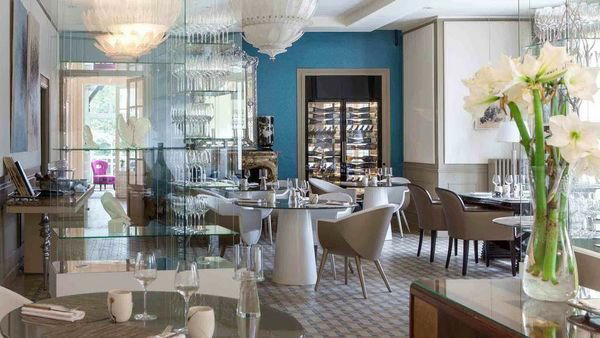
Where Normandy's Larder Meets Impressionist Country
Giverny is a village that attracts visitors for one reason, and that reason is Claude Monet. What the village does less predictably is hold a Michelin-starred kitchen capable of making an argument that the food deserves the journey independently of the gardens. The village destination restaurant, holding a single star and building its identity around hyper-local sourcing, represents a different category entirely, one where the connection between kitchen and immediate geography is the whole point.
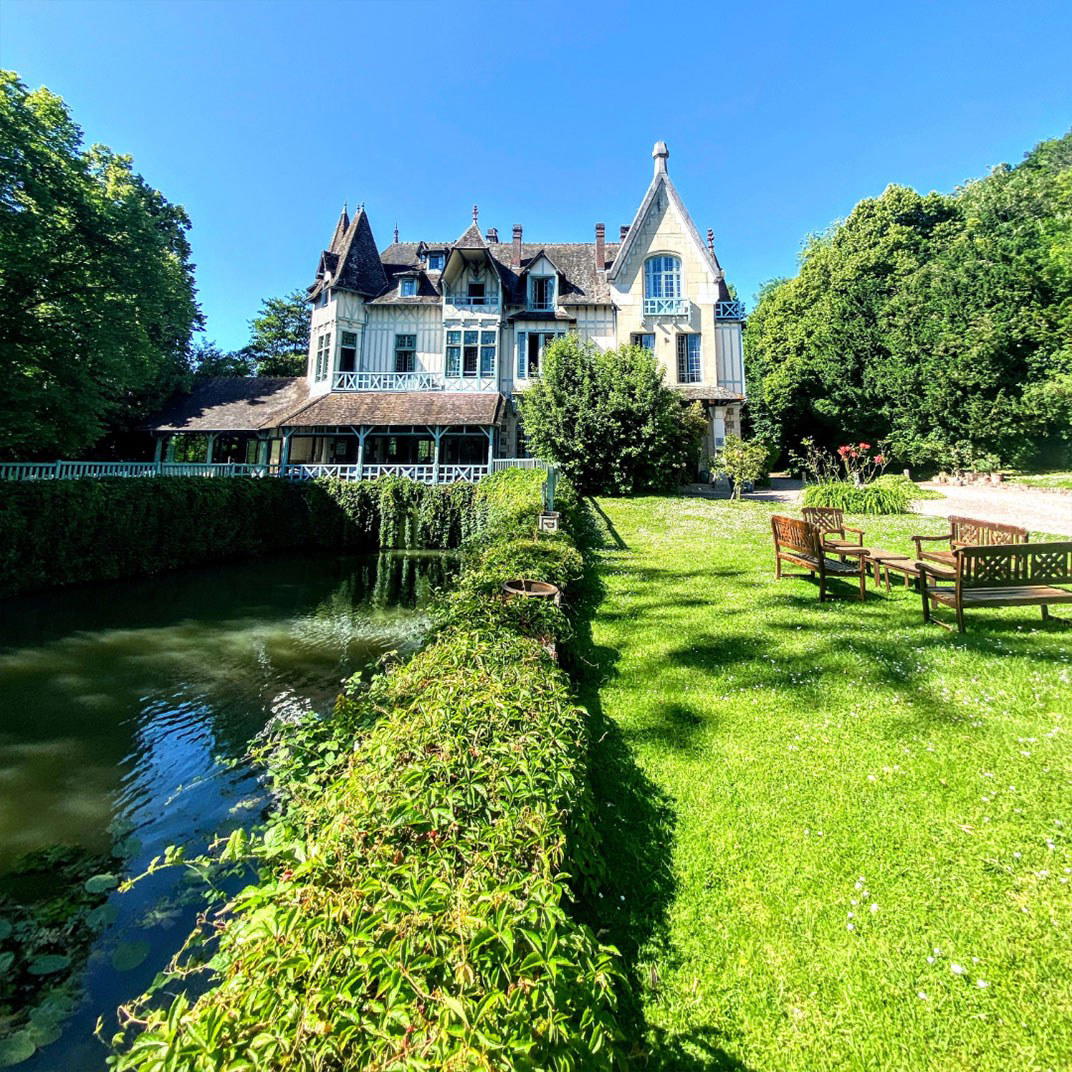
Le Jardin des Plumes occupies a 1912 Anglo-Norman half-timbered building on Rue du Milieu. Approaching it, the structure reads as domestic rather than institutional, worn blue and white floor tiles visible through the windows, peacock blue walls, a garden patio flanked by trees. Inside, the design mixes Art Deco elements with 1960s white leather armchairs and glass and rosewood tables, a combination that avoids the common rural French fine dining trap of either faux-rustic theatrics or anonymous contemporary minimalism. The patio extends the experience outward into a wooded garden, which in a village whose visual vocabulary is entirely defined by Monet's planted grounds, carries its own resonance.
The Sourcing Logic Behind the Menu
Le Jardin des Plumes's clearest identity is where the food comes from. Chef David Gallienne, Norman by origin, trained at the Manoir du Lys before building relationships with producers and fishermen that now form the structural backbone of the menu. The Orne connection brings land-side Norman produce: dairy, poultry, game from the bocage countryside that defines inland Normandy. The Dieppe connection brings the Channel coast: a port with among the more active fish markets in northern France, where the daily catch includes sole, turbot, scallops, and shellfish that have supplied Norman kitchens for centuries.
This dual-source logic, Norman farmland plus Channel coast, is not decorative. It mirrors a deep tradition in the region's cooking, where cream and seafood have coexisted in the same recipes since long before fine dining existed as a category. What makes the approach here distinct is the combination of that sourcing fidelity with what Michelin describes as inventive recipes featuring unorthodox flavours and textures. The kitchen is not replicating classic Norman cuisine; it is using Norman ingredients as the raw material for creative work that earns a star in the same cohort as French regional destinations like Bras in Laguiole or Auberge de l'Ill in Illhaeusern, where local identity and high technique have coexisted for generations.
The sourcing relationships Gallienne built at Manoir du Lys were not abandoned when he moved to Giverny, he brought suppliers with him, which is a signal about the depth of those connections. New Dieppe fishing contacts have been added since, extending the kitchen's coastal reach. This kind of accumulated supplier network takes years to build and is not easily replicated. It is one of the reasons single-starred rural kitchens like this one occupy a position that is genuinely difficult to benchmark against urban peers. A Paris-based creative restaurant at €€€€, such as those in the same price tier across Giverny's dining scene, is competing on a different axis.
Creative Cuisine in Its Regional Context
The Creative classification that Michelin applies here is worth examining in context. Across France, the creative designation clusters around kitchens that treat classical technique as a foundation rather than a destination, where the cooking shows clear individual authorship and does not sit comfortably inside a regional or historical style. At a restaurant like AM par Alexandre Mazzia in Marseille or Troisgros in Ouches, that creativity operates at three-star scale. At Le Jardin des Plumes, the single-star creative category describes something more contained but no less intentional: a kitchen using Norman produce in combinations and textures that the classical tradition would not have sanctioned.
For comparison, look at how similar creative-sourcing ambitions play out at one-star level in other European contexts: Enrico Bartolini in Milan and JAN in Munich both occupy the creative single-star category with strong regional-sourcing commitments. The pattern across these kitchens is consistent: the star is awarded for technique and invention, but the identity comes from where the ingredients originate. At Le Jardin des Plumes, Normandy is not a backdrop; it is the ingredient list.
A wine list that earns White Star status at a village restaurant in Normandy is making a statement about programme depth that is worth noting for serious wine-focused travellers.
The Venue Beyond the Dining Room
Both expansions follow a logic common to serious rural destination restaurants, if you are pulling diners from Paris or beyond, overnight accommodation removes the constraint of catching the last train back. The Vernon delicatessen extends the kitchen's sourcing relationships into a retail format, allowing those Norman producer connections to reach a broader audience than dinner service alone.
Within Giverny's dining options, La Musardière represents the Modern Cuisine alternative at a different price point, worth consulting if a full tasting menu at €€€€ does not fit the budget or occasion.
Planning a Visit
The restaurant is closed Monday and Tuesday. Wednesday through Sunday, lunch service runs from 12:15 PM to 1:30 PM and dinner from 7:30 PM to 9:30 PM, windows that are narrow by design, which means the booking window for weekend sittings, particularly summer weekends when Monet's gardens draw the largest crowds, extends well in advance. The address is 1 Rue du Milieu, 27620 Giverny, within short walking distance of Monet's house and gardens. Giverny is most easily reached from Paris via Vernon station on the Paris-Rouen line, with the village accessible by shuttle or taxi from there. which for a village restaurant serving a partly tourist audience is a harder result to sustain than the number alone suggests.
What to Order at Le Jardin des Plumes
What the sourcing record makes clear is that any seafood preparation drawing on the Dieppe fishermen supply chain, particularly Channel fish, scallops, or shellfish in season, will reflect the closest and most direct connection between supplier and plate. Norman dairy and land produce from the Orne will appear in sauces, accompaniments, and meat courses. The Michelin citation specifically notes unorthodox flavours and textures, so arriving with expectations set by classical Norman cuisine will likely result in surprise. The safer frame is a creative kitchen using Norman ingredients as its vocabulary rather than its constraint. For a broader picture of Giverny's dining options to build an itinerary around, see our full Giverny restaurants guide.
A Pricing-First Comparison
Comparable venues nearby, for context on price, style, and recognition.
| Venue | Cuisine | Price | Awards | Notes |
|---|---|---|---|---|
| Le Jardin des PlumesThis venue — the venue you are viewing | Giverny, Modern French Cuisine d'Auteur | $$$$ | Michelin 1 Star | Not listed |
| La Musardière | Giverny, Bistronomic Norman French | $$$ | Michelin Plate | Not listed |
| Oscar | Giverny, Bistronomic French | $$ | Not listed | Not listed |
| L'Atelier de Joël Robuchon - Étoile | Not listed | $$$$ | Michelin 1 Star | Champs-Élysées, Modern French Fine Dining |
| Mallory Gabsi | Not listed | $$$$ | Michelin 1 Star | 17th arrondissement, Modern French Fine Dining |
| La Grande Cascade | Not listed | $$$$ | Michelin 1 Star | Bois de Boulogne, Classic French Fine Dining |
Recognition history
Dated appearances from independent guides and award organizations, with the underlying list record or original source where available.
Michelin 1 Star
Michelin
Star Wine List
Star Wine List
Gault & Millau Remarkable Restaurant
Gault & Millau
Michelin 1 Star
Michelin
Michelin 1 Star
Michelin
Continue exploring
More in Giverny
More from Chef David Gallienne
Browse all →
Restaurants in Giverny
Browse all →
Hotels in Giverny
Browse all →
Wineries in Giverny
Browse all →
At a Glance
- Romantic
- Elegant
- Intimate
- Sophisticated
- Scenic
- Date Night
- Celebration
- Special Occasion
- Anniversary
- Garden
- Terrace
- Private Dining
- Historic Building
- Hotel Restaurant
- Extensive Wine List
- Sommelier Led
- Farm To Table
- Local Sourcing
- Garden
Current opening hours
- Monday
- Closed
- Tuesday
- Closed
- Wednesday
- 12:15–1:30 PM, 7:30–9:30 PM
- Thursday
- 12:15–1:30 PM, 7:30–9:30 PM
- Friday
- 12:15–1:30 PM, 7:30–9:30 PM
- Saturday
- 12:15–1:30 PM, 7:30–9:30 PM
- Sunday
- 12:15–1:30 PM, 7:30–9:30 PM
Hours can change for holidays and private events. Last verified .
Warm, intimate dining room with Art Deco-inspired décor featuring peacock-blue walls, white leather furnishings, and soft ambient lighting; tables are well-spaced for privacy; adjoining garden terrace with arboreal landscaping.