


2 Michelin Stars · Relais Chateaux Award · Gault & Millau Remarkable Restaurant
Our verdict
A Michelin-starred table in Ville-d'Avray, Le Corot frames its set menu around the villages and gardens of Île-de-France, with Chef Rémi Chambard sourcing personally from locations including the King's Kitchen Garden in Versailles. The cooking is marked by structural lightness, precise sauces, and a seasonal logic grounded in the agricultural geography of the greater Paris region.

Pearl is the En Primeur Club membership app — saves, bookings, and concierge access live there. Same editors, same standards.
- Address
- 55 Rue de Versailles, 92410 Ville-d'Avray, France
- Phone
- +33 1 41 15 37 01
- Hours
- Mon–Tue ClosedWed–Fri 7:30–9:30 PMSat 12:30–1:30 PM, 7:30–9:30 PMSun Closed
- Website
- etangs-corot.com
- Directions
- Get directions
The menu
What to order
- Boletus eggs
- Lobster with champagne and watercress
- Tomate à la marjolaine
Île-de-France on the Plate: Terroir Cooking Beyond the Boulevard
French fine dining has long treated Paris as its centre of gravity, pulling chefs toward the arrondissements where critics gather and guide inspectors circle. But some of the most considered cooking in the greater Paris region has quietly moved outward, into the towns and villages that ring the capital and still carry the agricultural identity that fed it for centuries. Ville-d'Avray, a small commune in the Hauts-de-Seine department roughly twelve kilometres southwest of central Paris, sits in that orbit. It is the kind of place where the ponds painted repeatedly by the landscape artist Jean-Baptiste-Camille Corot in the nineteenth century still exist, and where a restaurant named in his honour uses that same geography as a sourcing map rather than a marketing device.
Le Corot earned its first Michelin star in 2024 and retained it in the 2025 guide, placing it within the smaller tier of destination restaurants outside Paris proper that reward the extra travel with cooking that would not make sense anywhere else. The distinction matters: where a restaurant like Alléno Paris au Pavillon Ledoyen or Le Gabriel at La Réserve Paris draws authority from its address as much as its kitchen, Le Corot draws authority from what grows and swims within reach of Rémi Chambard's personal sourcing routes.
A Kitchen Rooted in Urban Harvest
The sustainability argument in contemporary fine dining is often more procedural than substantive: a line on the menu about local suppliers, a photograph of a farm. At Le Corot, the sourcing architecture is structural. Chambard organises his set menu around named villages in Île-de-France, from Montmorency in the north to Crécy-la-Chapelle in the Seine-et-Marne, mapping the plate to a specific agricultural geography rather than using region as a loose descriptor. Each village represents not just an ingredient origin but a distinct microclimate and tradition: Montmorency for its cherries, Crécy for its carrots, both with histories that predate industrialised supply chains by several centuries.
More directly, Chambard conducts what the Michelin guide describes as his own "urban harvest" in the Potager du Roi, the King's Kitchen Garden at Versailles, which has been producing vegetables and fruit for royal and then public use since Louis XIV commissioned André Le Nôtre and Jean-Baptiste de La Quintinie to develop it in the 1680s. That a working chef sources personally from a garden with that lineage is not incidental: it anchors the menu in a land-use tradition that is historically continuous, not reconstructed for contemporary tastes. The approach places Le Corot in a lineage that includes Arpège, where Alain Passard's shift toward vegetable-forward cooking more than two decades ago reframed what serious French cuisine could look like, and Bras in Laguiole, where Michel and Sébastien Bras built an entire aesthetic around the flora of the Aubrac plateau. Le Corot is less extreme in its commitment than either, but the underlying logic is similar: the landscape defines the cooking, not the reverse.
What the Michelin Assessment Signals
Michelin's Remarkable category designation for Le Corot is accompanied by specific dish references that reveal something about the kitchen's priorities. The wild pike-perch from the Giverny area, served with a sabayon of saffron and parsley, and the veal sweetbreads au gratin with Meaux mustard, watercress, and tarragon both reflect a cooking style where the primary work is in the sauce and emulsion rather than in theatrical presentation. Sabayon construction requires timing and temperature precision; the Meaux mustard reference is geographically deliberate, pointing to a producer in Seine-et-Marne that has been making whole-grain mustard since the seventeenth century.
The Michelin notation specifically mentions the depth of sauces and emulsions alongside the freshness and lightness of the dishes overall. This is a pairing that takes technical discipline: sauces with structural depth and dishes that read as light demand that the reduction work is done before service, not layered onto the plate with cream or butter at the last moment. It is the kind of cooking that rewards attention without demanding effort from the diner, which is a different register from the maximalist tasting menus common at comparable price points in central Paris. Le Meurice Alain Ducasse or Blanc operate in the same price tier but with a different compositional logic, one shaped more by classical luxury codes than by regional sourcing constraint.
For a broader view of how this kind of cuisine sits within the French fine dining conversation, Mirazur in Menton, Flocons de Sel in Megève, and Troisgros in Ouches represent the same broader tendency in French cooking: kitchens anchored to a specific geography outside the capital, building seasonal authority through consistent sourcing relationships rather than through prestige address. Auberge de l'Ill in Illhaeusern demonstrates the longer arc of that model, with generations of sourcing from the Alsatian Rhine plain. Paul Bocuse's L'Auberge du Pont de Collonges established the template for landmark dining outside a metropolitan centre. Le Corot operates at an earlier point in that trajectory but with comparable intent. Creative restaurants in other European capitals working through similar regional sourcing frameworks include Enrico Bartolini in Milan and JAN in Munich.
The Room and the Context
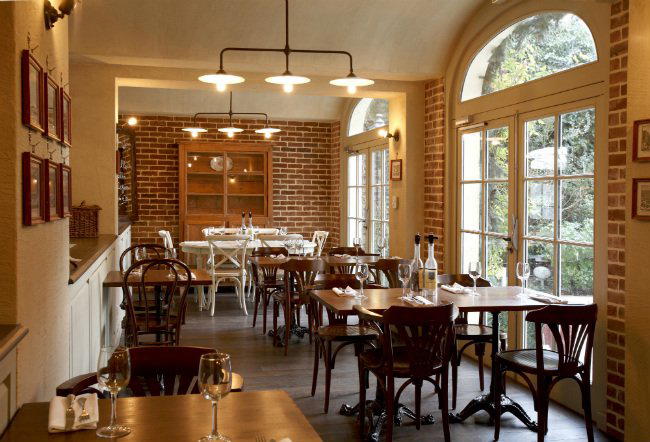
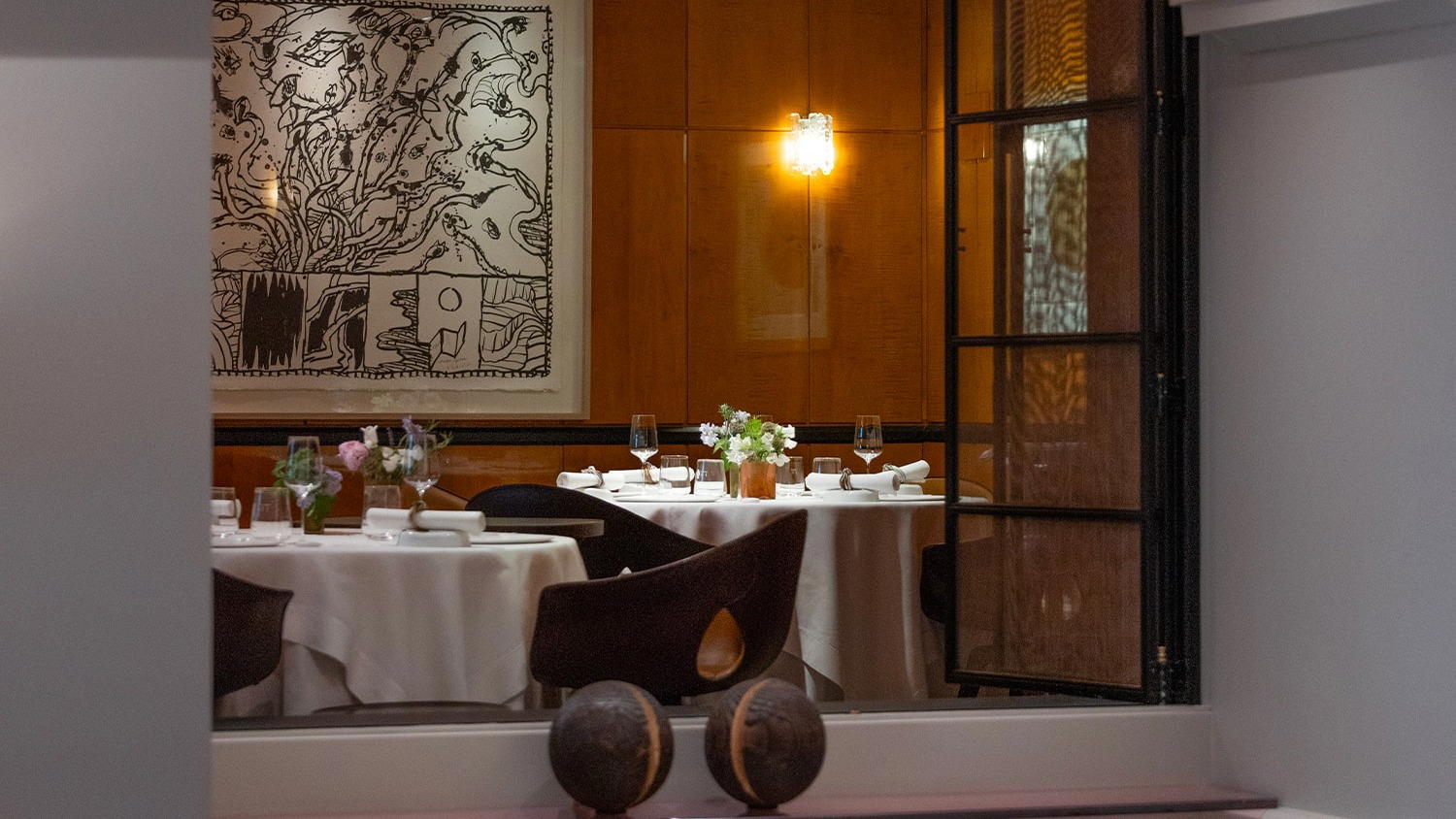
Michelin describes the interior as pared-back, plush, and cosy, language that signals a deliberate counterpoint to the cooking rather than an extension of it. In central Paris, rooms at the €€€€ tier tend toward grandeur: high ceilings, formal table distances, service choreographed for ceremony. A more intimate register in a room of this kind redirects attention toward the plate, which is consistent with a menu philosophy built on freshness and restraint rather than spectacle.
The address, 55 Rue de Versailles, Ville-d'Avray, is accessible by RER C to Viroflay-Rive Droite or by car from central Paris in under thirty minutes outside peak hours, a reasonable proposition for a table that represents a specific culinary argument rather than casual dining. The journey has a precedent in the French imagination: Corot himself made the same trip repeatedly, and the ponds he painted are within walking distance. Whether that context adds to the meal depends on the diner, but it is not an accidental framing.
Planning Your Visit
Le Corot sits in the €€€€ price tier and operates a set menu format. Reservations are advisable; the restaurant's positioning as a destination table outside central Paris means it operates with a considered capacity rather than volume throughput. For those building a broader Paris itinerary, EP Club's guides to Paris restaurants, Paris hotels, Paris bars, Paris wineries, and Paris experiences provide the full picture. Le Corot works as a standalone destination or as part of a day that takes in Versailles itself, where the Potager du Roi is open to visitors and provides direct context for what arrives on the plate at dinner. That alignment between the sourcing geography and a visitable landscape is not common at this level of cooking, and it gives the meal a legibility that most destination restaurants at comparable price points cannot offer.
What Regulars Order at Le Corot
The Michelin guide's cited dishes provide the clearest indication of what the kitchen does at its most considered. The wild pike-perch from the Giverny area with sabayon of saffron and parsley is highlighted as a reference point for the kitchen's sauce work, where a classical technique is applied to an ingredient sourced from a specific river system rather than a general supplier. The veal sweetbreads with Meaux mustard and a jus reduced with watercress and tarragon demonstrate the approach to meat cookery: a secondary cut treated with the same care as prime protein, with the sauce carrying the structural weight of the dish. Both dishes reflect a menu logic where vegetables, herbs, and emulsions do the expressive work, with the primary ingredient as the context rather than the entire argument. Regulars report a experience across current reviews, suggesting the consistency expected of a kitchen that has built its identity around a stable, season-driven sourcing framework rather than on rotation for novelty.
Standing Among Peers
| Venue | Cuisine | Price | Awards | Notes |
|---|---|---|---|---|
| Le CorotThis venue — the venue you are viewing | Modern French Fine Dining | $150–200 | 2 Michelin Stars · Relais Chateaux Award | Not listed |
| Alléno Paris au Pavillon Ledoyen | Modern French Fine Dining | $150–200 | 3 Michelin Stars · World's 50 Best #79 | Creative |
| Kei | Modern French with Japanese Influences | $300–500 | 3 Michelin Stars · World's 50 Best #93 | Contemporary French, Modern Cuisine |
| L'Ambroisie | Classic French Haute Cuisine | $300–500 | 2 Michelin Stars · World's 50 Best #23 | French, Classic Cuisine |
| Le Cinq - Four Seasons Hôtel George V | French, Modern Cuisine | Not listed | Michelin 3 Star | Not listed |
| Plénitude | Modern French Sauce-Led Fine Dining | $300–500 | 3 Michelin Stars · World's 50 Best #14 | Contemporary French |
Recognition history
Dated appearances from independent guides and award organizations, with the underlying list record or original source where available.
Michelin 2 Stars
Michelin
Relais Chateaux Award
Relais Chateaux
Gault & Millau Remarkable Restaurant
Gault & Millau
Full recognition history (5 entries)
Michelin 1 Star
Michelin
Relais Chateaux Award
Relais Chateaux
Continue exploring
More in Paris
Restaurants in Paris
Browse all →

Bars in Paris
Browse all →
Hotels in Paris
Browse all →



Details
- Elegant
- Sophisticated
- Intimate
- Date Night
- Special Occasion
- Open Kitchen
- Terrace
- Private Dining
- Local Sourcing
- Garden
- Tasting Menu
Current opening hours
- Monday
- Closed
- Tuesday
- Closed
- Wednesday
- 7:30–9:30 PM
- Thursday
- 7:30–9:30 PM
- Friday
- 7:30–9:30 PM
- Saturday
- 12:30–1:30 PM, 7:30–9:30 PM
- Sunday
- Closed
Hours can change for holidays and private events. Last verified .
Refined Japanese-brown ambiance with white and wood materials, designer lighting, open kitchen, and panoramic garden views from terrace.